
India Engages Europe, G7 Partners Amid Shifting Global Security Order
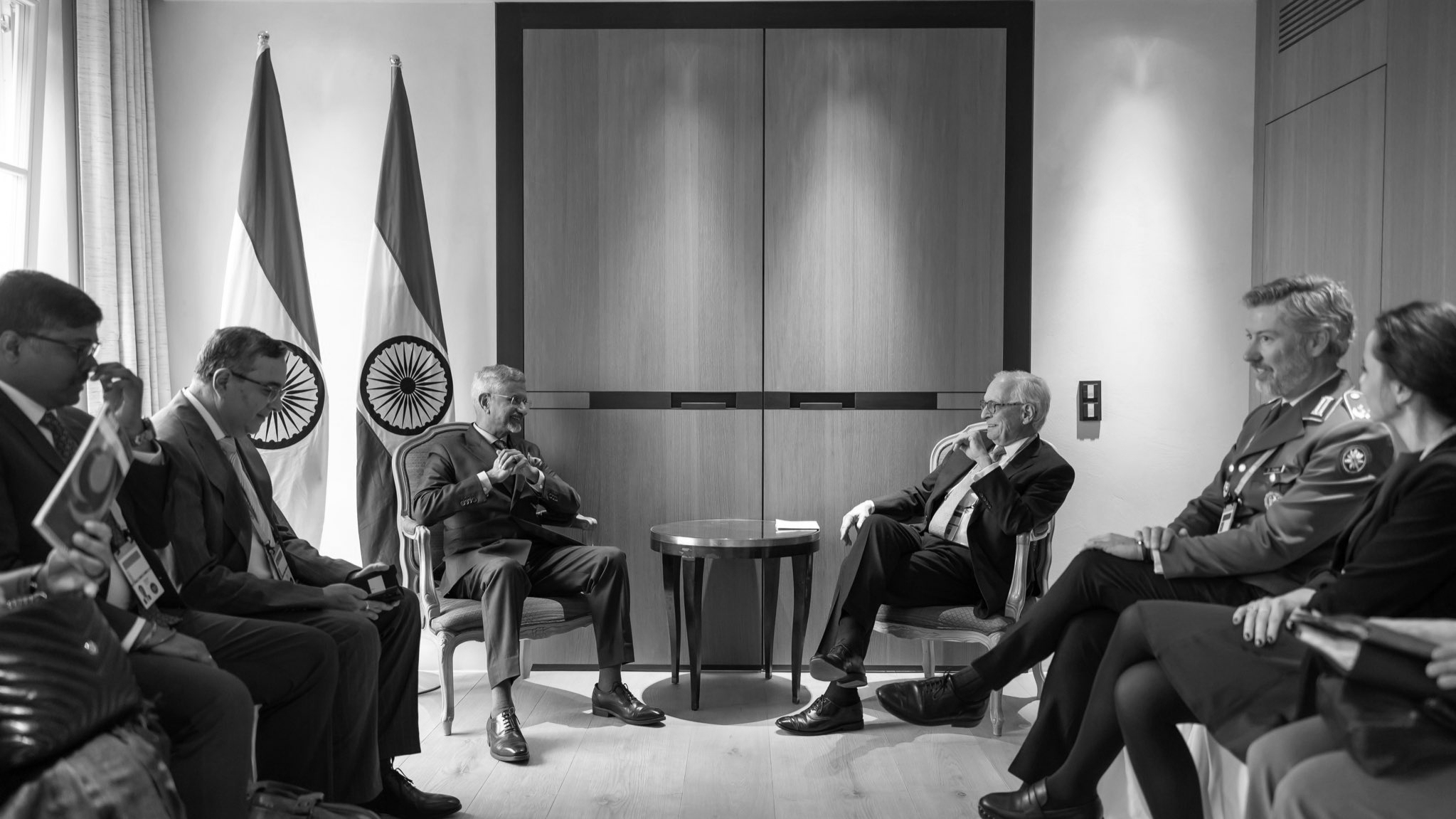
External Affairs Minister Subrahmanyam Jaishankar held a series of bilateral meetings with counterparts from Europe and the G7 on the sidelines of the Munich Security Conference 2026 , which concluded on February 15 in Munich, Germany. His engagements underscored India’s expanding diplomatic outreach at a time of growing geopolitical uncertainty and a shifting global power balance.
Jaishankar described his meeting with German Foreign Minister Johann Wadephul as “productive,” noting that both sides reviewed progress in cooperation across key sectors and exchanged views on regional hotspots. Germany remains one of India’s most significant partners within Europe, particularly in trade, technology, and green energy collaboration.
In talks with Czech Deputy Prime minister and Foreign Minister Petr Macinka , discussions focused on strengthening economic ties and defence cooperation. Jaishankar expressed hope of welcoming him to India soon, signalling momentum in New Delhi’s outreach to Central and Eastern Europe.
The minister also met Canadian Foreign Minister Anita Anand , stating that India–Canada relations continue their steady progress, an important diplomatic signal following recent tensions. Discussions with French Foreign Minister Jean-Noël Barrot reaffirmed the strong India–France strategic partnership spanning defence, space, nuclear energy, and Indo-Pacific cooperation. Jaishankar additionally met Croatian Foreign Minister Gordan Grlić-Radman , reflecting India’s widening engagement across the European Union.
Earlier, Jaishankar engaged with G7 foreign ministers, reiterating India’s support for meaningful reform of the UN Security Council under the UN@80 agenda, emphasizing the need for a more representative global governance structure. His participation comes shortly after India concluded a free trade agreement with the 27-nation European Union , expected to boost trade flows, investment, and supply-chain resilience.
The Munich Security Conference, attended by dozens of heads of government and nearly 100 foreign and defence ministers, focused on escalating global security challenges. Key agenda themes included the Ukraine war and European defence preparedness, transatlantic burden-sharing, Indo-Pacific security and China’s growing influence, Middle East instability, cybersecurity threats, and the security implications of emerging technologies.
Discussions reflected increasing momentum within Europe toward greater defence self-reliance and higher military spending, while reaffirming support for Ukraine. Delegates also emphasized the central role of cyber defence, critical infrastructure protection, and resilient supply chains in national security planning.
The conference highlighted a world moving toward multipolar geopolitics, with emerging powers gaining influence in shaping global governance. India’s presence reinforced its positioning as a bridge between Western nations and the Global South, while advocating institutional reform and cooperative security frameworks.
Jaishankar began his Munich visit with a roundtable titled “Delhi Decided: Mapping India’s Policy Calculus,” where he highlighted the importance of a nimble and dynamic foreign policy to navigate an increasingly complex and multipolar international order.