
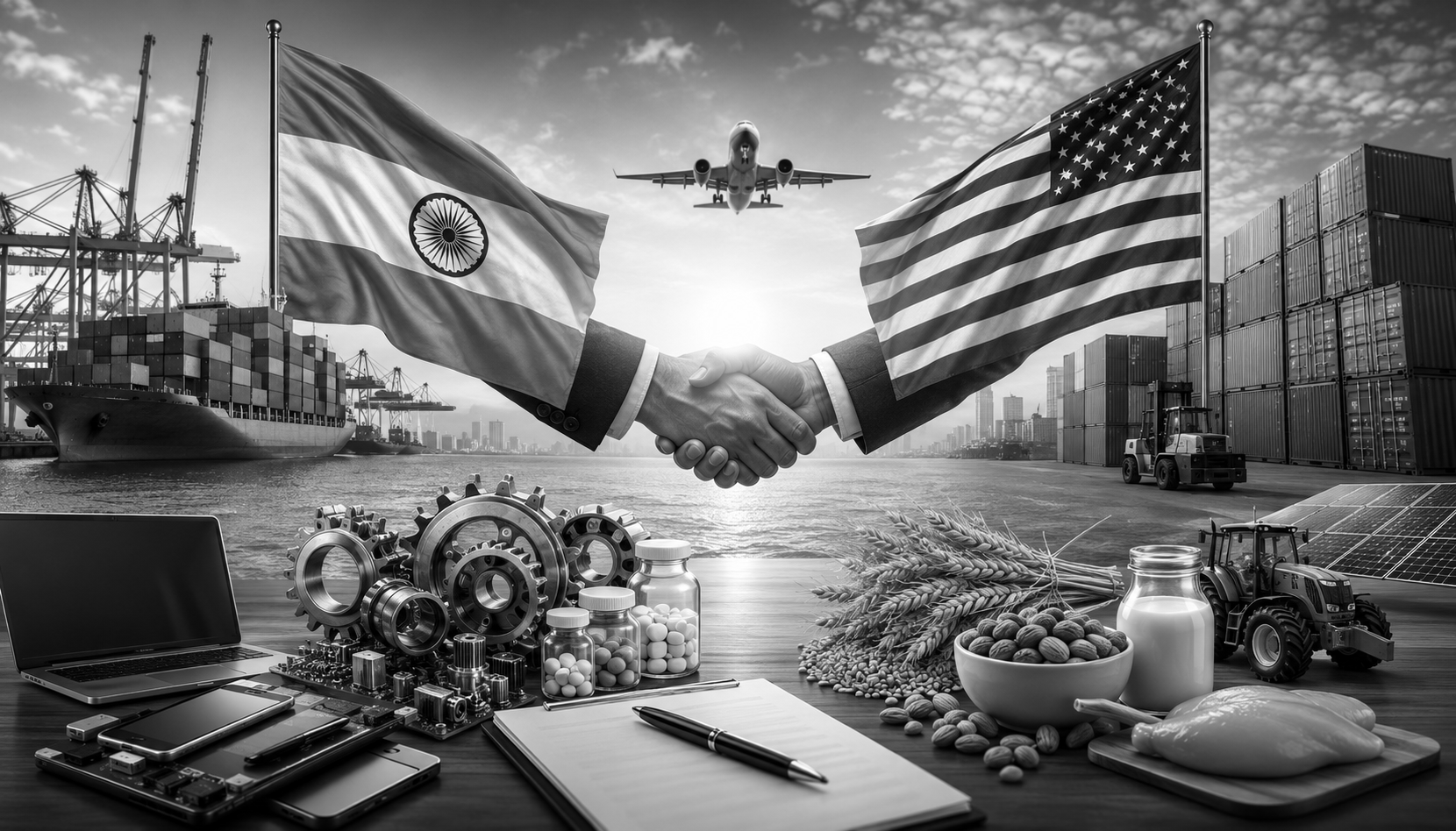
India Engages U.S. on Section 301 Tariffs as Landmark Trade Pact Talks Advance
A fresh trade challenge from the United States has arrived at a critical moment for India. While Washington has proposed additional tariffs on imports from 60 economies, including India, under Section 301 of the U.S. Trade Act of 1974 , both countries are simultaneously working toward a broader trade framework that could redefine one of the world's fastest-growing economic partnerships.
The development has sparked intense discussions among policymakers, exporters, manufacturers and trade experts, not only because of its immediate implications but also because of what it could mean for the future of India-U.S. trade relations .
According to the Office of the United States Trade Representative (USTR) , investigations have been concluded against 60 economies regarding measures related to the import of goods. Based on these investigations, Washington has proposed imposing additional tariffs on imports from these countries. However, the proposal is still under review and has not yet been finalized.
The consultation process remains open. Stakeholders can request participation in public hearings until June 22 , submit written comments until July 6 , and present testimony during hearings scheduled for July 7 . The USTR will consider all submissions before deciding whether to implement, modify or withdraw the proposed measures.
For India, the issue is particularly important because it coincides with ongoing negotiations on a wider trade framework announced earlier this year. The Ministry of Commerce and Industry has confirmed that India remains actively engaged with the United States on the Section 301 proceedings while simultaneously pursuing the finalization of a bilateral framework agreement announced in February 2026.
Understanding Section 301 and Why It Matters
Although Section 301 is often viewed as a technical trade provision, it is one of the most powerful tools available to the U.S. government in international commerce.
The law allows the USTR to investigate foreign policies that are considered "unjustifiable," "unreasonable," or "discriminatory" if they are believed to negatively affect American trade interests. Following an investigation, Washington can impose retaliatory tariffs, suspend trade concessions or negotiate corrective measures.
The provision became globally famous during the U.S.-China trade dispute, when billions of dollars worth of Chinese exports were subjected to additional tariffs.
In the current case, the proposed measures are not limited to India. They affect dozens of economies and remain subject to consultation. Certain products already covered under Section 232 tariffs have been exempted, while the U.S. has also proposed a special mechanism for textiles and apparel that could allow limited imports from selected countries at lower tariff rates.
A Bigger Story Than Tariffs
While the tariff proposal has attracted headlines, trade experts argue that the larger story lies in the parallel negotiations taking place behind the scenes.
India and the United States are working toward a framework that could eventually evolve into a comprehensive Bilateral Trade Agreement (BTA) . Such an agreement would go far beyond tariffs and could influence investment flows, manufacturing strategies, technology cooperation and supply-chain integration for years to come.
The discussions cover a broad range of sectors, including electronics, semiconductors, pharmaceuticals, medical devices, engineering goods, textiles, agriculture, energy, digital services, financial services and critical minerals .
These negotiations are particularly significant because both countries increasingly view each other as strategic economic partners amid shifting global supply chains and growing geopolitical competition.
The Sectors That Could Gain the Most
Among all sectors under discussion, electronics manufacturing is widely viewed as the biggest opportunity for India.
Global companies have been steadily expanding production facilities in India as part of efforts to diversify manufacturing away from China. Improved access to the American market could strengthen India's ambitions of becoming a major global manufacturing hub.
Another major beneficiary could be the pharmaceutical industry . India is already among the world's leading suppliers of generic medicines and has established a strong presence in the U.S. healthcare market. Easier regulatory approvals and greater cooperation could further boost exports.
The country's powerful engineering goods sector , which includes machinery, industrial products and auto components, is also expected to benefit. Engineering products currently account for roughly a quarter of India's exports to the United States, making them one of the most important pillars of bilateral trade.
The negotiations could also create new opportunities for textiles and apparel , a sector that employs millions of Indians and competes directly with manufacturing hubs such as Vietnam and Bangladesh.
In addition, exporters of gems and jewellery, seafood, specialty chemicals and processed food products are closely monitoring the discussions for potential gains.
The Services Advantage
While public attention often focuses on goods, many economists believe the real prize for India lies in services trade .
The United States is the largest overseas market for Indian software companies, consulting firms and business-process management providers. Any improvement in market access for IT services, engineering services, professional services and digital trade could generate long-term economic benefits far exceeding those achieved through tariff reductions alone.
Digital trade has emerged as one of the most sensitive areas of negotiation, with discussions covering data flows, e-commerce rules, cloud services and technology cooperation.
What the United States Wants
The negotiations are not one-sided.
Washington is seeking improved access for American exports and investors in areas such as agriculture, energy, medical devices, industrial machinery and financial services .
U.S. negotiators are also interested in stronger provisions relating to intellectual property rights, regulatory transparency, customs procedures and supply-chain standards .
Agriculture remains one of the most politically sensitive areas. While the United States seeks greater access for products such as almonds, apples, dairy items and other agricultural goods, India is expected to proceed cautiously to protect domestic farmers and rural livelihoods.
Will the Deal Lead to More Privatization?
One question frequently raised in policy circles is whether a trade agreement with the United States could trigger a wave of privatization.
Most analysts believe the answer is no.
The proposed framework is not designed to force the sale of public-sector enterprises. Instead, it is likely to encourage greater private-sector participation , foreign investment and competition in sectors such as electronics, logistics, pharmaceuticals, advanced manufacturing and technology.
In practical terms, the agreement could accelerate private investment without requiring large-scale privatization of government-owned assets.
The Import Question
Another concern is whether India could see a surge in imports.
The answer is almost certainly yes. Imports of energy products, industrial machinery, aerospace equipment and medical devices from the United States could increase if market access improves.
However, trade experts emphasize that rising imports are not necessarily negative. The key question is whether India's exports, investment inflows and manufacturing activity grow at a faster pace than imports.
If sectors such as electronics, pharmaceuticals, engineering goods, textiles and services gain meaningful access to the U.S. market, the overall economic impact could remain strongly positive.
A Defining Moment
For India, the coming weeks may prove decisive. The outcome of the Section 301 consultations and the progress of the broader trade framework negotiations will shape not only tariff policy but also the future architecture of the India-U.S. economic partnership .
At stake is far more than a temporary tariff dispute. The discussions touch upon supply chains, technology, manufacturing, investment, digital commerce and strategic cooperation. A successful agreement could strengthen India's position as a global production hub and deepen its integration with the world's largest economy.
As public hearings approach and negotiations intensify, policymakers on both sides face the challenge of balancing national interests with the promise of expanded trade. The decisions taken in the months ahead could influence the direction of bilateral economic relations for the next decade and beyond.