
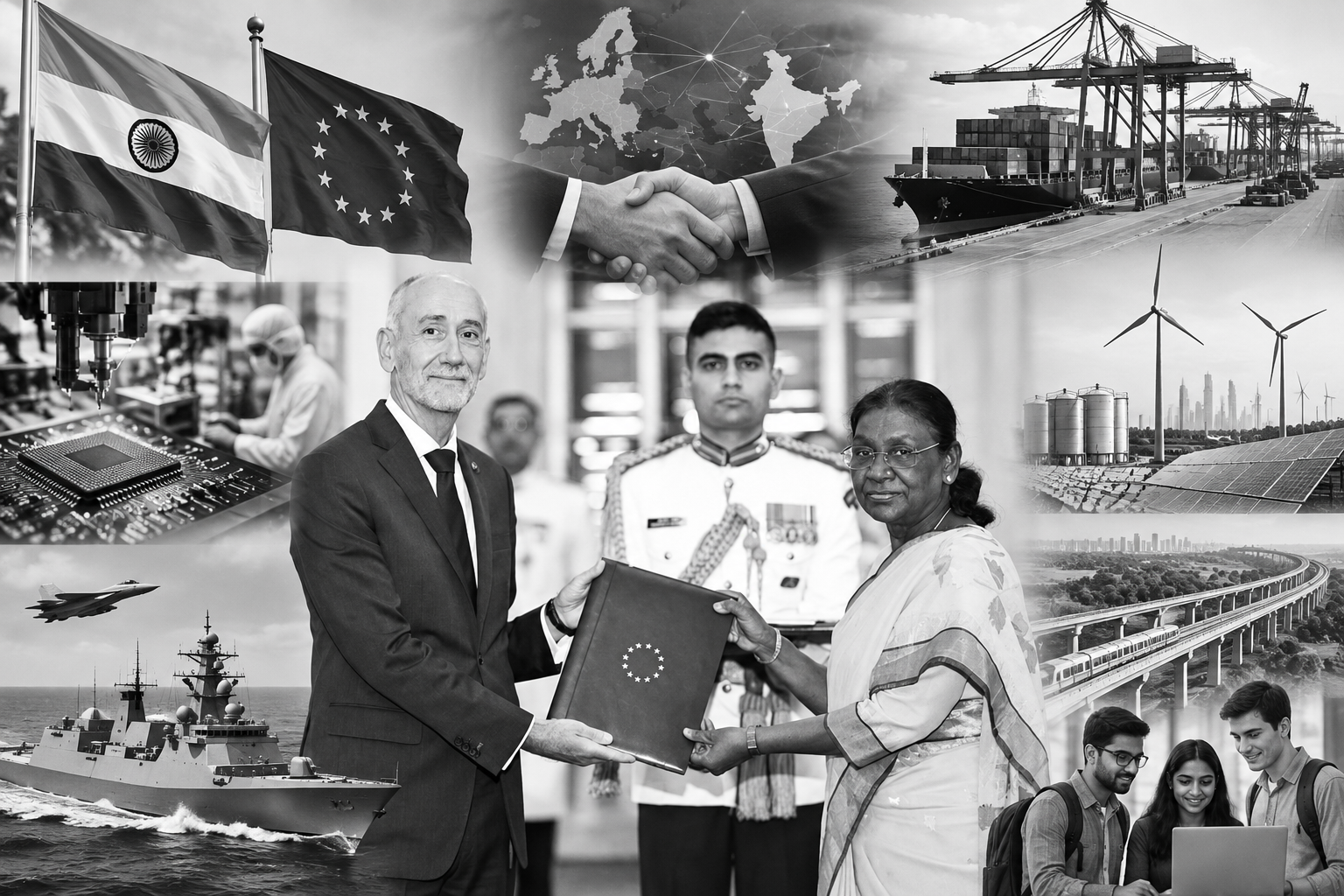
India-EU Ties Reach ‘Remarkable’ Political Depth, Says EU Envoy Paquet
The relationship between India and the European Union has reached a “remarkable” level of political intensity, but the next phase must focus on converting political momentum into concrete economic, technological, security and development outcomes, newly appointed EU Ambassador to India Jean-Eric Paquet said on Friday.
Paquet made the remarks after presenting his credentials to President Droupadi Murmu at Rashtrapati Bhavan, formally beginning his tenure. He said the EU's priority would be to transform political vision and promises into “tangible outcomes”, working with administrations across India and Europe. He also said he and his spouse intend to visit all 28 states and Union Territories, having already travelled to Amritsar and Jaisalmer.
The comments come as India-EU relations enter a new phase following the 16th EU-India Summit in January 2026, where leaders adopted a Comprehensive Strategic Agenda Towards 2030 and concluded negotiations on a landmark Free Trade Agreement. The agenda covers prosperity, sustainability, technology, innovation, security, defence, connectivity and people-to-people cooperation.
The EU is India's third-largest trading partner, with goods trade reaching €118 billion in 2025 and services trade standing at €67 billion in 2024. EU foreign direct investment stock in India reached €132.8 billion in 2024, while around 6,000 European companies operate in the country. An EU economic assessment said these companies generated €186 billion in turnover in 2024, contributing about 5 per cent of India's GDP, nearly a quarter of manufacturing-sector turnover and around 3 million jobs.
The FTA, concluded after years of negotiations, is expected to remove or reduce tariffs on more than 99 per cent of Indian goods exports, while India will provide access for almost 97 per cent of EU exports. The agreement is accompanied by negotiations on investment protection and geographical indications.
Technology has emerged as another strategic pillar. At the July 2026 Trade and Technology Council, India and the EU expanded cooperation on AI, semiconductors, quantum technologies, high-performance computing and 6G, while launching an Innovation Hub for EV charging technologies and an EU-India Startup Partnership. Negotiations are also underway on India's association with Horizon Europe.
Security cooperation has expanded through the EU-India Security and Defence Partnership, covering maritime security, cyber threats, counterterrorism, space and defence industries. Cooperation also extends to Global Gateway, IMEC, green hydrogen, clean energy and resilient supply chains.
Paquet's emphasis on state-level engagement builds on former ambassador Hervé Delphin's outreach, including Assam, where the EU identified opportunities in semiconductors, pharmaceuticals, renewable energy, electronics, tea and agri-food. The EU's Blue Valley approach seeks to connect regional clusters with European investment and value chains.
With more than 50 sectoral dialogues already in place, Paquet's message is clear: the next test of India-EU relations will be turning an expanding diplomatic framework into measurable trade, investment, technology, security and development outcomes.