
India Generates 20% of Global Data, but Has 3% of Data-Centre Capacity
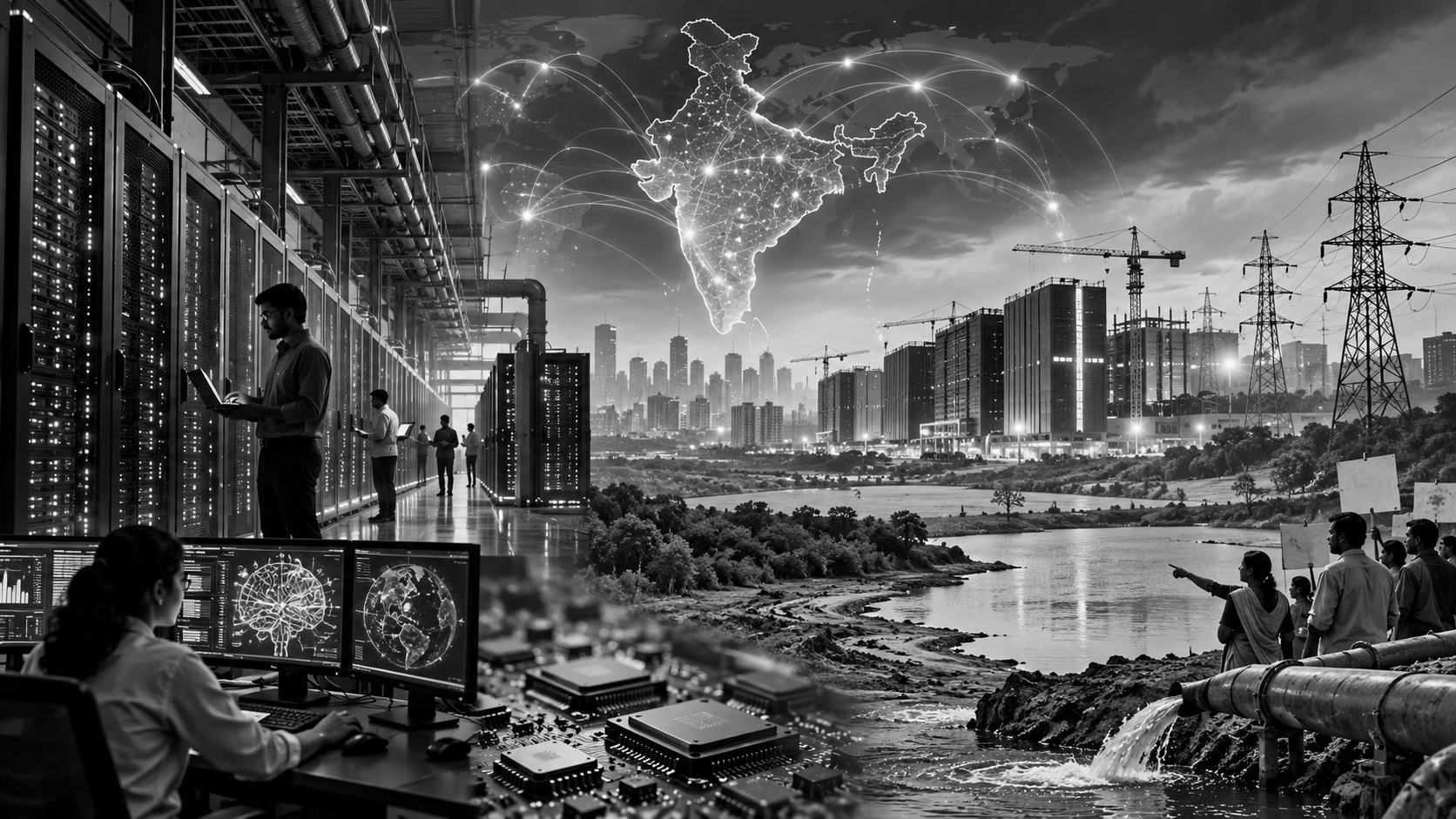
India generates nearly 20 per cent of the world's data but hosts only around 3 per cent of global data-centre capacity, highlighting a widening gap between the country's enormous digital footprint and the infrastructure available to store and process it. The contrast, highlighted by former Union minister Murli Manohar Joshi at the FICCI Higher Education Summit, points to a larger challenge facing India's artificial intelligence ambitions. As the country seeks to emerge as a major AI power, it must build not only data centres, but also the computing power, electricity, cooling systems, semiconductor ecosystem, connectivity and skilled workforce needed to turn data into technological capability.
From Digital India to the AI infrastructure race
India's data-centre expansion is rooted in the country's broader digital transformation. The growth of smartphones, affordable internet, digital payments, e-governance and cloud services has generated enormous volumes of information. The National Informatics Centre's network of data centres, including major facilities in Delhi, Pune, Hyderabad and Bhubaneswar, provided an early foundation for government digital services. The rapid expansion of the digital economy has since created demand for much larger commercial and hyperscale facilities.
Government data shows India's installed data-centre power capacity rising from about 375 MW in 2020 to around 1.57 GW by August 2026. Capacity is projected to approach 8 GW by 2030, while nearly $70 billion is already being invested in the sector and another $90 billion worth of projects has been announced. The expansion reflects how data centres have moved from being specialised technology facilities to becoming critical economic infrastructure.
The race for AI compute
Artificial intelligence has changed the nature of this infrastructure demand. Conventional data centres support websites, banking, cloud storage and enterprise applications, but advanced AI systems require enormous computing power. GPUs and other specialised processors can perform the parallel calculations required to train and operate sophisticated models, making access to compute one of the biggest challenges for researchers and start-ups.
India's response has been the IndiaAI Mission, approved in 2024 with an outlay of ₹10,371.92 crore over five years. Its seven pillars cover compute infrastructure, foundation models, datasets, applications, future skills, start-up financing and safe and trusted AI. The government initially targeted 10,000 GPUs but subsequently expanded shared capacity beyond 38,000 GPUs and over 45,000 by June 2026. By August, 237 projects had accessed subsidised computing, accounting for more than 93 lakh GPU hours.
The effort is also moving towards indigenous AI. From 506 applications, the government selected 20 foundation-model proposals, while the AI Kosh platform had more than 14,000 datasets and 331 AI models by July 2026. Fifty-eight AI Centres of Excellence had also been approved across States and Union Territories. The objective is increasingly clear: India wants to develop its own models and applications rather than remain only a consumer of foreign AI technology.
The power and cooling challenge
The word "cloud" can make digital infrastructure seem invisible, but every AI query ultimately depends on physical facilities, servers, fibre networks, transformers, cooling equipment and electricity. The Central Electricity Authority estimates India's data-centre electricity demand could reach around 17 GW by 2031–32. Globally, the International Energy Agency estimates data centres consumed about 415 TWh of electricity in 2024 and projects this to more than double to around 945 TWh by 2030, driven partly by AI workloads.
Cooling presents another challenge. Higher-density AI servers generate significantly more heat, increasing demand for advanced cooling systems. The Alliance for an Energy Efficient Economy estimates cooling can account for roughly 30–40 per cent of data-centre energy consumption. The growing use of liquid cooling and other technologies is therefore becoming essential, while also raising questions about water use.
The World Resources Institute India says more than half of India's data centres are located in water-stressed regions, with about 75 per cent concentrated in Maharashtra, Tamil Nadu, Karnataka, Telangana and Uttar Pradesh.
Hyderabad's growing role
The issue has particular relevance for Telangana. Hyderabad is already one of India's principal data-centre hubs. Government data puts the city at around 22 per cent of India's data-centre capacity, while the Telangana government says Hyderabad has approximately 200 MW of live IT capacity and 4.7 GW of committed or early-stage capacity. The state has identified more than 1,000 acres for data-centre clusters at Chandanvelly and Bharat Future City and aims to develop 8–10 GW of capacity over the longer term.
The state is also planning dedicated electricity and treated-greywater infrastructure for these clusters. This highlights the scale of supporting infrastructure required: data centres need not only land and buildings, but also reliable power, water management and high-capacity connectivity.
Billions of dollars are chasing the opportunity
Global technology companies are making large bets on India's AI infrastructure. Google has committed $15 billion over five years to an AI hub in Visakhapatnam, combining data-centre infrastructure, gigawatt-scale computing and new international connectivity. Microsoft has announced $17.5 billion in investment between 2026 and 2029 for India's cloud and AI infrastructure, skills and operations.
The investment demonstrates the size of India's opportunity, but it also raises questions about the physical and environmental costs of building infrastructure at such a scale.
Activists question the environmental cost
Environmental activists, scientists and local communities are increasingly challenging aspects of India's data-centre expansion. In Visakhapatnam, activists have questioned the water requirements, environmental approvals and location of Google's proposed AI hub, including its proximity to the Kambalakonda Wildlife Sanctuary. Reuters reported that the city's daily water requirement already exceeded available supply, while Google has said it plans to use advanced air cooling and sound-dampening measures. The Andhra Pradesh government has rejected allegations that the project was improperly fast-tracked.
The Human Rights Forum has demanded fresh environmental assessment and public hearings for hyperscale projects at Tarluvada and Rambilli. In Telangana, retired scientists have similarly questioned whether environmental assessments for hyperscale data centres adequately account for cooling systems, thermal loads, water requirements, power consumption and emissions.
Community researchers have also raised concerns over land, agriculture, water and livelihoods around data-centre developments in Telangana. In Thane, residents have protested against a proposed Amazon hyperscale facility, citing concerns over water, electricity, heat and the project's proximity to residential areas. The civic administration has said treated sewage water, rather than potable water, would be supplied to the facility.
The regulatory and sovereignty questions
The Centre has said AI data centres do not automatically require environmental clearance under the existing EIA framework, although qualifying large construction and township projects can require prior approval, with authorities examining water availability, water balance, recycling and reuse.
The debate is therefore not simply whether India should build data centres, but where they should be built, how their cumulative resource demands should be assessed and how much information should be publicly disclosed.
There is also a strategic dimension. India wants greater control over critical computing infrastructure and digital data. Budgetary incentives, including infrastructure status for data centres and a tax holiday until 2047 for eligible foreign cloud providers using India-based infrastructure for global operations, are designed to attract capital while anchoring more digital infrastructure within the country.
Chips, talent and the road ahead
India's AI ambitions also depend on semiconductors. Semicon 2.0, approved with an outlay of ₹1,27,500 crore, expands the country's semiconductor strategy into equipment, materials, advanced packaging, research and talent. Twelve semiconductor projects have been approved with committed investments exceeding ₹1.64 lakh crore.
At the same time, India has a significant human-capital advantage. UNESCO estimates that the country accounts for about 16 per cent of global AI talent, while India ranked third in Stanford's 2025 Global AI Vibrancy ranking. But talent alone cannot create advanced AI systems without affordable access to computing, datasets, research funding and infrastructure.
India is consequently entering a decisive phase. Its data advantage, technology workforce and rapidly expanding digital market provide a powerful foundation, while billions of dollars are being committed to data centres, cloud platforms, AI models and semiconductor manufacturing.
But the cloud is not weightless. Behind every AI model are buildings, GPUs, fibre cables, electricity, cooling systems, water and people. India's challenge is no longer simply to generate more data. It is to build enough compute, chips, power, connectivity and talent to convert that data into technological and economic value - without allowing the physical costs of the AI boom to fall disproportionately on the communities and resources that sustain it.