
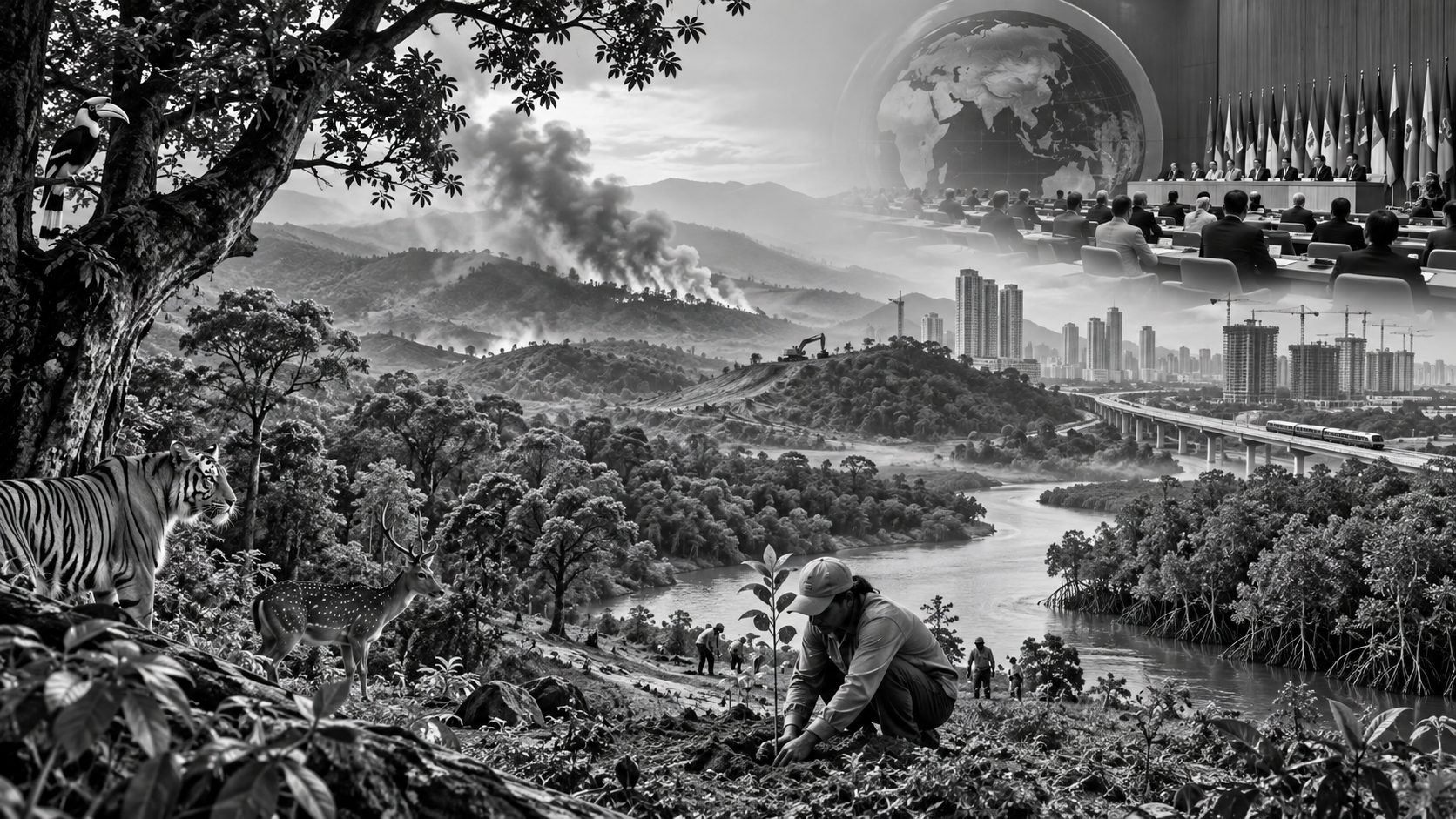
India Highlights Forest Restoration at COFO 28, Raising Questions Beyond Forest-Cover Gains
India has taken its forest and landscape restoration efforts to the global stage at the 28th Session of the Food and Agriculture Organization’s Committee on Forestry (COFO 28) in Rome, highlighting its expanding forest and tree cover, carbon-storage gains and large-scale restoration commitments.
India said its forest and tree cover stands at 82.74 million hectares, accounting for 25.17 per cent of its geographical area. It also reported an additional carbon sink of 2.29 billion tonnes of CO₂ equivalent by 2021 and has raised its ambition to create an additional 3.5–4 billion tonnes of CO₂ equivalent carbon sink by 2035, compared with 2005 levels.
The country has further committed under the Bonn Challenge to restore 26 million hectares of degraded and deforested land by 2030, of which 21.76 million hectares have already been brought under restoration, according to the government.
Yet, behind these impressive numbers lies a more complicated question: what does an increase in forest and tree cover actually tell us about the health of forests?
Beyond the green-cover number
COFO is FAO’s highest global intergovernmental body on forestry. Its 128 members meet every two years to shape international forestry policy and cooperation. COFO 28, being held from September 28 to October 2, 2026, is centred on the theme “Forests for food, resilience and prosperity” and brings together more than 400 delegates and participants, with 31 international and research organisations attending as observers.
The meeting comes as global forests face mounting pressure. FAO’s State of the World’s Forests 2026 estimates that forests cover 4.14 billion hectares, store around 714 gigatonnes of carbon and support up to 80 per cent of terrestrial biodiversity. At the same time, more than 460 million hectares of forests are degraded, while around 1.56 billion hectares of land are degraded worldwide. About 489 million hectares of forest were lost to deforestation between 1990 and 2025, while forest fires affect around 127 million hectares annually.
The figures illustrate why the global debate is shifting from simply planting trees to restoring functioning landscapes.
India's own forest-cover trend has been positive. Forest cover increased from around 698,712 sq km in 2013 to 715,343 sq km in 2023, a net increase of approximately 16,630 sq km.
But forest cover is not synonymous with pristine natural forest. India's Forest Survey of India classifies forest cover according to canopy density, including very dense, moderately dense and open forests, while tree cover outside recorded forests is assessed separately.
This means a rise in the national forest-cover figure can occur even while forest loss or degradation takes place in particular locations. Trees can be added through natural regeneration, plantations, agroforestry and afforestation, while other forests are simultaneously affected by infrastructure, agriculture, mining, fires or urban expansion.
Therefore, forest gain and forest loss are not mutually exclusive.
Restoration is more than planting trees
India's Bonn Challenge commitment reflects the growing emphasis on landscape restoration. Of the 26 million hectares targeted for restoration, 21.76 million hectares have reportedly been brought under restoration, leaving about 4.24 million hectares to reach the stated target.
However, “brought under restoration” should not automatically be interpreted as meaning that the land has been completely restored to its original ecological condition.
FAO increasingly defines restoration as a landscape-level process involving forests, farms, water, soils, biodiversity and communities. Its 2026 report identifies four broad requirements: putting people and their rights at the centre, planning at landscape scale, mobilising long-term finance and developing coherent policies and institutions.
India is showcasing initiatives including the Aravalli Green Wall, under which about 6.45 million hectares of degraded land have been identified for restoration, and MISHTI, which focuses on mangrove restoration. The country has also highlighted the Ek Ped Maa Ke Naam campaign, under which more than 3.5 billion saplings have been planted.
The long-term test, however, is not simply how many saplings are planted, but whether they survive, grow, regenerate and contribute to functioning ecosystems.
Development and the land-use dilemma
India's restoration push is taking place alongside rapid urbanisation and infrastructure expansion.
The National Remote Sensing Centre's land-use assessment shows that India's built-up area increased by 30.77 per cent between 2005–06 and 2022–23. This does not mean that 30.77 per cent of forest land was converted into buildings; built-up land can come from several land categories.
But it illustrates the larger challenge. India needs land for housing, roads, railways, industry, energy and expanding cities, while also protecting forests, wetlands, wildlife habitats and ecological corridors.
This makes the distinction between green cover and ecological quality increasingly important. A plantation, an agroforestry landscape, an urban tree canopy and an old natural forest may all contribute to green cover, but they do not necessarily provide identical biodiversity, habitat or ecosystem functions.
Carbon, biodiversity and resilience
Forests are central to India's climate strategy. The country's 2.29-billion-tonne additional carbon sink by 2021 and 3.5–4-billion-tonne target by 2035 underline the importance of maintaining and expanding carbon-storing landscapes.
But carbon storage depends on the continued survival and growth of forests. Fires, clearing and severe degradation can reverse carbon gains.
That is why wildfire management is a major COFO 28 agenda item. FAO estimates that around 127 million hectares of forest are affected by fires annually, making prevention, early warning, integrated fire management and post-fire restoration increasingly important.
Biodiversity presents another challenge. Forests can remain standing while becoming fragmented by roads, railways, mining and urban development. Such fragmentation can disrupt wildlife movement, breeding and access to food and water. COFO 28 is therefore also addressing sustainable wildlife management and human-wildlife coexistence.
From COFO 27 to COFO 28
The current meeting builds on the previous session held in 2024. COFO 27 endorsed the FAO Forestry Roadmap 2024–2031 and the Committee's Multi-year Programme of Work for 2024–2027. The roadmap focused on forest conservation, sustainable production and innovation, while also addressing biodiversity, climate change, wildfire management, urban forestry and the forest-based bioeconomy.
COFO 28 takes these priorities further, focusing on restoration, food security, wildfires, bioeconomy, Green Cities, finance, wildlife, forest degradation and improved forest monitoring.
India has called for stronger coherence between FAO's forestry work, the Global Forest Goals and other international processes, as well as stronger South-South and triangular cooperation to share knowledge, technology and scalable restoration solutions.
The financing question is particularly important. Restoring millions of hectares requires long-term investment, not one-time planting drives. Public budgets, CAMPA, climate finance, biodiversity finance and private and blended financing mechanisms will all have roles to play.
The real measure of India's green transition
India's presentation at COFO 28 offers a powerful collection of numbers: 82.74 million hectares of forest and tree cover, 25.17 per cent geographical coverage, 2.29 billion tonnes of additional carbon sink, a 3.5–4-billion-tonne carbon-sink ambition, 26 million hectares of restoration commitments and 21.76 million hectares reportedly brought under restoration.
But the broader forest story cannot be reduced to a single green-cover number.
The real test is whether natural forests are protected, degraded landscapes recover, biodiversity is maintained, wildlife corridors remain connected, carbon remains stored, communities benefit and forests withstand increasing climate and development pressures.
That is the larger significance of COFO 28. The global forestry debate is moving from counting trees to asking whether forests can continue to provide food, resilience, livelihoods, biodiversity and prosperity.
For India, the challenge is therefore not merely to increase the area that appears green on a map. It is to ensure that the green landscapes represented by those numbers remain healthy, connected, resilient and ecologically functional as the country continues to develop.