
India Moves Closer to Global Leadership in Zinc Battery Research
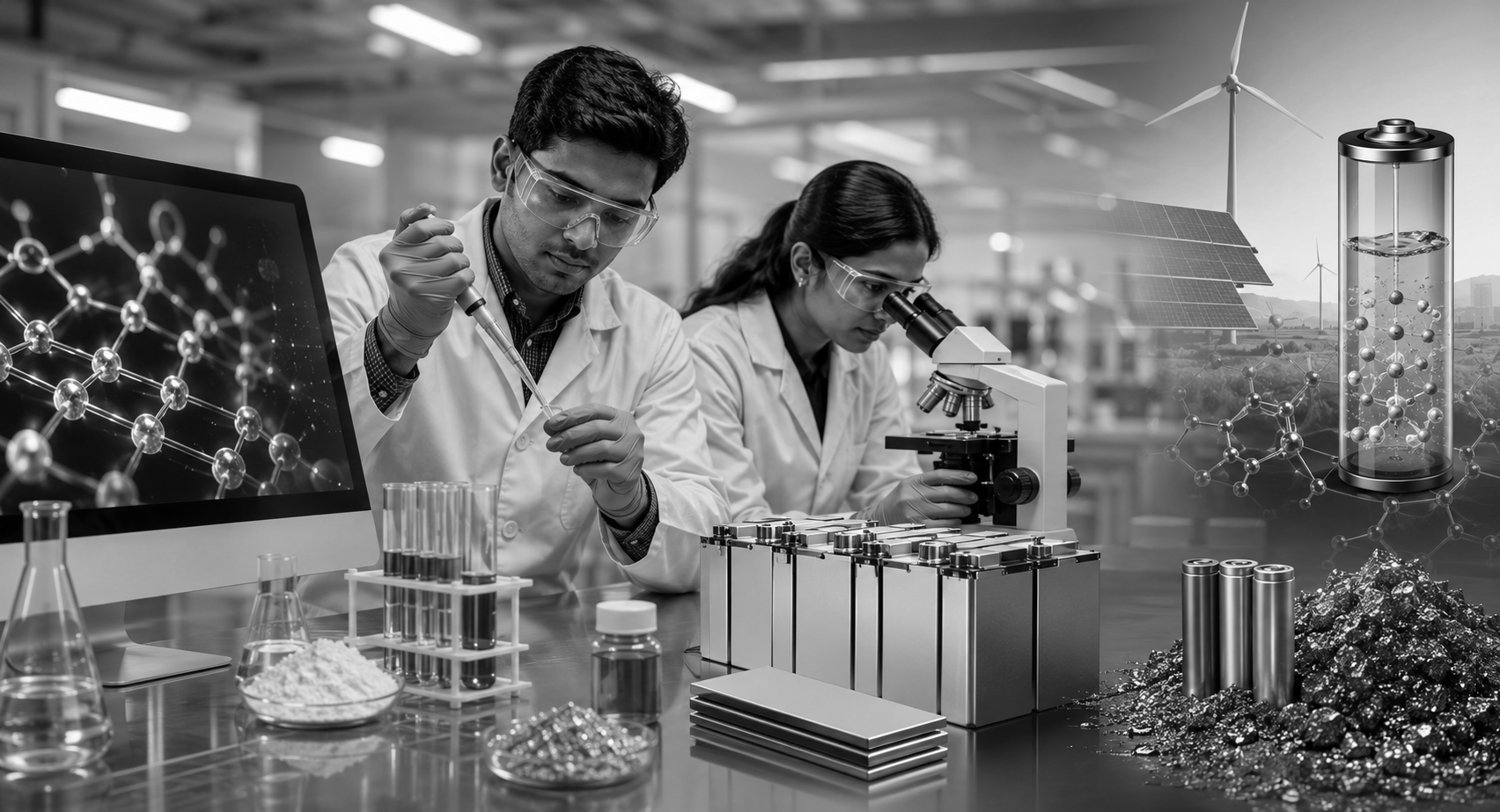
In a significant breakthrough for next-generation energy storage, scientists at the Institute of Nano Science and Technology (INST), Mohali , have developed a novel electrolyte additive that could make aqueous zinc-ion batteries safer, longer-lasting and more affordable. The innovation is expected to strengthen India's growing capabilities in advanced battery technologies and support the country's transition towards large-scale renewable energy storage.
The research, led by Dr. Ramendra Sundar Dey , Scientist E at INST, has been published in the journal ACS Electrochemistry . Scientists developed an electrolyte additive called 1,3-bis (1,3-dicarboxypropyl)-1H-imidazole-3-ium chloride (BDIM) , which addresses some of the most persistent challenges that have prevented the commercial adoption of Aqueous Zinc-Ion Batteries (AZIBs) .
Tackling the Biggest Challenge in Zinc Batteries
Aqueous zinc-ion batteries are increasingly being viewed as a promising alternative to lithium-ion batteries because they use abundant and inexpensive zinc, rely on water-based electrolytes and are inherently non-flammable. However, their commercialization has been hindered by zinc dendrite growth, hydrogen evolution reaction (HER), corrosion and poor cycling stability, all of which reduce battery lifespan and performance.
Rather than redesigning expensive battery materials, the INST team adopted an interface-engineering approach. Researchers synthesized BDIM by dissolving glutamic acid in sodium hydroxide and water, followed by the addition of glyoxal, formaldehyde and acetic acid. The mixture was heated at 70°C under a nitrogen atmosphere for 24 hours before being processed into a crystalline powder.
The additive contains multiple oxygen and nitrogen donor sites that strongly interact with zinc metal. During battery operation, BDIM selectively adsorbs onto the zinc surface and occupies the Inner Helmholtz Plane (IHP) , the region where electrochemical reactions occur. By displacing water molecules from the zinc-electrolyte interface, the additive suppresses hydrogen evolution, corrosion and dendrite formation, significantly improving zinc-anode stability and battery life.
Advanced Tools Provide New Insights
To better understand zinc-deposition mechanisms, the researchers combined a laboratory-developed ultramicroelectrode (UME) with fast-scan cyclic voltammetry (FSCV) . The UME, measuring less than 50 micrometres, alters diffusion behaviour from linear to radial, enabling high scan rates, while FSCV allows scientists to visualise changes in charge-transfer behaviour.
These advanced techniques helped researchers directly investigate interfacial charge-transfer and mass-transfer kinetics, providing fresh insights into how zinc deposits on battery electrodes and how those processes can be controlled more effectively.
Why Zinc Matters
The breakthrough comes at a time when global demand for energy storage is rising rapidly. While lithium-ion batteries currently dominate the market, concerns over safety, supply-chain concentration and dependence on critical minerals have intensified the search for alternatives.
Globally, more than half of all zinc consumption is used in galvanised steel for infrastructure, construction and automobile manufacturing. Zinc is also widely used in die-casting, brass production, electronics and industrial machinery. Battery storage, however, is emerging as one of the fastest-growing future applications for the metal.
India is already the world's second-largest zinc producer and has witnessed steady growth in refined zinc production. Output increased from around 778,000 tonnes in FY2020-21 to a record 851,000 tonnes in FY2025-26 , reflecting expanding capacity and strong industrial demand. The country also exports zinc worth thousands of crores annually to markets such as China, South Korea, Japan, Taiwan, the United States and several European countries.
If zinc-ion batteries become commercially viable, India could move beyond exporting refined zinc and become a supplier of battery-grade materials, advanced electrolytes and energy-storage technologies.
Supporting India's Clean Energy Ambitions
The technology has significant applications in renewable-energy storage, backup power systems, telecom infrastructure, rural microgrids, data centres and grid-scale energy storage facilities. As India expands solar and wind generation, demand for affordable and safe long-duration storage solutions is expected to grow substantially.
The development aligns with broader national priorities, including the National Critical Mineral Mission , which seeks to strengthen mineral security, domestic processing, recycling and advanced-material technologies. The mission, backed by an outlay of around ₹34,300 crore , aims to reduce import dependence and build resilient supply chains for future industries.
At the industry level, Hindustan Zinc Limited has announced major expansion plans, including investments exceeding ₹12,000 crore , with a long-term goal of expanding refined metal production capacity towards 2 million tonnes annually by 2030 .
INST Mohali's Growing Reputation
Established under the Government of India's Nano Mission , INST Mohali is one of the country's premier nanoscience research institutions operating under the Department of Science and Technology. Since becoming operational in 2013, the institute has emerged as a multidisciplinary research hub focusing on energy, healthcare, environment, advanced materials and nanobiotechnology.
Over the years, INST scientists have developed a range of innovative technologies, including graphene-based micro-supercapacitors for energy storage, nanotechnology-based solutions for water purification, advanced biosensors for disease detection and Nano-Spray Gel technology for frostbite treatment. The institute has built a strong record of publications in leading international journals and has contributed to several strategic technology-development programmes.
Competing with Global Leaders
India possesses several advantages in the emerging zinc-battery sector, including abundant zinc reserves, a growing renewable-energy market and a strong scientific research base. However, countries such as China, the United States, Japan and South Korea continue to dominate battery manufacturing, commercialization and patent ownership.
Experts note that India's next challenge is translating laboratory breakthroughs into commercial products through pilot projects, industry partnerships and large-scale manufacturing. Success in these areas could help the country emerge as a significant player in next-generation battery technologies.
The latest INST Mohali innovation demonstrates that Indian researchers are increasingly contributing to cutting-edge energy-storage science. If successfully scaled, the BDIM additive could help create safer, longer-lasting and more affordable zinc-ion batteries, opening new opportunities for India's clean-energy ecosystem and strengthening its position in the global battery technology race.