
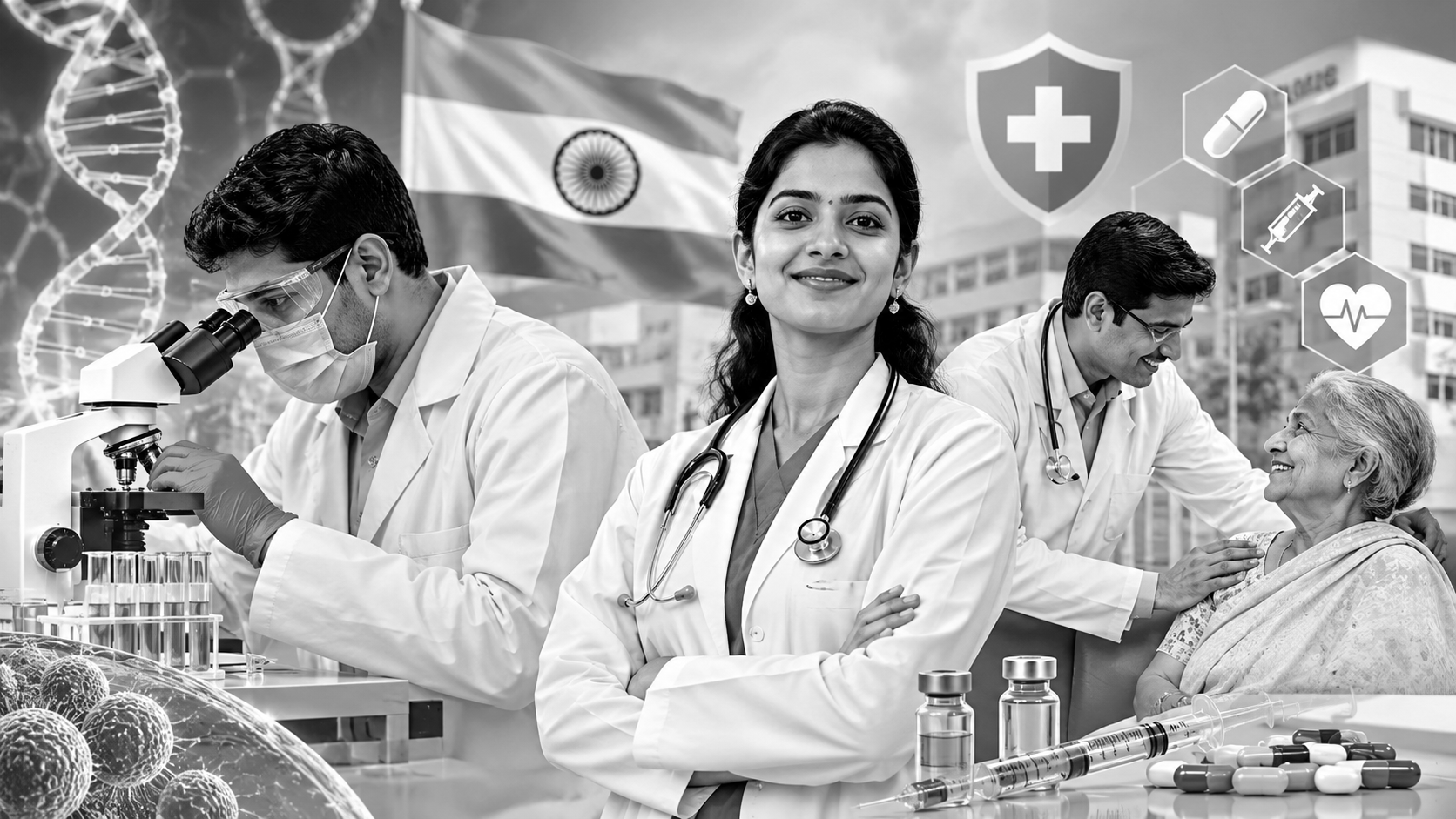
India Moves Towards Global Healthcare Leadership Through Indigenous Medical Breakthroughs
India is steadily transforming into a global healthcare powerhouse through indigenous medical research, scientific innovation and affordable advanced treatments, Union Minister of State for Science and Technology Dr Jitendra Singh said on Saturday. He highlighted the country's growing capabilities in vaccine development, antibiotics, genome sequencing, gene therapy and cancer treatment, stating that India is increasingly developing its own medical solutions instead of depending on technologies and treatments imported from other countries.
Addressing the Global Healthcare Conclave 2026, organised by the Global Association of Indian Medical Students (GAIMS), the minister said India's scientific capabilities, unique genetic diversity and advancements in precision medicine were opening new opportunities for the country to contribute to global healthcare. He also emphasised the need to maintain a balance between modern medical technologies and conventional clinical practices, cautioning that technological advancements should complement rather than replace doctors' clinical judgement and practical experience.
Dr Jitendra Singh said India had made considerable progress in developing indigenous healthcare solutions and was emerging as a cost-effective destination for quality medical treatment. Recalling the transformation of the country's healthcare ecosystem over several decades, he noted that medical science had advanced from conventional X-ray-based diagnosis to sophisticated technologies such as ultrasound, CT scans and MRI, alongside significant improvements in treatment methods and disease management.
The minister observed that India's disease profile had also undergone a major shift. While communicable diseases once accounted for a significant share of illness and mortality, the country was now facing a dual burden of communicable and non-communicable diseases. Type-2 diabetes, cardiovascular diseases, hypertension, dyslipidemia and fatty liver disease were emerging as major public health challenges. He expressed concern that metabolic disorders were increasingly being detected among younger people, making research into prevention, early diagnosis and targeted treatment essential.
Highlighting the importance of India's genetic diversity in medical research, Dr Jitendra Singh referred to the Indian Genome Programme, under which approximately 10,000 to 15,000 individuals belonging to 84 different population groups have already been sequenced. The initial target is to expand the programme to one million individuals. He said the extensive genomic database could strengthen India's precision medicine capabilities by helping researchers understand genetic variations, disease patterns and individual responses to treatments. The findings could also generate valuable scientific knowledge benefiting healthcare research across the world.
He said the convergence of genomics, Artificial Intelligence (AI) and other emerging technologies was creating opportunities for personalised and targeted medical treatment. Referring to ongoing research, he mentioned efforts to genetically engineer E. coli to produce GLP analogues, which could potentially help address insulin resistance and related metabolic conditions. Such research, he said, reflected India's growing focus on developing scientific solutions to healthcare challenges specific to its population.
The minister also highlighted India's achievements in vaccine development and its increasing contribution to global vaccination efforts. Referring to the HPV vaccination programme, he said more than 50 lakh adolescent girls had already been vaccinated. He described the progress as an example of the country's expanding capabilities in developing and delivering healthcare solutions.
India had also made significant advances in indigenous antibiotic development, with two indigenously developed antibiotics emerging over the past two years. One of these is being marketed by pharmaceutical company Wockhardt. According to the minister, these developments demonstrated the country's increasing ability to conduct advanced research, develop new molecules and create treatments for diseases that were earlier addressed largely through imported medicines and technologies.
Citing further examples of advanced medical research, Dr Jitendra Singh referred to successful gene therapy trial work for haemophilia at Christian Medical College (CMC), Vellore, which was published in the New England Journal of Medicine. He said the achievement demonstrated India's growing capacity to contribute to cutting-edge medical research and develop treatments for complex diseases.
He also highlighted CAR-T cell therapy and cancer research at Tata Memorial Centre, Mumbai, as important examples of India's progress in making advanced cancer treatments more affordable. These indigenous innovations, he said, were strengthening India's position in specialised healthcare and creating opportunities for Indian doctors and researchers to make greater contributions internationally.
Dr Jitendra Singh said the global perception of Indian medical professionals had changed significantly, with Indian doctors and researchers receiving increasing recognition for their knowledge, expertise and contributions to medical science. Progress in vaccines, antibiotics, advanced cancer therapies and medical research had enhanced India's international standing and provided younger medical professionals with a stronger platform to participate in global healthcare initiatives.
However, the minister cautioned against excessive dependence on diagnostic investigations and technology-driven medical practices. Drawing from his experience as a medical practitioner, he recalled how earlier generations of doctors developed their expertise through extensive hospital exposure, direct patient interaction and careful clinical examination. He said the ability to identify symptoms, assess a patient's condition and arrive at a diagnosis through observation and experience remained fundamental to medical practice.
He stressed that medical investigations should support clinical findings rather than become substitutes for doctors' independent assessments. Medical education, he said, must continue to prioritise bedside learning, practical training, patient interaction and clinical examination. Even as AI, quantum technologies and advanced diagnostic tools transform healthcare, doctors must retain the ability to make sound medical decisions based on their knowledge and experience.
Encouraging young medical students to remain curious and continuously update their knowledge, Dr Jitendra Singh said emerging areas such as AI, quantum technologies, genomics and precision medicine offered considerable opportunities for improving diagnosis and treatment. However, he emphasised that these advancements must be applied with appropriate clinical judgement.
He also suggested that medical education, particularly postgraduate training and selection, should give greater importance to clinical competence and practical exposure. A doctor should be capable of providing medical assistance even in situations where advanced diagnostic equipment and sophisticated healthcare facilities are unavailable. Developing such clinical skills, he said, required sustained patient interaction and hands-on experience.
Highlighting the government's efforts to make healthcare more accessible and affordable, the minister referred to Ayushman Bharat, which has expanded financial protection for patients, including provisions covering pre-existing diseases. He also mentioned the expansion of dialysis facilities across district hospitals as an important measure to improve access to essential treatment, particularly for patients who may otherwise face difficulties reaching specialised healthcare centres.
Dr Jitendra Singh further stressed that preventive healthcare would become one of the defining features of India's medical system in the coming years. With lifestyle-related and metabolic disorders increasingly affecting younger populations, he called for greater attention to early detection and India-specific medical research. He particularly highlighted the pattern of central obesity among Indians, explaining that people who appear physically lean may still have significant visceral fat, which independently increases the risk of metabolic and cardiovascular conditions. Generating population-specific medical data, he said, would help researchers understand these patterns and develop more effective preventive interventions.
The minister also called on healthcare organisations such as GAIMS to expand their role beyond conventional medical education by actively participating in research, healthcare delivery, public health awareness and collaboration with the private sector. He encouraged young medical professionals to make use of the expanding opportunities in India's scientific ecosystem and contribute to addressing emerging healthcare challenges.
The Global Healthcare Conclave 2026 brought together young medical students, healthcare professionals and members of the medical fraternity to discuss emerging developments, opportunities and challenges in the healthcare sector. Dr Minu Bhajpai, Vice President of the National Board of Examinations in Medical Sciences (NBEMS), attended the event as the Guest of Honour. Dr Shubham Anand, National Chairman of GAIMS, and other members of the organisation's executive team were also present.
During the event, Dr Jitendra Singh released the official souvenir of the Global Healthcare Conclave 2026 and interacted with young medical students, encouraging them to embrace emerging technologies while maintaining strong clinical foundations.
Expressing confidence in India's healthcare future, the minister said the country was at a promising stage, with indigenous research, technological advancements, a growing scientific ecosystem and globally recognised medical professionals creating new opportunities. He said the next generation of doctors would play a significant role through their contributions to research, innovation and patient care, helping strengthen India's healthcare capabilities and advance the vision of Viksit Bharat 2047.