
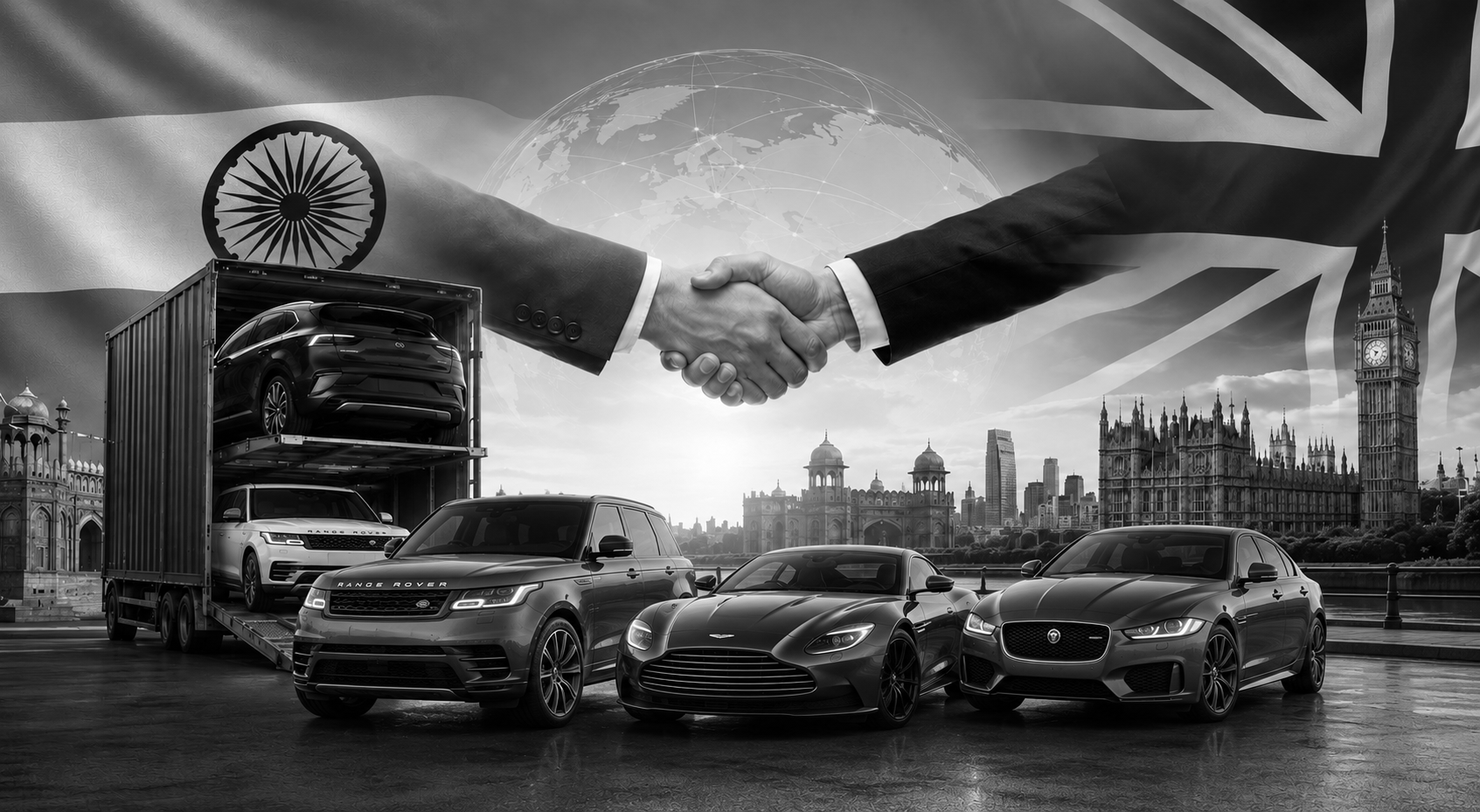
India Opens Door to UK Car Imports Under Trade Pact, Safeguards Domestic EV Industry
The newly announced India-UK Comprehensive Economic and Trade Agreement (CETA) is set to bring significant changes to the automobile sector, opening India's market to British vehicles while carefully protecting the country's growing domestic electric vehicle industry.
Under the agreement, which comes into effect on July 15 , India will permit the import of nearly 3.78 lakh conventional-engine passenger vehicles from the United Kingdom over the next 15 years at substantially reduced customs duties. The move marks one of the most notable outcomes of the landmark trade pact between the two countries and is expected to deepen economic ties while creating new opportunities for automobile manufacturers on both sides.
At present, imported vehicles attract duties of up to 110 percent , making foreign cars significantly more expensive in India. Under the new arrangement, tariffs on eligible UK vehicles will gradually decline and eventually settle at 10 percent , subject to quota limits agreed upon by both nations.
The agreement introduces a phased approach. During the first year, India will allow the import of 20,000 passenger vehicles across different engine categories under concessional duty rates. Premium vehicles with larger engine capacities will receive the biggest tariff reductions, while selected mass-market models will also gain access to the Indian market under controlled quotas.
The import quota is scheduled to expand steadily before reaching its peak in the fifth year. Thereafter, the system will stabilize, with annual quotas continuing under the agreed framework. By the end of the 15-year period, the total number of conventional-engine vehicles imported from the UK under concessional terms is expected to reach approximately 3.78 lakh units .
However, the agreement also reflects India's strategic focus on nurturing its domestic EV ecosystem. New Delhi has kept vehicles priced below GBP 40,000 outside the concession framework , effectively shielding the mass-market electric vehicle segment where Indian manufacturers are investing heavily.
This protection is expected to benefit leading domestic players such as Tata Motors , Mahindra & Mahindra , and Maruti Suzuki , which are increasingly positioning themselves as key players in India's transition toward cleaner mobility.
The deal also creates opportunities for Indian automakers in the British market. Beginning in the sixth year of implementation, India will gain duty-free access for electric, hybrid, and hydrogen-powered passenger vehicles exported to the UK within specified price categories. The export quota for these vehicles will gradually expand, eventually reaching 88,000 units annually by the 15th year , offering a potentially significant growth avenue for Indian manufacturers.
While concessions have been extended for certain premium electric and hybrid vehicles entering India from the UK after the sixth year, the agreement clearly excludes electric or hydrogen-powered two-wheelers, buses, and trucks from any tariff reduction commitments.
The auto provisions of the India-UK trade pact highlight a carefully calibrated approach: opening markets, encouraging trade and investment, and strengthening bilateral economic relations, while simultaneously preserving policy space for India's long-term ambition of becoming a global hub for affordable electric mobility.