
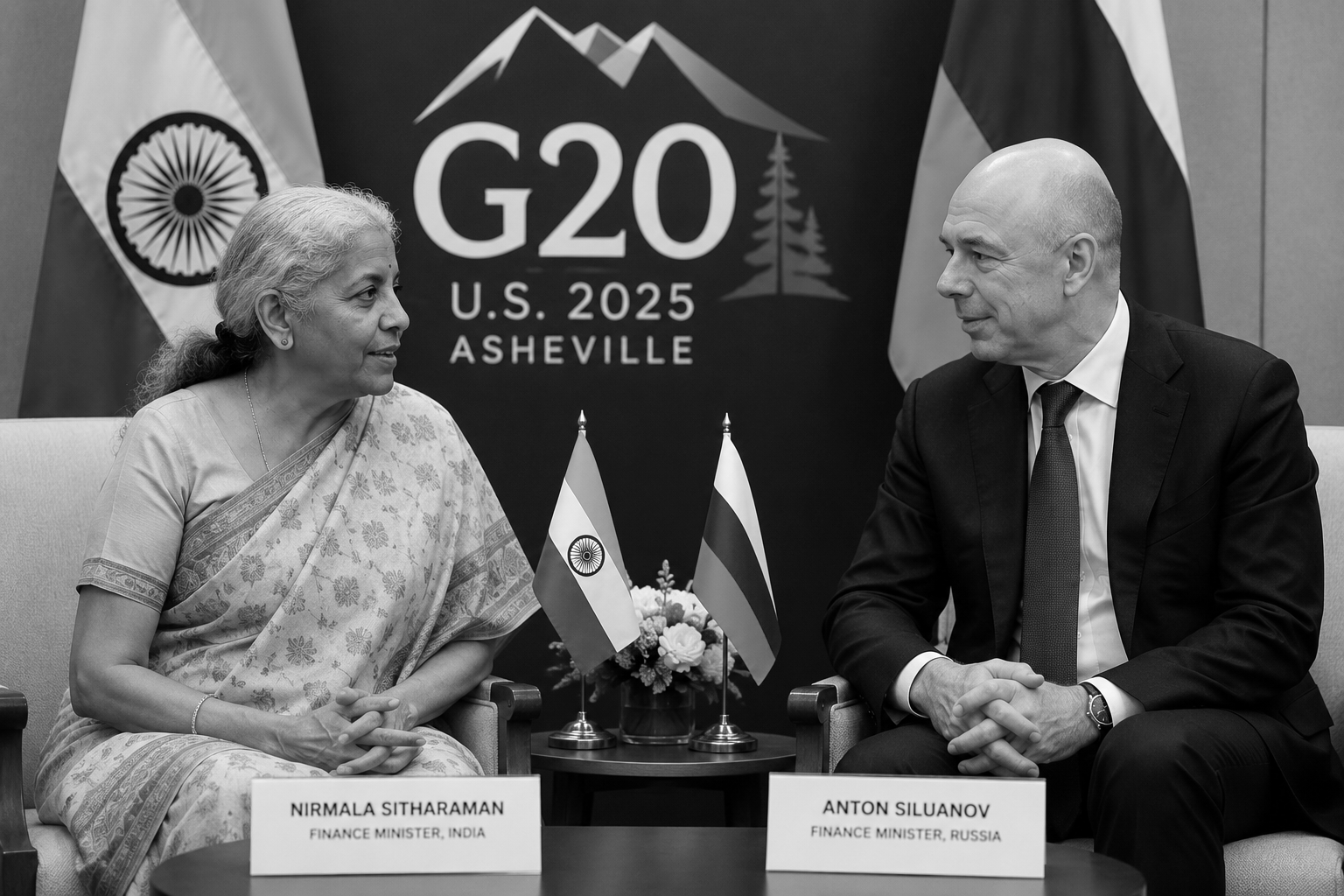
India-Russia Financial Push: Sitharaman, Siluanov Explore SCO Development Bank
India and Russia are seeking to deepen cooperation in multilateral development finance, with Finance Minister Nirmala Sitharaman and her Russian counterpart Anton Siluanov discussing the New Development Bank (NDB), Asian Infrastructure Investment Bank (AIIB) and proposed Shanghai Cooperation Organisation (SCO) Development Bank.
Their talks, held on the sidelines of the G20 Finance Ministers and Central Bank Governors meeting in Asheville, focused on strengthening bilateral economic ties, regional and global developments, and shared interests in the multilateral sphere. The discussions underline an effort by both countries to make existing development institutions more effective while exploring new financing mechanisms.
At the NDB and AIIB, India and Russia can coordinate priorities around infrastructure, connectivity, energy, digital networks and sustainable projects. Greater cooperation could help both countries influence lending priorities and strengthen the institutions' effectiveness as multilateral development banks.
The proposed SCO Development Bank could widen that institutional network. If established with adequate capital and credible governance, it could provide long-term financing for infrastructure and cross-border projects across the SCO region. For developing member states, especially in Central Asia, an additional source of development finance could help address funding gaps and support regional connectivity.
For India and Russia, engagement across the three institutions also offers a way to build stronger links between Asian, BRICS and SCO financial mechanisms. Joint positions could amplify the voice of emerging economies on development priorities and reform of global economic governance.
The partnership could also encourage greater financial diversification and cooperation in cross-border payments and local-currency transactions, although the eventual impact would depend on institutional design and participating countries' willingness to coordinate.
For India, however, the approach is likely to remain pragmatic. New financial platforms can complement existing institutions without replacing established lenders. India’s emphasis on sovereignty and transparent connectivity would also shape its participation.
The broader significance is strategic: sustained India-Russia coordination could give both countries greater influence in multilateral finance and support a more representative, multipolar development-finance architecture, while creating additional channels for investment across Eurasia.