
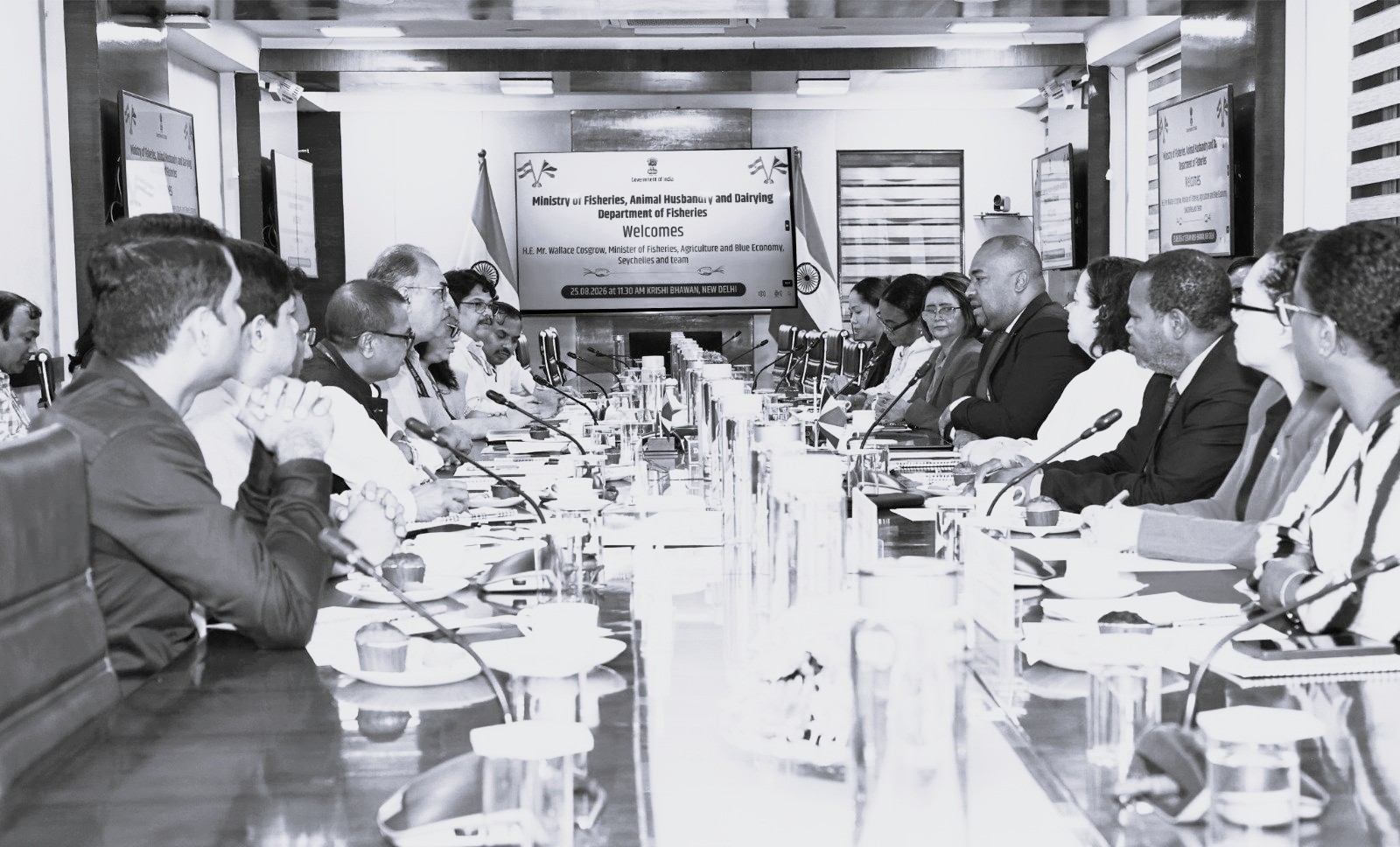
India, Seychelles Forge Stronger Fisheries Ties with Focus on Tuna, Aquaculture
India and Seychelles are moving to deepen cooperation in fisheries, aquaculture and the blue economy, with both countries seeking to translate their longstanding maritime partnership into a more structured programme of scientific, technological and institutional collaboration. The discussions are significant as Seychelles looks to secure greater economic value from its marine resources, while India brings expanding expertise in fisheries production, aquaculture, seafood processing, research and digital fisheries management.
The latest engagement followed a high-level bilateral meeting on August 25, 2026, hosted in New Delhi by the Department of Fisheries under the Ministry of Fisheries, Animal Husbandry and Dairying. The Indian delegation was led by Dr. Abhilaksh Likhi, Secretary, Department of Fisheries, while the Seychelles delegation was headed by Wallace Cosgrow, Minister of Fisheries, Agriculture and Blue Economy. Both sides reviewed existing frameworks and discussed a roadmap for sustainable marine-resource utilisation.
The meeting builds on a broader India-Seychelles relationship in which the blue economy has emerged as a strategic area. Earlier in 2026, the countries identified fisheries, aquaculture, marine infrastructure, ocean-based renewable energy and marine research as priority areas for deeper cooperation. India’s engagement with Seychelles is also guided by its MAHASAGAR vision of mutual and holistic advancement for security and growth across regions.
Fisheries were placed at the centre of the latest discussions because of their importance to economic growth, employment, food security and sustainable development. India highlighted its record 19.7 million tonnes of fish production and US$8.46 billion in seafood exports. Recent government data show production reached 197.75 lakh tonnes in 2024-25, while marine-product exports reached 19.72 lakh tonnes worth Rs.73,890 crore in 2025-26.
For Seychelles, fisheries are a major economic and food-security pillar, with the government particularly focused on obtaining greater and fairer returns from its industrial tuna sector. Its 2026 priorities include value addition, diversification, aquaculture development and strengthening fisheries governance and skills.
Against this backdrop, India and Seychelles explored cooperation in marine aquaculture, modern hatcheries, tuna-fisheries optimisation, stock assessment, post-harvest engineering and marine conservation. The countries also discussed technical studies, fisheries extension services and institutional training to facilitate knowledge transfer.
A major focus was digital transformation. Potential collaboration includes fisheries data systems, monitoring, control and surveillance (MCS) infrastructure and the use of Artificial Intelligence in harvest management. Both sides also highlighted tuna processing, product diversification and sustainable fish-waste management to strengthen the fisheries value chain.
To turn discussions into measurable outcomes, India and Seychelles agreed on the importance of a structured annual work plan, regulatory alignment, joint pilot projects, reciprocal laboratory access and faster commercialisation of scientific research. Seychelles expressed interest in accelerating a dedicated bilateral MoU on fisheries and aquaculture, backed by an advanced work plan.
The latest initiative also complements the countries’ growing institutional cooperation. During Prime Minister Narendra Modi’s 2026 visit to Seychelles, ICAR and Seychelles’ Agriculture Department signed an MoU supported by a 2026-2031 work plan covering research, education, capacity building and technology transfer.