
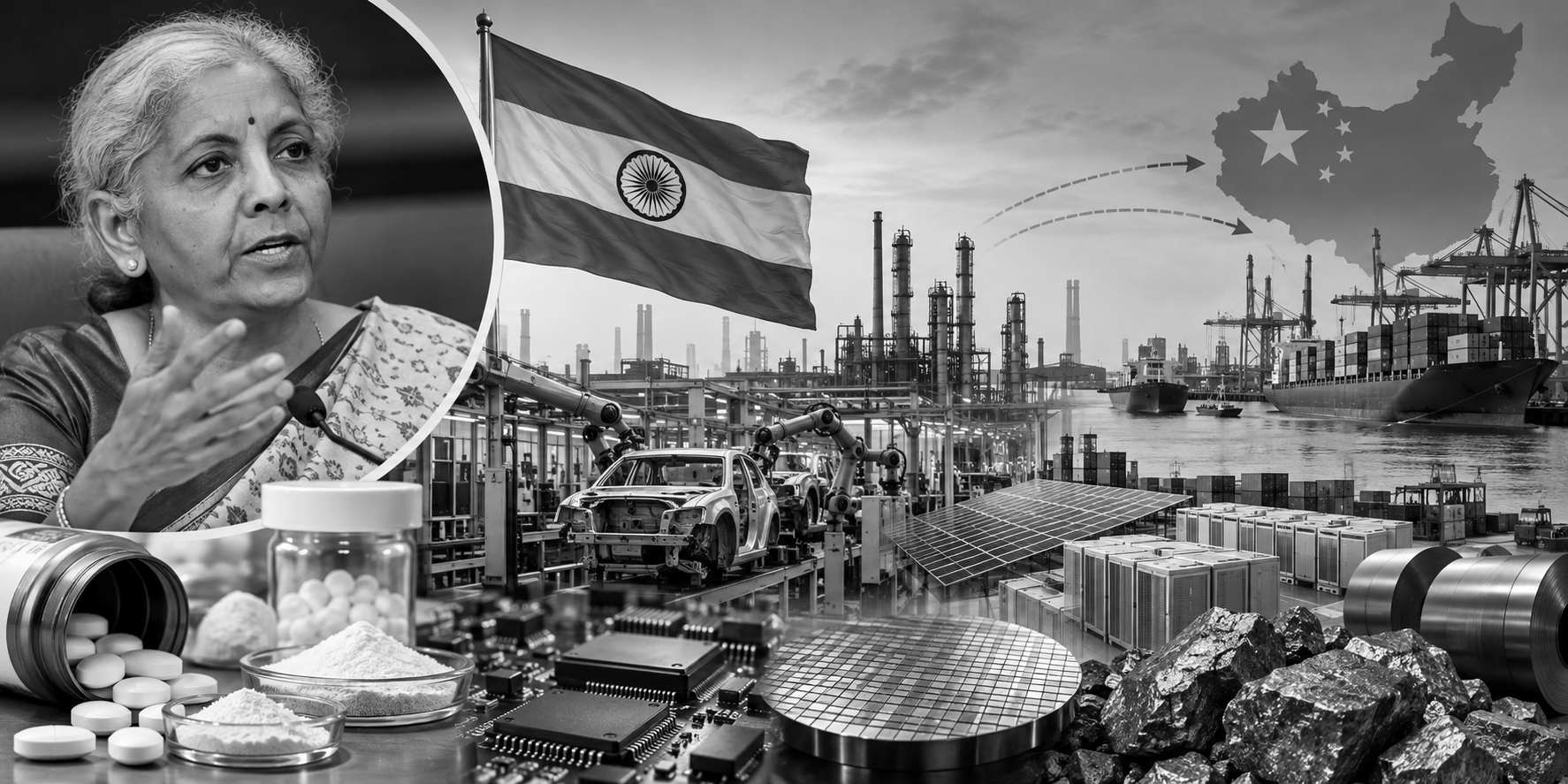
India Steps Up Domestic Manufacturing Push to Reduce Import Dependence
The Centre is using budgetary incentives, production-linked support and industrial infrastructure to help Indian companies build domestic manufacturing capacity and reduce dependence on overseas suppliers, Union Finance Minister Nirmala Sitharaman said at an interactive session at the Bharat Shakti Pondy Lit Fest.
Sitharaman said the government was supporting industries to establish domestic production for the long term while allowing them to source from alternative markets in the short term. She said the objective was to incentivise companies to eventually manufacture critical products in India.
Highlighting India's trade with China, Sitharaman said some Indian goods reach the Chinese market through countries such as Vietnam and therefore are not reflected as direct exports to China. She said India lacks adequate market access in China for certain bulk-value products, including buffalo meat and generic pharmaceutical drugs, which she said are sometimes routed through third countries.
She said India had consciously decided to develop domestic capacity in strategically important sectors. Referring to active pharmaceutical ingredients (APIs), Sitharaman said India was once a major producer but lost ground amid intense price competition. The government is now encouraging companies to restart production through targeted incentives.
The ₹6,940-crore bulk-drug PLI scheme targets critical APIs, Key Starting Materials and drug intermediates. By March 2026, 48 projects had been approved, while 28 APIs, KSMs and intermediates had achieved production capacity. The Centre has also approved Bulk Drug Parks in Andhra Pradesh, Gujarat and Himachal Pradesh.
The broader PLI programme, covering 14 sectors with an approved outlay of ₹1.91 lakh crore, had attracted over ₹2.40 lakh crore in investment, generated more than 14.15 lakh direct and indirect jobs and contributed over ₹15.2 lakh crore in exports by March 31, 2026.
The manufacturing push has expanded under Budget 2026–27, with ₹10,000 crore proposed for Biopharma SHAKTI, a major expansion of the Electronics Components Manufacturing Scheme to ₹40,000 crore, and Semiconductor Mission 2.0. The Budget also proposes Rare Earth Corridors in Odisha, Kerala, Andhra Pradesh and Tamil Nadu and three dedicated Chemical Parks.
At the same time, the ₹25,060-crore Export Promotion Mission is providing trade-finance and market-access support, while a credit guarantee programme offers up to ₹20,000 crore in additional credit for eligible exporters.
On welfare spending, Sitharaman said properly budgeted schemes should not automatically be called freebies, but warned that excessive committed expenditure can reduce funds available for capital investment. She cited cases where states moved from revenue surplus to deficit and sought borrowing beyond the 3% of GSDP ceiling.
She also clarified that proposed UPI Merchant Discount Rate (MDR) is not a tax, cess or surcharge. Person-to-person payments remain free, while the government says about 96% of person-to-merchant transactions remain unaffected.
The combined measures underline the Centre's broader strategy of building domestic supply chains, reducing strategic import dependence and strengthening India's export capacity.