
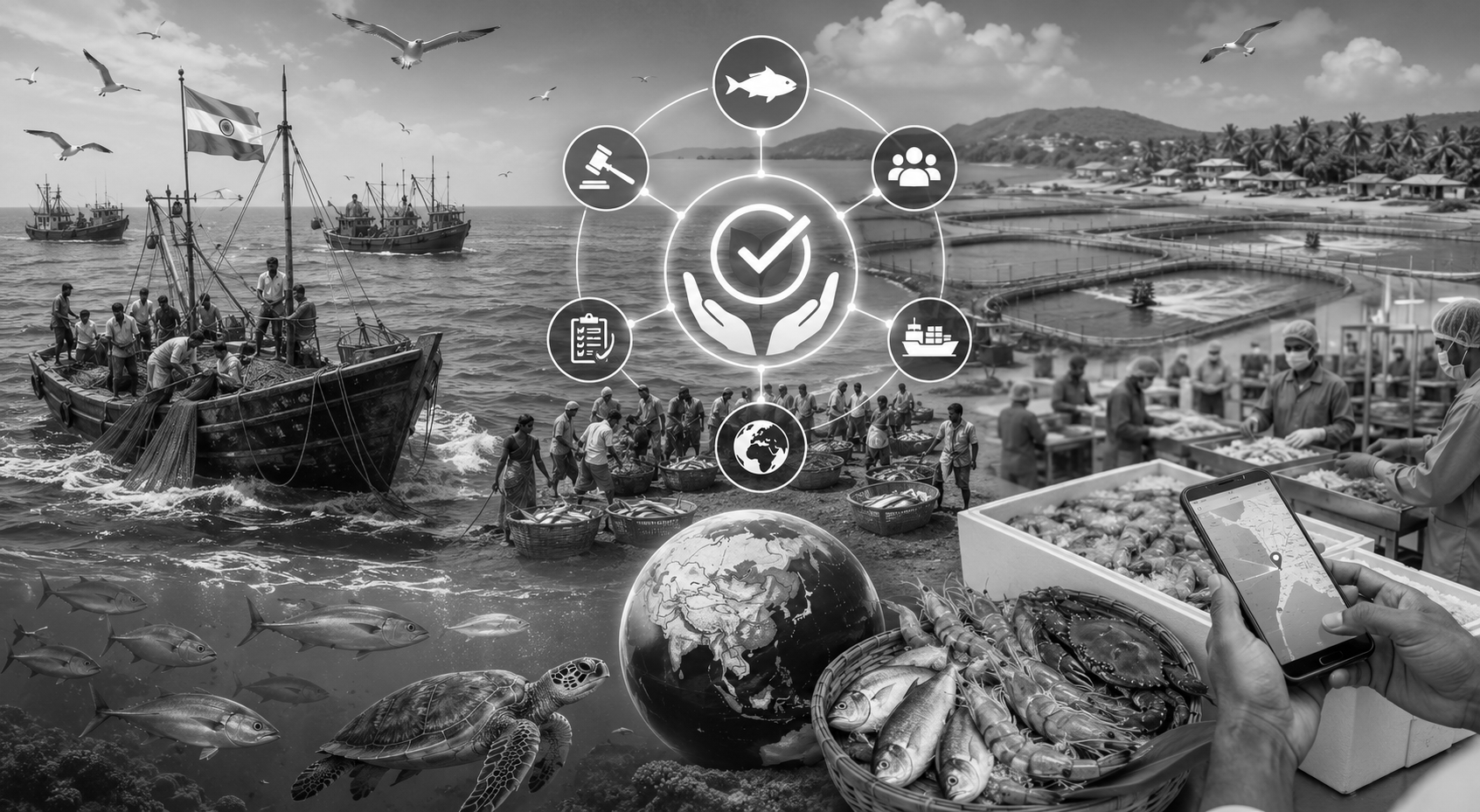
India Unveils Marine Ecolabelling Framework to Boost Fisheries and Seafood Exports
In a significant step towards strengthening sustainable fisheries governance and enhancing the competitiveness of Indian seafood in global markets, the ICAR-Central Marine Fisheries Research Institute (CMFRI) has released a draft of India's National Guidelines for Marine Ecolabelling . The discussion paper proposes a comprehensive framework to regulate seafood sustainability certification programmes, safeguard the interests of fishing communities, and align India's marine fisheries sector with evolving international market requirements.
The initiative comes at a time when global demand for sustainably sourced seafood is rising rapidly and international certification agencies are showing increasing interest in operating in India. While ecolabelling has become an important market-access tool for seafood exporters worldwide, India currently lacks a national mechanism to govern how sustainability certification systems function within the country.
The proposed framework seeks to fill this gap by creating a structured regulatory architecture for marine ecolabelling that reflects India's environmental priorities, fisheries laws, and socio-economic realities.
What is Marine Ecolabelling?
Marine ecolabelling is a certification process that verifies that fish and fishery products originate from sustainable and responsibly managed fisheries . An ecolabel on seafood products assures buyers and consumers that the fish has been harvested in a manner that maintains healthy fish stocks, minimizes environmental impacts, and complies with established management measures.
Globally, seafood buyers, retailers, and consumers are increasingly demanding sustainability-certified products . International certification systems such as the Marine Stewardship Council (MSC), Aquaculture Stewardship Council (ASC), and Friend of the Sea have emerged as influential gatekeepers in premium seafood markets, particularly in Europe, North America, Japan, and other developed economies.
For exporting nations, certification can open doors to high-value markets , improve buyer confidence, strengthen brand reputation, and in some cases command premium prices. However, the costs and compliance requirements associated with certification can also create barriers for small-scale fishing communities .
Bridging the Gap Between Global Standards and Indian Realities
One of the central objectives of the proposed framework is to bridge the growing gap between international sustainability expectations and the realities of India's fisheries sector.
Unlike many developed fishing nations where certification systems evolved around large industrial fleets, India's marine fisheries are dominated by millions of traditional and small-scale fishers operating across diverse coastal ecosystems. Fisheries are often multi-species in nature , involve numerous landing centres, and are governed through a complex mix of central and state regulations.
Recognising these unique characteristics, the draft warns that market-driven certification systems could inadvertently exclude traditional and artisanal fishers who may lack the financial resources, technical expertise, or documentation required to meet certification standards.
To address this challenge, the proposed guidelines call for equitable participation of traditional and small-scale fishing communities in certification processes. The framework seeks to ensure that sustainability certification does not become a privilege reserved for large commercial operators but remains accessible to legitimate stakeholders throughout the fisheries sector.
Potential approaches could include group certification models , cooperative-based certification mechanisms, shared compliance costs, and greater representation of fisher organisations in certification-related decision-making.
A Comprehensive Governance Framework
Beyond ecolabelling itself, the draft outlines a broader governance framework for sustainable fisheries certification in India.
At its core, the framework seeks to ensure that certification programmes operate in alignment with Indian laws and national priorities . Certification bodies would be expected to comply with fisheries regulations, biodiversity conservation laws, seafood safety standards, and coastal aquaculture norms.
The draft also reaffirms India's sovereign rights over marine fisheries resources within its Exclusive Economic Zone (EEZ) , underscoring that all certification activities must function within the country's legal and regulatory framework.
This provision is particularly significant as it establishes India's authority over how sustainability is defined, assessed, and certified within its waters, rather than leaving such decisions solely to private international certification organisations.
Sustainability at the Heart of Certification
The proposed framework places environmental sustainability at the centre of certification efforts.
Fisheries seeking certification would likely be expected to demonstrate responsible management practices, including sustainable harvest levels , healthy fish stocks, ecosystem protection measures, reduction of bycatch, and long-term fisheries management planning.
Such standards are intended to ensure that certification reflects genuine sustainability outcomes rather than merely serving as a marketing tool.
By encouraging science-based fisheries management , the framework aims to contribute to the long-term conservation of marine resources while supporting livelihoods dependent on those resources.
Strengthening Traceability Across the Seafood Value Chain
Another key pillar of the draft is traceability .
The guidelines emphasise the need for stronger tracking systems throughout the seafood supply chain—from the point of capture to processing, export, and final sale.
Improved traceability can help verify species identity, fishing locations, harvesting methods, legality of catches, and sustainability claims. It can also reduce the risk of illegal, unreported, and unregulated (IUU) fishing entering certified supply chains.
Experts note that traceability systems can generate valuable fisheries and market intelligence . Over time, such systems may provide detailed insights into which species generate the highest export earnings, which fisheries are experiencing growing demand, and which products command premium prices in international markets.
For policymakers, exporters, and fisher cooperatives, this data could support more informed decisions regarding resource management, investment priorities, and market development strategies.
Potential Benefits for Fishers and Aquaculture Producers
If implemented effectively, the framework could offer significant benefits to both marine fishers and aquaculture producers .
For fishers, certification could improve access to premium export markets and strengthen relationships with international buyers increasingly focused on sustainability. Improved fisheries management may also help maintain healthy fish stocks and ensure long-term livelihood security.
For shrimp farmers and other aquaculture producers, sustainability certification could enhance export competitiveness, improve market credibility, and encourage adoption of responsible farming practices related to water quality, feed management, and environmental protection.
However, experts caution that compliance costs , auditing requirements, documentation obligations, and monitoring systems could pose challenges, particularly for smaller operators. Ensuring that these groups are not left behind remains one of the most important objectives of the proposed framework.
Exploring an Indigenous Indian Marine Eco-label
Among the most strategic elements of the draft is the possibility of developing an indigenous Indian marine eco-label .
Such a label could complement internationally recognised certification systems while being tailored to India's ecological, social, and economic conditions. An Indian eco-label could potentially reduce certification costs, better accommodate multi-species fisheries, and provide greater recognition to traditional fishing communities.
At the same time, gaining international credibility and acceptance would be essential for such a label to deliver meaningful market benefits.
Supporting India's Blue Economy Vision
The proposed National Guidelines for Marine Ecolabelling represent more than a certification initiative. They form part of a broader effort to strengthen India's Blue Economy by integrating environmental sustainability, economic growth, social inclusion, and marine resource governance.
By linking conservation objectives , export competitiveness , and community welfare , the framework seeks to create a balanced pathway for the future of India's fisheries sector.
If successfully implemented, the guidelines could establish the foundation for a modern, transparent, and inclusive seafood sustainability system—one that protects marine ecosystems, safeguards fisher livelihoods, and positions Indian seafood more competitively in global markets.
This level of highlighting is generally suitable for newspapers, magazines, policy publications, and long-form explainers: it emphasizes the key takeaways without turning the article into a wall of bold text.