
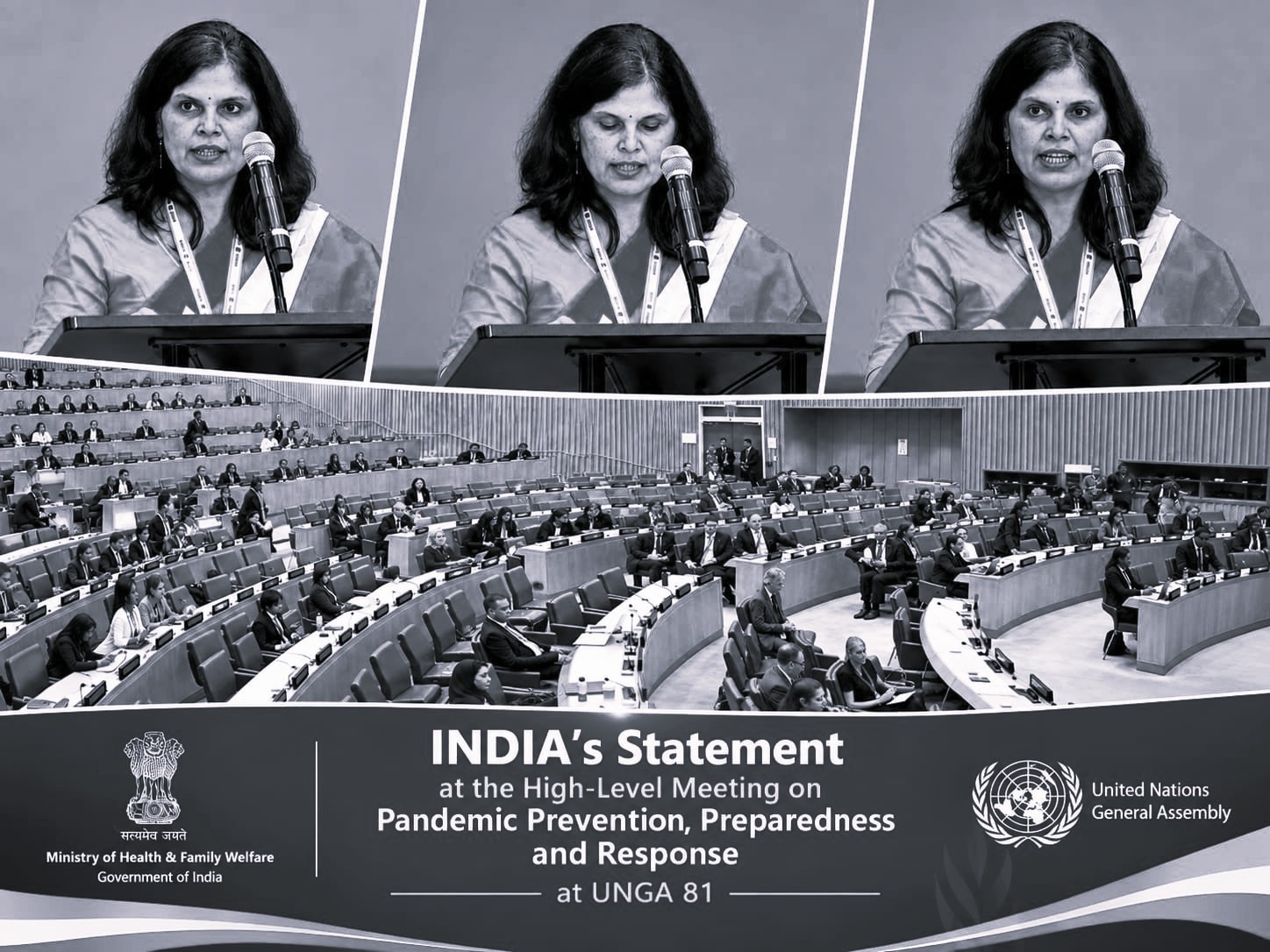
India Urges Global Action to Build Pandemic-Ready Health Systems
India has called for a stronger and more equitable global health security architecture, urging countries to turn the hard lessons of COVID-19 into sustained investment, institutional capacity and resilient healthcare systems rather than treating pandemic preparedness as an emergency exercise that begins only after an outbreak has started.
Representing India at the UN High-Level Meeting on Pandemic Prevention, Preparedness and Response in New York on September 25, Union Health Secretary Punya Salila Srivastava said preparedness must become part of national health systems, development plans and domestic financing, with international assistance complementing national responsibility. She highlighted efforts to expand laboratory networks, emergency coordination, health workforce, stockpiles and clinical-care capacity.
COVID-19 exposed major weaknesses in global healthcare. The UN says 90% of countries reported disruptions to essential health services, while WHO's 2022-23 survey found that almost one-quarter of essential services remained disrupted on average. The pandemic also caused more than 20 million excess deaths between 2020 and 2023 and wiped more than US$10 trillion from the global economy, according to WHO.
India's response has since focused on institutionalising preparedness. Its 100-day pandemic preparedness framework, developed by NITI Aayog, seeks to strengthen governance, surveillance, forecasting, research, manufacturing, infrastructure, skills, community engagement and international cooperation. The framework aims to enable the country to track, test, treat and manage a new outbreak within the first 100 days.
Srivastava also called for digital public infrastructure to be recognised as a global public good, citing its role in surveillance, vaccination, risk communication, supply chains and continuity of healthcare during COVID-19. India's CoWIN experience demonstrated how digital systems could support vaccination at unprecedented scale, while the pandemic also underscored the need for physical healthcare capacity, trained personnel and inclusive digital access.
India further stressed One Health, linking human, animal and environmental health, with the UN noting that around 75% of emerging infectious diseases are zoonotic. The country also highlighted equity, stating that it supplied 300 million vaccine doses to around 100 countries and two UN entities and medical assistance to more than 150 countries during COVID-19.
A key issue remains the Pathogen Access and Benefit-Sharing (PABS) mechanism under the WHO Pandemic Agreement, adopted in May 2025. India said countries contributing pathogens and biological resources should receive timely access to vaccines, diagnostics, therapeutics and technologies developed from them. PABS negotiations are continuing, with the annex expected to be considered by the World Health Assembly in May 2027.
WHO chief Tedros Adhanom Ghebreyesus stressed that completing PABS negotiations is crucial to strengthening the world's ability to respond to future pandemics.
India's message is ultimately that preparedness must move from crisis response to permanent health-system resilience, combining national capacity with global solidarity.