
India-US Indian Ocean Partnership Focuses on Security, Infrastructure and Connectivity
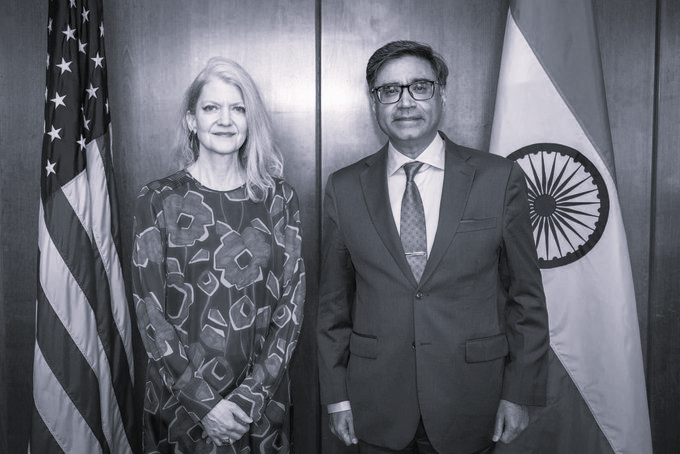
India and the United States are moving to deepen cooperation across the Indian Ocean Region (IOR), with Foreign Secretary Vikram Misri and US Under Secretary of State Allison M. Hooker discussing ways to translate their strategic partnership into practical regional initiatives. During a recent call, the two officials advanced discussions on the India-US Indian Ocean Strategic Venture (IOSV) and explored opportunities for cooperation in maritime security, strategic infrastructure and connectivity, while keeping the priorities of regional partner countries at the centre of the engagement.
The latest conversation follows the launch of the IOSV by Prime Minister Narendra Modi and US President Donald Trump during Modi's Washington visit in February 2025. The initiative was established as a bilateral, whole-of-government forum to promote coordinated investment in economic connectivity and commerce across the Indian Ocean. The US also recognised India's role as a developmental, humanitarian-assistance and net-security provider in the region.
The Indian Ocean is critical to India's economic and security interests, connecting the Middle East, Africa, South Asia and the wider Indo-Pacific. The region faces threats including piracy, armed robbery, trafficking, illegal fishing, irregular migration, gun running, poaching and maritime terrorism. India's Information Fusion Centre–Indian Ocean Region (IFC-IOR), established in Gurugram in 2018, has developed 76 linkages across 28 countries and hosts liaison officers from 15 partner nations, including the US, strengthening maritime information-sharing.
The partnership also builds on extensive India-US naval cooperation and the Quad, which includes Australia and Japan. The Quad's Indo-Pacific Partnership for Maritime Domain Awareness has helped more than two dozen countries access maritime information, while the MAITRI initiative seeks to strengthen regional maritime capacity. The IOSV could add a dedicated bilateral layer to these wider efforts.
Infrastructure and digital connectivity are emerging as equally important priorities. The 2025 leaders' statement welcomed Meta's proposed 50,000-km-plus undersea cable project, connecting five continents, while India committed to supporting cable maintenance, repair and financing through trusted vendors. The two countries have also discussed resilient undersea cables, satellite systems, Open RAN and 6G cooperation.
The initiative complements India's SAGAR and MAHASAGAR visions and programmes such as IOS SAGAR, through which India has expanded naval training, surveillance and capacity-building with Indian Ocean partners. While China's growing maritime and infrastructure presence provides an important strategic backdrop, the IOSV is broader than countering Beijing, focusing on secure sea lanes, resilient infrastructure, regional development and economic connectivity.
If implemented effectively, the IOSV could strengthen maritime-domain awareness, coast-guard capacity, subsea-cable resilience, port connectivity, disaster response and digital infrastructure. For India, it reinforces its role as a leading Indian Ocean power; for the US, it deepens engagement with a key regional partner. For Indian Ocean states, its success will ultimately depend on whether it delivers safer seas, stronger connectivity and tangible economic and security benefits.