
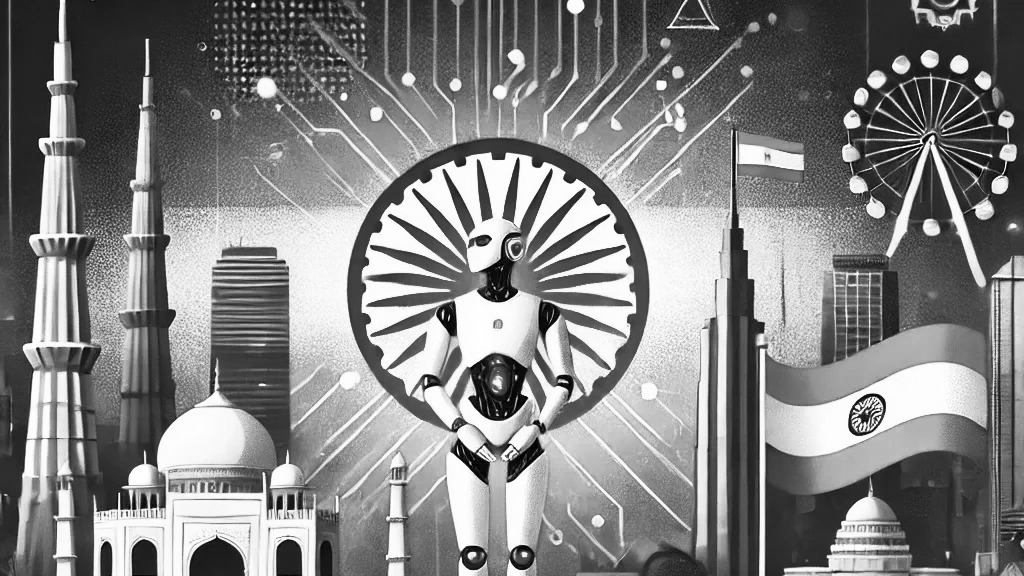
Indian IT and the AI Revolution: Not a Crisis, But a New Springtime!
In the current global technological landscape, Artificial Intelligence (AI) is surging forward like a massive storm. Across the industry, there are deep-seated fears that the Indian IT services sector, a pillar of the national economy for decades, might be swept away by this tectonic shift. As tools like ChatGPT and specialized LLMs (Large Language Models) begin to write complex code in seconds, the average layperson and even seasoned professionals are asking a fundamental question: "Is the era of the software engineer coming to an end?"
However, J.P. Morgan, the prestigious international financial services firm, has effectively dismantled these fears in its latest research report. The firm asserts that AI is not a "monster" destined to consume the IT sector; rather, it is a "formidable engine" capable of propelling the industry to its next stage of evolution.
History Repeats Itself: Old Fears, New Outcomes
The narrative that a new technology will lead to the extinction of the IT sector is an old one. J.P. Morgan’s report astutely points out three historical milestones where the industry faced similar "existential" threats:
The Rise of Offshoring:
When IT work first began shifting to India, critics in the West predicted the death of IT jobs. Instead, the cost efficiencies gained allowed global corporations to undertake significantly more projects, expanding the entire ecosystem.
Enterprise Resource Planning (ERP):
When automation software like SAP and Oracle arrived, many believed humans would no longer be needed for business processes. On the contrary, installing, customizing, and managing these complex systems required millions of new skilled experts.
Cloud Computing:
A decade ago, the shift from physical data centers to the Cloud was expected to render IT service providers obsolete. Instead, "Cloud Migration" became the single largest revenue driver for Indian IT firms over the last ten years.
AI follows this exact pattern. It changes how work is done, but it does not reduce the volume of work. By allowing companies to accomplish more within a limited budget, AI encourages a surge in new, ambitious projects that were previously deemed too expensive or time-consuming.
The "Plumbers" of the Digital World
One of the most striking metaphors in the J.P. Morgan report describes IT companies as the "Plumbers of the Technology World." This is not a derogatory term; it is a recognition of their essential, foundational service.
Consider a modern home: you can buy the most sophisticated pipes, high-tech faucets, and automated water heaters, but having the hardware doesn't mean you have a functional water system. You need a plumber to integrate the parts, ensure there are no leaks, maintain the pressure, and coordinate the entire network.
AI functions similarly. While an AI tool might generate a snippet of code, the real challenge lies in
Integration:
How do you weave that code into a complex, multi-layered banking system or a global insurance platform without breaking existing structures?
Data Security:
How do you ensure that the AI-generated processes don't expose sensitive client information?
Hallucination Management:
How do you correct the "hallucinations" (false information) that AI occasionally produces?
To solve these high-stakes problems, the human intelligence and domain expertise of Indian IT professionals remain indispensable.
New Horizons: Emerging Opportunities for Indian IT
Setting aside the pessimistic view of job losses, the next five years are poised to see a massive revenue influx for IT companies in specific high-growth areas. The landscape of Indian IT is being reshaped by four primary pillars:
Legacy Modernization
For decades, global corporations have relied on archaic software code (Legacy Code) that is difficult to maintain. Historically, migrating this to modern languages was a slow, manual, and prohibitively expensive process. AI has changed math. It can analyze millions of lines of old code in minutes, identifying patterns and translating them into modern frameworks. This efficiency will trigger a massive wave of "modernization projects" that will flow directly to Indian service providers.
AI Agent Development
Every modern business now desires a "Custom AI Agent." Unlike generic chatbots, these agents are integrated into a company’s internal operations—from automated customer support to supply chain logistics. Developing, deploying, and constantly monitoring these specialized agents is a creative process that requires deep business logic, providing a fresh and recurring revenue stream for the IT services sector.
Data Management: The Foundation of AI
AI is only as good as the data it is trained on. Most global corporations currently possess vast oceans of data that are unorganized, redundant, or "dirty." Data Cleaning, Labeling, and Structuring will become the biggest business opportunity of the next half-decade. Indian firms, with their massive scale and expertise in data processing, are perfectly positioned to act as the world’s "data refineries."
AI-Driven Cyber Security
As AI tools become more sophisticated, so do cyber-attacks. We are entering an era of "AI vs. AI" in the digital security space. Building robust, AI-powered defense systems to thwart automated threats is a high-value challenge. Indian IT professionals will transition from traditional security roles to becoming architects of autonomous security frameworks.
Market Volatility: A Temporary Phenomenon
The recent 10% dip in the Nifty IT index was largely driven by "hyper-inflated fear." J.P. Morgan suggests that investors are miscalculating the long-term impact of AI. While global economic factors have caused a temporary slowdown in revenue growth, this has little to do with AI-induced disruption. In the long run, AI will increase productivity, reduce operational costs, and ultimately improve the profit margins of Indian IT firms.
Transformation is the Only Path Forward
Every major technological shift initially creates a climate of fear. However, the Indian IT sector has a proven track record of turning challenges into gold, from the Y2K crisis to the mobile and cloud revolutions. As the J.P. Morgan report reinforces, AI is not an enemy; it is a brilliant "Co-Pilot."
By aggressively upskilling their workforce and embracing these new tools, Indian companies will not only survive but thrive. The reality of the modern era is simple: IT will not be destroyed by AI; rather, IT companies that fail to adopt AI will be the only ones left behind. India stands at the threshold of a new digital spring, ready to lead the world once again.