
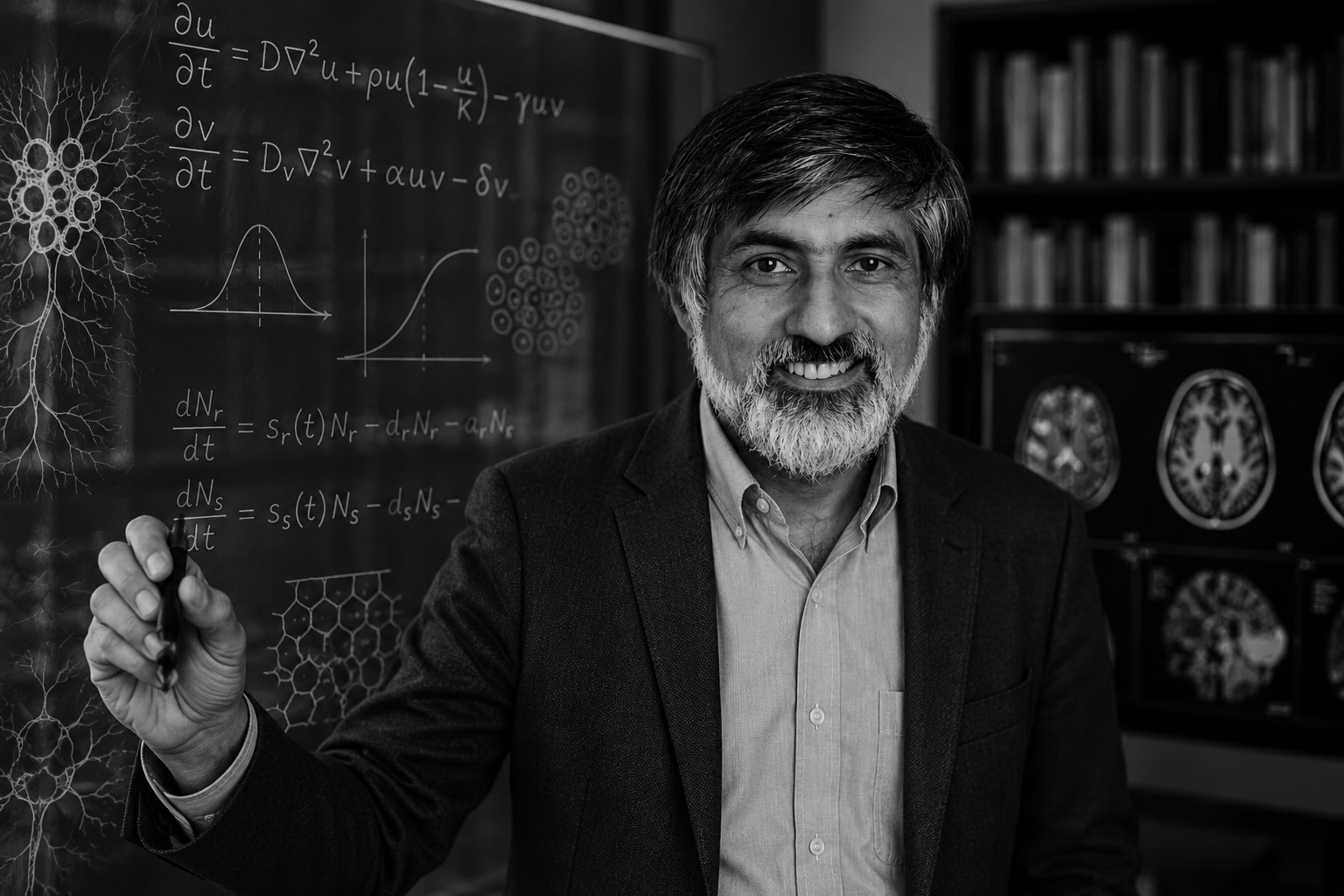
Indian-Origin Oxford Professor Explores Mathematical Cancer Therapy
Indian-origin mathematician Professor Philip Maini is exploring how mathematics can be applied to living systems to uncover biological mechanisms, improve understanding of cancer and potentially guide the development of more effective therapies. His work at the University of Oxford brings together mathematicians, biologists and clinicians to turn complex biological behaviour into mathematical models that can be tested and translated into medical applications.
Maini, Professor of Mathematical Biology at Oxford and Director of the Wolfson Centre for Mathematical Biology, has spent decades modelling tumour growth, angiogenesis, oxygen delivery, cell growth, wound healing and embryonic development. Oxford says his research has produced more than 300 publications. His latest cancer work focuses on adaptive therapy, which treats tumours as evolving ecosystems containing drug-sensitive and drug-resistant cells.
The approach challenges the idea that killing the maximum number of tumour cells is always best. Aggressive treatment can eliminate sensitive cells and allow resistant cells to dominate. Adaptive therapy instead seeks to maintain a controlled population of sensitive cells that can compete with resistant cells, potentially delaying cancer progression. The strategy is being investigated in cancers including prostate cancer, ovarian cancer and BRAF-mutant melanoma.
Recent research has strengthened the potential clinical role of modelling. A 2026 JAMA Oncology study involving Maini analysed 53 prostate-cancer patients from two clinical trials 40 with castrate-sensitive disease and 13 with metastatic castrate-resistant disease. Mathematical biomarkers based on the first treatment cycle showed associations with time to progression and overall survival, while conventional PSA measures did not demonstrate the same predictive value in the metastatic cohort. The researchers said such biomarkers could eventually support personalized adaptive-therapy decisions, although prospective validation remains necessary.
Another 2025 study examined how mathematical models could optimize treatment timing, highlighting the possibility of adapting therapy to individual tumour dynamics rather than using identical schedules for all patients.
Maini, born in Northern Ireland to Punjabi immigrant parents, studied mathematics at Oxford and became director of the Wolfson Centre in 1998 before being appointed Professor of Mathematical Biology in 2005. He is a Fellow of the Royal Society, Fellow of the Academy of Medical Sciences and Foreign Fellow of the Indian National Science Academy. In 2024, he received the Royal Society Sylvester Medal for his contributions to mathematical biology.
His work also has a strong teaching dimension, with Oxford reporting more than 20 million views for his educational videos. The broader promise of his research is to turn mathematical models into a “virtual laboratory”, allowing scientists to test treatment strategies computationally before experimental or clinical validation. Ultimately, Maini's work could help shift cancer care towards treatments tailored not only to the disease, but to how an individual tumour evolves.