
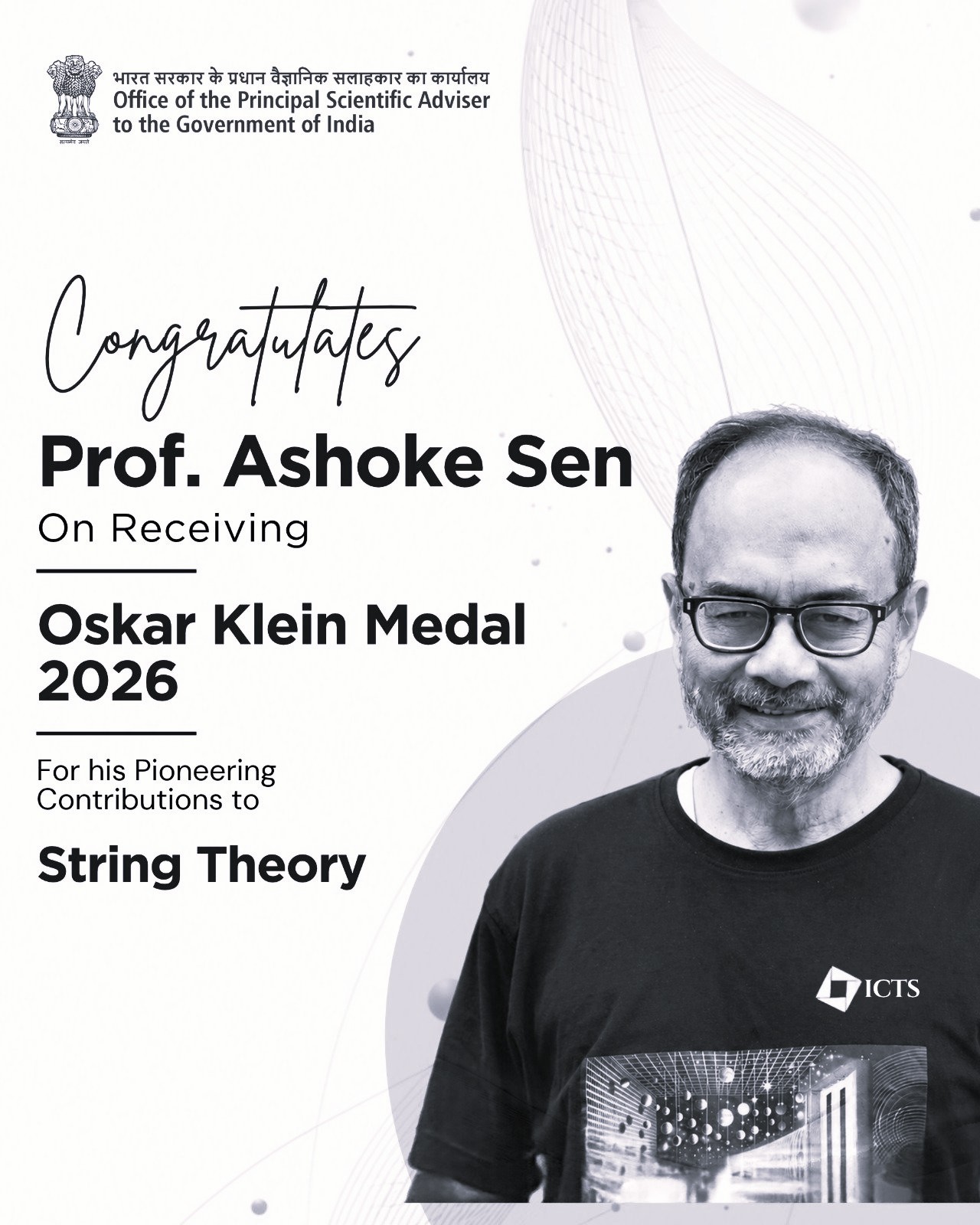
Indian Physicist Ashoke Sen Becomes First Indian to Receive Oskar Klein Medal
Indian theoretical physicist Ashoke Sen has been awarded the 2026 Oskar Klein Medal for his pioneering contributions to string theory, black-hole physics and quantum gravity, becoming the first Indian physicist to receive the prestigious international honour. The recognition places Sen among an eminent group of scientists whose research has transformed understanding of the fundamental laws governing the universe.
Sen is an ICTS-Infosys Madhava Chair Professor at the International Centre for Theoretical Sciences (ICTS), part of the Tata Institute of Fundamental Research (TIFR), Bengaluru. Widely regarded as an architect of modern string theory, his research has helped connect apparently different theoretical frameworks and advance the understanding of black holes and quantum gravity.
Established in 1988 in memory of Swedish theoretical physicist Oskar Klein, the medal is awarded annually by Stockholm University and the Nobel Committee for Physics of the Royal Swedish Academy of Sciences. Sen delivered his memorial lecture, titled “Gravity from Strings and Strings from Gravity,” at the AlbaNova University Centre in Stockholm on October 22, exploring how string theory could provide a consistent quantum description of gravity and address unresolved questions involving black holes.
Sen's major contributions include S-duality, string field theory and the precise counting of black-hole entropy. His research on strong–weak duality helped establish that apparently different string theories could represent different limits of a deeper underlying framework. These contributions earned him the 2012 Breakthrough Prize in Fundamental Physics.
His work on black-hole entropy has helped connect the macroscopic properties of black holes with their underlying quantum states. He also developed the entropy-function formalism and advanced research into tachyon condensation, which examines unstable configurations within string theory. Although a complete, experimentally verified theory of quantum gravity remains elusive, his work has provided important mathematical tools for investigating it.
Sen completed his PhD at the State University of New York at Stony Brook in 1982, joined TIFR in 1988 and subsequently worked at the Harish-Chandra Research Institute in Prayagraj before joining ICTS in Bengaluru. His honours include the Shanti Swarup Bhatnagar Prize (1994), election as a Fellow of the Royal Society (1998), the Padma Shri (2001), the Padma Bhushan (2013), the Infosys Prize (2009) and the Dirac Medal (2014).
Previous Oskar Klein Medal recipients include Reinhard F. Werner (2025), Renata Kallosh (2024), Kip Thorne (2016), Peter Higgs (2009) and Stephen Hawking (2003). Earlier recipients included Chen-Ning Yang, Steven Weinberg and Hans Bethe.
Congratulating Sen, ICTS Director Rajesh Gopakumar praised his contribution to scientific excellence at the institution. Sen's achievement marks a historic milestone for Indian science, recognising decades of theoretical research that have helped shape modern physics.