
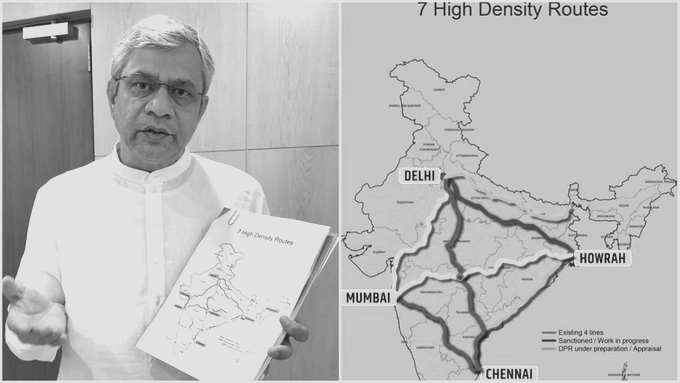
Indian Railways Eyes Four-Tracking of Routes Carrying 41% of Rail Traffic
Indian Railways is moving towards four-laning of seven high-density rail routes spanning nearly 11,000 km to expand passenger and freight capacity across the country, Railway Minister Ashwini Vaishnaw said on Wednesday.
The seven corridors are among the most heavily used sections of the national railway network. According to Vaishnaw, they account for around 41 per cent of total railway traffic, despite covering only about 16 per cent of the overall railway network.
The identified high-density routes connect several of India's major cities and economic centres. They include Delhi-Howrah, Howrah-Chennai, Chennai-Mumbai, Mumbai-Delhi, Delhi-Chennai, Mumbai-Howrah and Delhi-Guwahati.
Vaishnaw said Indian Railways is working towards four-tracking the entire high-density network to accommodate the growing movement of both passengers and goods. The expansion is expected to provide additional capacity on corridors that already handle a significant share of the country's rail traffic.
The minister also highlighted the wider economic and environmental benefits of strengthening the rail network. Greater rail capacity could help reduce transportation costs, improve the movement of freight and passengers, and support more efficient logistics across key regions.
The initiative is part of the government's broader efforts to modernise railway infrastructure and create a network capable of handling rising demand. Increasing the number of tracks on busy corridors is expected to ease congestion and allow more trains to operate without significantly disrupting existing services.
Vaishnaw also emphasised the role of railways in promoting cleaner mobility, as rail transport generally has a lower environmental impact than several other modes of long-distance transportation.
The expansion of these seven corridors is therefore expected to play a crucial role in strengthening India's transport infrastructure while supporting economic activity, passenger mobility and the country's growing freight requirements.