
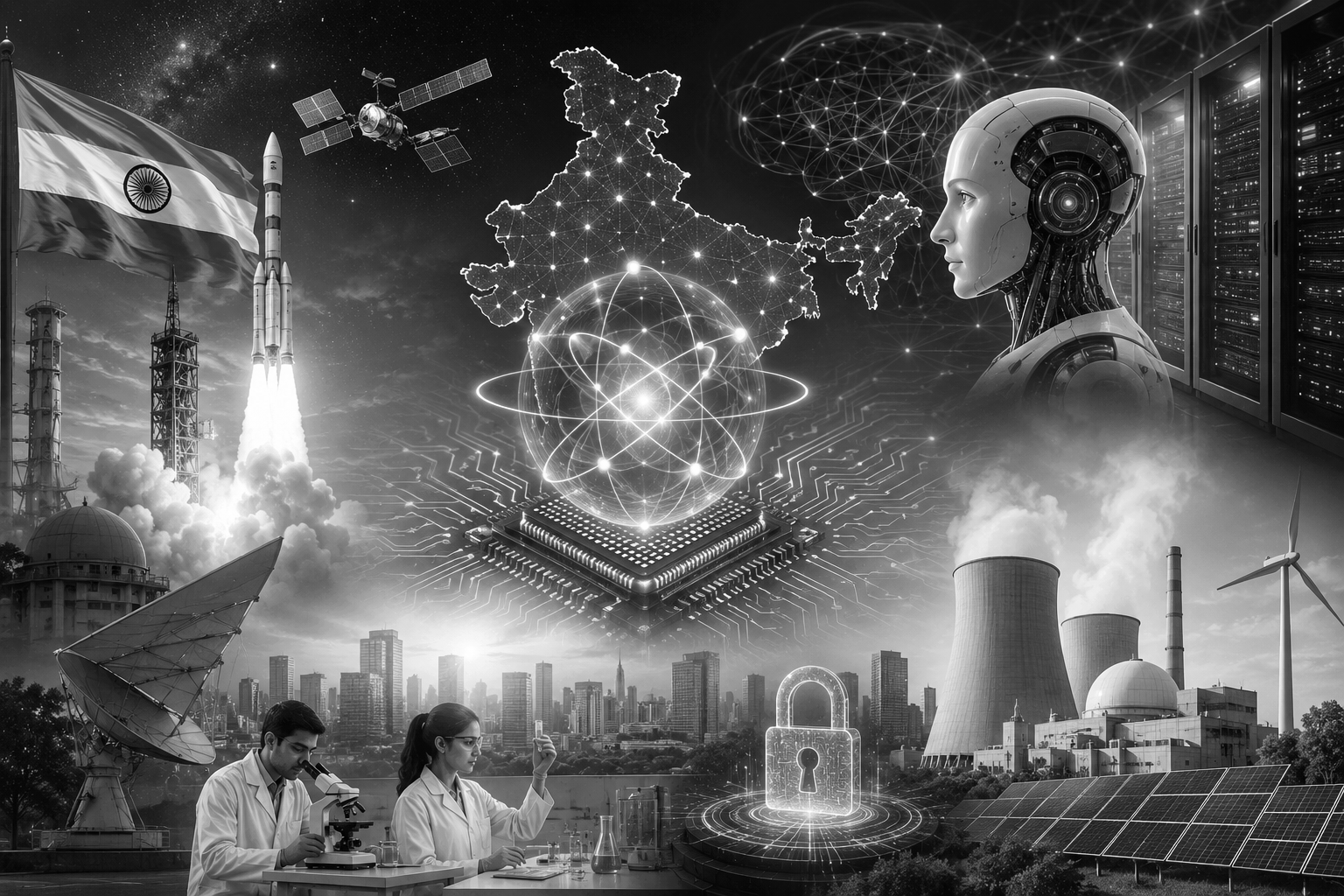
India's Big Bet on AI, Quantum, Space and Nuclear Technologies
As nations compete to dominate the technologies that will define the 21st century, India is accelerating investments in artificial intelligence, quantum computing, space technology and nuclear energy in a bid to secure its place among the world's leading innovation-driven economies.
The global economy is entering a new phase in which technological capability is increasingly becoming the primary measure of national strength. Countries that lead in frontier technologies are expected to enjoy significant advantages in economic growth, industrial competitiveness, defence preparedness and geopolitical influence. Against this backdrop, India has launched a series of initiatives aimed at building long-term capabilities in sectors that are expected to shape the future world order.
Among the most ambitious of these efforts is the National Quantum Mission (NQM) , launched in 2023 with an outlay of approximately ₹6,003.65 crore through 2030-31. The mission seeks to establish India as a global player in quantum technologies, an area that many experts describe as the next major technological revolution after the internet and artificial intelligence.
Quantum technology harnesses the principles of quantum mechanics to perform calculations, process information and transmit data in ways that are impossible for conventional computing systems. Its potential applications span sectors including defence, healthcare, finance, communications, logistics and scientific research.
India's quantum mission focuses on four strategic pillars quantum computing, quantum communication, quantum sensing and metrology, and quantum materials and devices . Research institutions, universities and industry partners are working together through specialised thematic hubs established under the programme. Government officials have indicated that several milestones under the mission have already been achieved ahead of schedule, including progress in quantum-secure communication systems.
The development of quantum communication networks is particularly important because of growing cybersecurity concerns worldwide. Quantum-based communication systems have the potential to provide highly secure transmission of information, making them valuable for defence establishments, financial institutions, government agencies and critical infrastructure operators. Countries including the United States, China, members of the European Union and Japan are investing heavily in this field, making the global quantum race increasingly competitive.
At the same time, artificial intelligence is emerging as one of the most transformative technologies of the modern era. AI is rapidly reshaping industries ranging from manufacturing and agriculture to healthcare, education, banking and governance. Analysts estimate that AI-driven productivity gains could add trillions of dollars to the global economy over the coming decades.
India's approach to AI extends beyond software development. Policymakers are increasingly focusing on the broader ecosystem required to support AI adoption, including high-performance computing infrastructure, advanced semiconductor capabilities, cloud services, data centres, skilled talent and reliable energy supplies.
The demand for computational power is rising sharply as AI models become larger and more sophisticated. This trend is driving investment in digital infrastructure across the world and creating new opportunities for countries capable of building large-scale computing ecosystems. For India, which already possesses one of the world's largest pools of technology professionals, AI represents both an economic opportunity and a strategic necessity.
The country's growing startup ecosystem is expected to play a crucial role in this transformation. India has emerged as one of the world's leading startup destinations, with entrepreneurs increasingly working in areas such as artificial intelligence, deep technology, robotics, space technology and advanced manufacturing. Government-backed initiatives aimed at promoting innovation and entrepreneurship have helped create an environment where research can increasingly be translated into commercial products and services.
Another area witnessing significant change is the space sector . Traditionally dominated by government agencies, India's space ecosystem has undergone a major transformation following policy reforms that opened the sector to greater private participation.
The reforms have led to the emergence of a vibrant private space industry, with startups and companies entering fields such as satellite manufacturing, launch services, Earth observation, geospatial applications and space-based communications. This expansion is expected to strengthen India's position in the rapidly growing global space economy, which is projected to be worth hundreds of billions of dollars in the coming years.
Private participation is also helping accelerate innovation by allowing entrepreneurs and researchers to develop technologies that complement the country's established space programme. Industry experts believe this collaborative model can significantly enhance India's competitiveness in commercial space activities while creating high-skilled employment opportunities.
Supporting these technology ambitions is the growing importance of nuclear energy , which is increasingly being viewed as a critical component of future economic development. The expansion of artificial intelligence, cloud computing, advanced manufacturing and digital services requires vast amounts of reliable electricity. Data centres alone are expected to account for a growing share of global energy consumption as demand for digital services continues to rise.
While renewable energy sources such as solar and wind power remain central to India's clean-energy transition, nuclear energy offers a stable source of low-carbon electricity capable of operating around the clock. As a result, policymakers are increasingly viewing nuclear power as an important complement to renewable energy in meeting the country's future energy needs.
The growing emphasis on frontier technologies is also reshaping India's education and research landscape. The National Education Policy (NEP) 2020 seeks to create a more flexible and multidisciplinary learning environment that encourages innovation, research and entrepreneurship. By reducing barriers between academic disciplines and promoting greater flexibility in higher education, the policy aims to prepare students for careers in emerging fields that may not have existed a decade ago.
Experts argue that technological leadership ultimately depends not only on infrastructure and investment but also on human capital. Developing a workforce capable of conducting advanced research, designing complex technologies and building globally competitive companies will be essential if India is to realise its long-term ambitions.
India's research ecosystem is likewise undergoing significant transformation. The traditional model, in which scientific research was driven primarily by government institutions, is gradually giving way to a more collaborative framework involving universities, private companies, startups and international partners. Such partnerships are increasingly recognised as essential for accelerating innovation and commercialising research outcomes.
The convergence of AI, quantum computing, advanced energy systems and space technologies is expected to create entirely new industries over the coming decades. These technologies are likely to influence everything from healthcare diagnostics and climate modelling to national security, communications and industrial production.
For India, the challenge is not merely to adopt these technologies but to become a creator of them. Success would strengthen economic growth, generate high-value employment, enhance strategic autonomy and improve the country's position in the global knowledge economy.
As competition intensifies among major powers to secure leadership in emerging technologies, the investments being made today in research, education, innovation and infrastructure are expected to determine which nations shape the future. India's expanding focus on AI, quantum technology, space innovation and nuclear energy reflects a recognition that technological capability will increasingly define economic strength and global influence in the decades ahead.
The coming years will reveal how effectively these initiatives translate into scientific breakthroughs, commercial success and strategic advantage. What is already clear, however, is that India is seeking to move beyond being a technology consumer and establish itself as a significant contributor to the technologies that will shape the future world.