
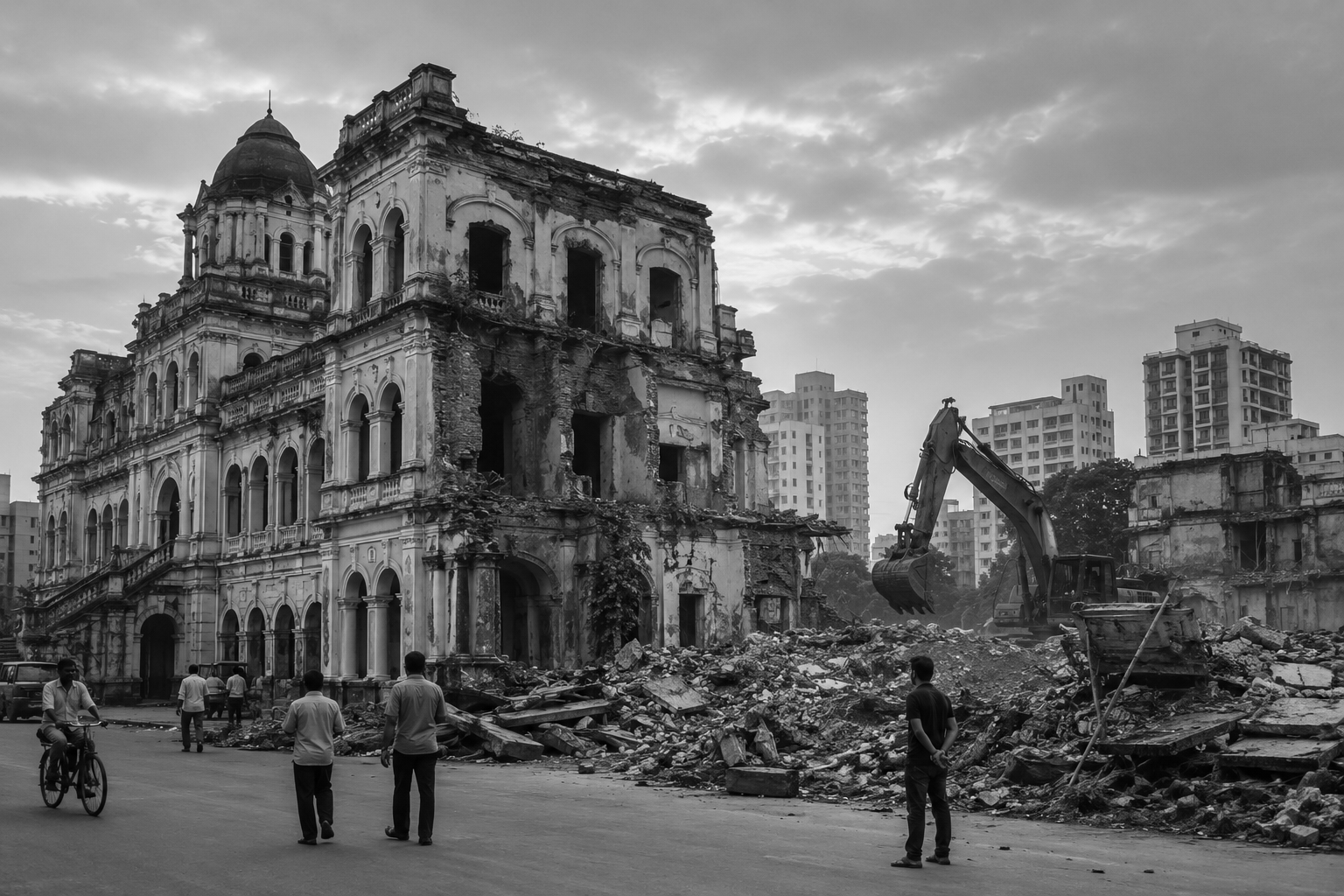
India’s Colonial Heritage at a Crossroads as Demolitions Raise Alarm
India’s colonial-era buildings, from grand district collectorates and courthouses to railway stations, hospitals and administrative complexes, are increasingly finding themselves at the centre of a heritage conservation debate. Even as the country promotes cultural tourism and celebrates its architectural legacy, many historic structures dating back to the British period remain vulnerable to neglect, redevelopment and demolition.
The issue has gained renewed attention after Union Culture and Tourism Minister Gajendra Singh Shekhawat urged states to take the preservation of British-era public infrastructure more seriously. His remarks have highlighted a growing concern among conservationists that many structures built over a century ago continue to fall outside formal heritage protection despite their historical, architectural and tourism significance.
Experts say the problem stems largely from a gap in India’s heritage framework. While the Archaeological Survey of India (ASI) protects 3,686 monuments of national importance, most colonial-era civic buildings are neither centrally protected nor listed as heritage assets by states. When India gained Independence in 1947, many of these buildings were still functioning government offices and were not viewed as heritage properties. Today, despite crossing the 100-year threshold commonly associated with heritage value, thousands remain legally unprotected.
The consequences have become evident in several cities. One of the most prominent examples was the demolition of the Patna Collectorate complex in 2022. The site contained structures linked to both the Dutch and British periods and was considered an important chapter in the region’s administrative history. Historians, architects and heritage groups had campaigned to save the complex, while former Dutch ambassador Alphonsus Stoelinga described it as a shared heritage asset of India and the Netherlands. Despite years of opposition, the landmark was ultimately demolished.
Urbanisation has emerged as another major challenge. Many colonial-era buildings occupy prime land in city centres, making them attractive targets for redevelopment, infrastructure expansion and modern government projects. Conservationists argue that years of neglect often allow authorities to justify demolition on safety grounds rather than invest in costly restoration.
Researchers also point to inadequate funding and a shortage of specialised conservation expertise. However, heritage experts argue that preservation should be viewed as an investment rather than a financial burden. States such as Rajasthan, Gujarat, Karnataka and Madhya Pradesh have successfully converted historic properties into heritage hotels, museums and cultural centres , generating tourism revenue and local employment.
Another challenge lies in the complex legacy of colonial architecture itself. While some see these structures as reminders of foreign rule, historians contend they are equally important records of India’s urban evolution, governance and architectural history.
As India undergoes rapid urban transformation, experts believe the future of its colonial-era heritage will depend on stronger legal protection, better funding and wider adoption of adaptive reuse models . The debate is no longer about whether these buildings possess heritage value, but whether that value will be recognised before more historic landmarks are lost forever.