
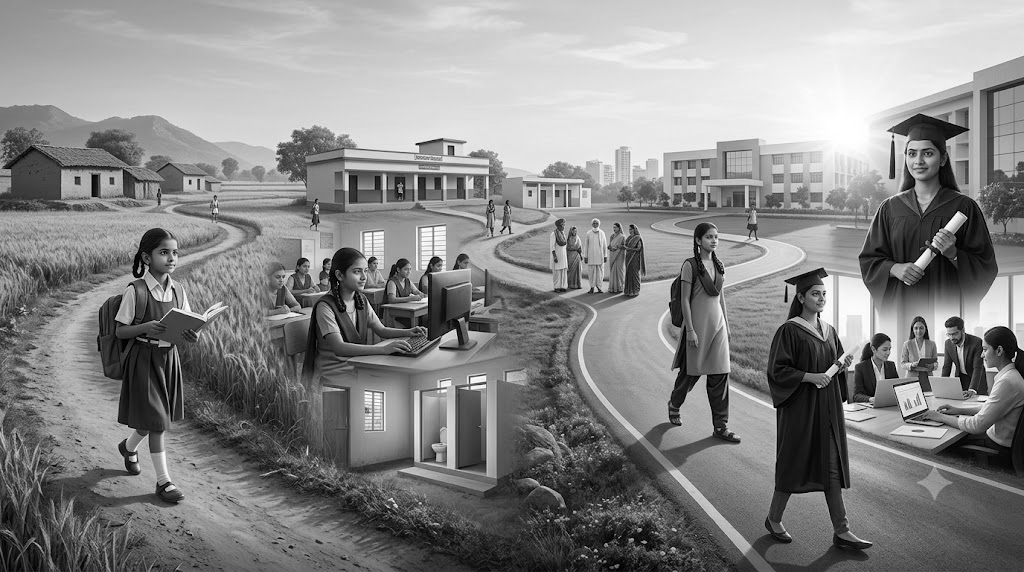
India’s Daughters: How Far Have We Come in the Fight for Equality?
India has made significant progress in improving girls’ access to education, healthcare and social welfare programmes, yet the journey towards gender equality remains incomplete. From rural villages to urban centres, millions of girls continue to face challenges that affect their education, safety, health and future opportunities. Although more girls are entering classrooms, the larger question is whether they can complete their education, pursue higher studies, make independent choices and build secure futures. True equality requires more than access to schools; it demands an environment in which every girl can live with dignity and realise her potential.
Education remains one of the strongest tools for empowering girls, but school enrolment alone does not tell the whole story. Regular attendance, learning outcomes, completion of secondary education and access to higher studies are equally important. Girls from economically disadvantaged families may be expected to help with household responsibilities, care for younger siblings or contribute to family work. In rural areas, long distances to schools, transportation difficulties and the cost of college education can further limit their opportunities. When girls are unable to continue beyond secondary education, their chances of obtaining skilled employment and achieving financial independence may also be reduced.
The scale of the challenge becomes clearer when school infrastructure and learning opportunities are examined together. According to the Ministry of Education’s UDISE+ 2025–26 data, 67.4% of schools in India had internet connectivity, while 98.5% had girls’ toilets. These figures indicate progress in infrastructure, but national averages can conceal inequalities between states, districts and individual schools. A facility may exist on paper without being consistently accessible or adequately maintained. The focus must therefore extend beyond enrolment and infrastructure to the quality of education, availability of teachers, learning support and opportunities for girls to move into higher education.
Child marriage continues to be another major barrier to equality. Early marriage can interrupt education, restrict personal freedom and expose girls to early pregnancy, health complications and economic dependence. UNICEF’s analysis of National Family Health Survey-5 data for 2019–21 found that 23.3% of women aged 20–24 had been married before the age of 18, down from 26.8% in 2015–16. Although the decline indicates progress, the figures also demonstrate that the practice remains a serious concern. Poverty, social pressure, concerns about safety and traditional expectations can influence families to arrange marriages before girls are ready to make independent decisions about their futures.
The Prohibition of Child Marriage Act provides a legal framework to address the practice, but legislation alone cannot eliminate it. Families need greater awareness of the consequences of early marriage, while girls must have access to education, counselling and support services. Local authorities, schools, community organisations and child protection agencies must work together to identify vulnerable children and prevent school dropouts and forced or underage marriages. Keeping girls in education and strengthening the economic security of their families can help address some of the underlying pressures.
Safety is equally important in determining whether girls can exercise their rights. Concerns about harassment, abuse and exploitation can influence decisions about school attendance, higher education and participation in public life. Girls may be discouraged from travelling long distances, attending colleges outside their villages or taking up employment because families fear for their safety. However, restricting girls’ freedom cannot be the solution. Schools and communities must create safer environments through reliable transportation, effective complaint mechanisms, awareness programmes and access to counselling. The Protection of Children from Sexual Offences Act provides legal safeguards against sexual offences involving children, but timely reporting, sensitive handling of complaints and appropriate support for survivors remain essential.
The growing use of digital platforms has introduced additional safety concerns, including cyberbullying, online harassment, exploitation and the misuse of personal photographs. Digital literacy must therefore include information about privacy, responsible online behaviour and ways to report abuse. Girls should be able to use technology for education and personal development without facing intimidation or unnecessary restrictions. Safety measures should empower them to participate confidently in society rather than limit their freedom.
Nutrition and adolescent health also play a crucial role in shaping girls’ futures. Anaemia, inadequate dietary diversity and unequal access to healthcare can affect physical development, concentration and school attendance. Menstrual health remains another concern, particularly where girls lack affordable menstrual products, clean toilets, water and reliable information. School meal programmes, adolescent health services and nutrition awareness initiatives can help address these challenges, but their benefits depend on effective implementation and access to vulnerable communities. Families must also recognise that girls require adequate food, healthcare and emotional support throughout childhood and adolescence.
The digital divide adds another layer to existing inequalities. Internet access can help girls prepare for examinations, learn new skills, access educational resources and explore career opportunities. However, not every girl has a personal smartphone, reliable connectivity or sufficient time to use digital devices. In some households, girls must share devices with family members or face restrictions on internet use. Differences in affordability, digital literacy and access to electricity can further widen the gap between rural and urban students. Providing digital facilities in schools and community centres, alongside practical training and online safety education, can help girls benefit from technology more equally.
Even when girls complete their education, the transition into employment can be difficult. Limited vocational training, inadequate career guidance, social expectations and a shortage of suitable jobs can prevent young women from using their qualifications effectively. Unpaid domestic work and caregiving responsibilities may further restrict their opportunities. Girls need access to higher education, technical skills, internships and employment information that enables them to make informed decisions about their careers. Safe workplaces, fair treatment and opportunities for professional development are equally important. Economic independence allows women to make decisions about their lives and contributes to the wider development of their families and communities.
The challenges faced by rural girls in Andhra Pradesh and Telangana deserve particular attention. Girls from tribal communities and economically disadvantaged households may encounter overlapping barriers involving school access, transportation, household income, digital connectivity and healthcare. UNICEF’s Andhra Pradesh profile, based on NFHS-5 data, reported that 29.3% of women aged 20–24 had been married before the age of 18 during the survey period of 2019–21. This historical figure highlights the importance of continued efforts to prevent child marriage, but it should not be interpreted as a current-year estimate. Comparable and recent state-level data are needed to assess progress in both Andhra Pradesh and Telangana.
The Young Lives longitudinal research programme, which has studied childhood poverty and development in Andhra Pradesh and Telangana, offers a useful perspective on how social and economic inequalities shape young people’s opportunities. Examining school retention, higher education participation, adolescent nutrition, digital access and employment can help reveal where progress remains uneven. Differences between rural and urban areas, as well as the experiences of tribal girls and girls from low-income families, should be considered when evaluating outcomes. Reliable transport, affordable college education, functional school facilities, digital learning resources and accessible child protection services can make a meaningful difference to girls’ everyday lives.
Ultimately, India’s progress towards equality must be measured by the choices available to its daughters. A girl should be able to complete her education without being forced into early marriage, receive adequate nutrition, live safely, access technology and choose a career according to her interests and abilities. Governments, schools, families, employers and communities must work together to turn policies into meaningful improvements. Special attention should be given to girls who face multiple disadvantages, while their experiences and concerns must inform decisions that affect them.
The road to equality cannot end with enrolling girls in schools or introducing welfare schemes. It must lead to better learning, improved health, personal safety, economic independence and the freedom to make decisions about their own lives. India has taken important steps, but sustained efforts are needed to ensure that a girl’s birthplace, family income or gender does not determine the limits of her ambitions. The true measure of progress will be whether every daughter has a fair opportunity to learn, live with dignity, work and shape her own future.