
India’s Defence Transformation: From Rafale and Tejas to AMCA, Drones and Nuclear Deterrence
India’s latest defence procurement push goes far beyond the ₹1.10 lakh crore headline. The Defence Acquisition Council (DAC), chaired by Defence Minister Rajnath Singh on September 7, 2026, accorded Acceptance of Necessity (AoN) to major acquisition proposals for the Army, Navy and Air Force. The package includes CBRN reconnaissance vehicles, high-mobility vehicles, mechanical mine layers, Advanced Light Helicopters, trawl tanks, Sarvatra bridge systems, Arudhra radars, Marine Gas Turbines, ground-based multi-purpose jammers and the Defence Forces Secure Access Card system. About 98% of these procurements are planned from Indian industry, reinforcing the government's push to link military modernisation with domestic manufacturing.
The announcement comes amid an unprecedented expansion of India's defence pipeline. During FY2025-26, the DAC accorded AoN to 55 proposals worth ₹6.73 lakh crore, while 503 capital procurement contracts worth ₹2.28 lakh crore were signed. The distinction is important: an AoN is an in-principle approval, not a completed purchase. Projects must still pass through tendering, evaluation, negotiations, contracting, production and delivery. The latest ₹1.10 lakh crore package therefore adds to a vast pipeline rather than immediately putting equipment worth that amount into service.
Money, Modernisation and the Fighter Gap
The financial backing for this transformation has also expanded. India's FY2026-27 defence allocation is about ₹7.85 lakh crore, including roughly ₹2.19 lakh crore in capital expenditure and ₹1.85 lakh crore for capital acquisition. The higher capital allocation is intended to support fighters, ships, submarines, missiles, drones, surveillance systems and other advanced capabilities.
One of the most urgent requirements is restoring the Indian Air Force's fighter strength. The IAF has been operating at around 29 squadrons against an authorised 42, making the proposed 114 Rafale acquisition particularly significant. The DAC approved the programme in February 2026 as part of a package estimated at about ₹3.6 lakh crore. India already operates 36 Rafales, while the Navy has separately contracted 26 Rafale-M fighters in a deal worth roughly ₹63,000 crore.
The current Rafale programme is increasingly moving beyond a conventional import. France has proposed extensive Indian production, potentially involving around 94 aircraft manufactured locally, while Safran has offered deeper engine-production cooperation. Unlike the earlier multi-aircraft MRFA competition, the present 114-aircraft process has effectively centred on the Rafale and the terms of the government-to-government arrangement.
At the same time, India is expanding its indigenous Tejas Mk-1A programme. A contract for 97 additional aircraft worth more than ₹62,370 crore, following the earlier 83-aircraft order, takes the planned Mk-1A fleet to around 180 aircraft. The programme has more than 64% indigenous content and involves around 105 Indian companies. However, engine-supply constraints have exposed a critical weakness: India can design the fighter but remains dependent on foreign propulsion technology.
That makes the AMCA programme strategically crucial. India's planned fifth-generation fighter is intended to build capabilities in stealth, avionics, sensors, electronic warfare and weapons integration. Tata Advanced Systems, Larsen & Toubro and Bharat Forge/Kalyani-linked groups are among the major private-sector players seeking a role in its development. The parallel competition between Rolls-Royce and Safran for advanced fighter-engine cooperation could ultimately prove as important as the aircraft itself.
Artillery, Drones and the New Battlefield
On land, the Army is undergoing a major artillery transformation. The ATAGS programme covers 307 155mm/52-calibre guns, supported by 327 high-mobility vehicles, while the Army is also pursuing around 300 Dhanush guns and approximately 300 K9 Vajra self-propelled artillery systems. Pinaka rocket systems, precision ammunition and guided rockets add another layer of long-range firepower.
The transformation, however, is not simply about increasing the number of guns. Modern artillery increasingly works as a networked system in which drones and sensors identify targets, digital fire-control systems transmit coordinates and guns or rockets deliver precision strikes. India is similarly expanding its focus on kamikaze drones, counter-drone systems, electronic warfare and advanced surveillance.
The July 2026 DAC package included the Akash Tarang electronic-warfare system, MPATGM, MRSAM, V-SHORADS, tank active-protection systems, kamikaze drones, naval UAVs and high-altitude pseudo-satellite capabilities. The September package's Ground-Based Multi-Purpose Jammer will strengthen India's ability to disrupt adversary radars. The DEFSAC smart-card system, meanwhile, reflects the broader shift towards a secure, digitally connected military.
The Navy and the Indigenous Push
India's Navy provides one of the strongest examples of indigenous defence production. Around 51 major naval ships worth nearly ₹90,000 crore have been under construction, while Indian shipyards have delivered more than 40 indigenous warships and submarines over the past decade. Around 67% of naval capital acquisition contracts over the previous decade went to Indian industry.
The completion of Project 75, with INS Vagsheer becoming the sixth and final Scorpene submarine in January 2025, marked a major milestone. The Project 17A programme continues, with INS Taragiri commissioned in April 2026. The latest DAC approval for Arudhra radars will modernise surveillance at Naval Air Stations, while the proposed indigenous Marine Gas Turbine programme seeks to reduce dependence on foreign propulsion suppliers.
Defence Industry, Nuclear Deterrence and Strategic Autonomy
India's defence-industrial transformation is increasingly based on joint ventures rather than simple imports. The BEL-Safran partnership is pursuing domestic production of HAMMER precision-guided weapons, while Kalyani Strategic Systems and Thales are developing and manufacturing 70mm rocket systems in India. Defence production reached a record ₹1.78 lakh crore in FY2025-26, while exports rose to ₹38,424 crore, with products reaching more than 80 countries. The government aims for ₹3 lakh crore in production and ₹50,000 crore in exports by 2029.
Yet "Made in India" does not automatically mean fully indigenous technology. Rafale can be manufactured locally while remaining French-designed; K9 Vajra is Indian-built but based on a South Korean platform; Tejas is Indian-designed but uses a foreign engine. The real measure of self-reliance is whether India can design, manufacture, repair, replenish and upgrade critical systems independently.
The nuclear dimension is also important, though it should not be confused with the latest DAC package. The CBRN vehicles are designed for detection and protection against chemical, biological, radiological and nuclear threats, not for nuclear-weapons acquisition. India's strategic deterrent rests on its nuclear triad, with ballistic-missile submarines providing a survivable second-strike capability. The commissioning of INS Aridhaman in 2026 and the longer-term S5 programme strengthen this maritime leg. Separately, India's civil nuclear programme targets 100 GW of nuclear power capacity by 2047, from around 8.78 GW today.
The Real Test Is Execution
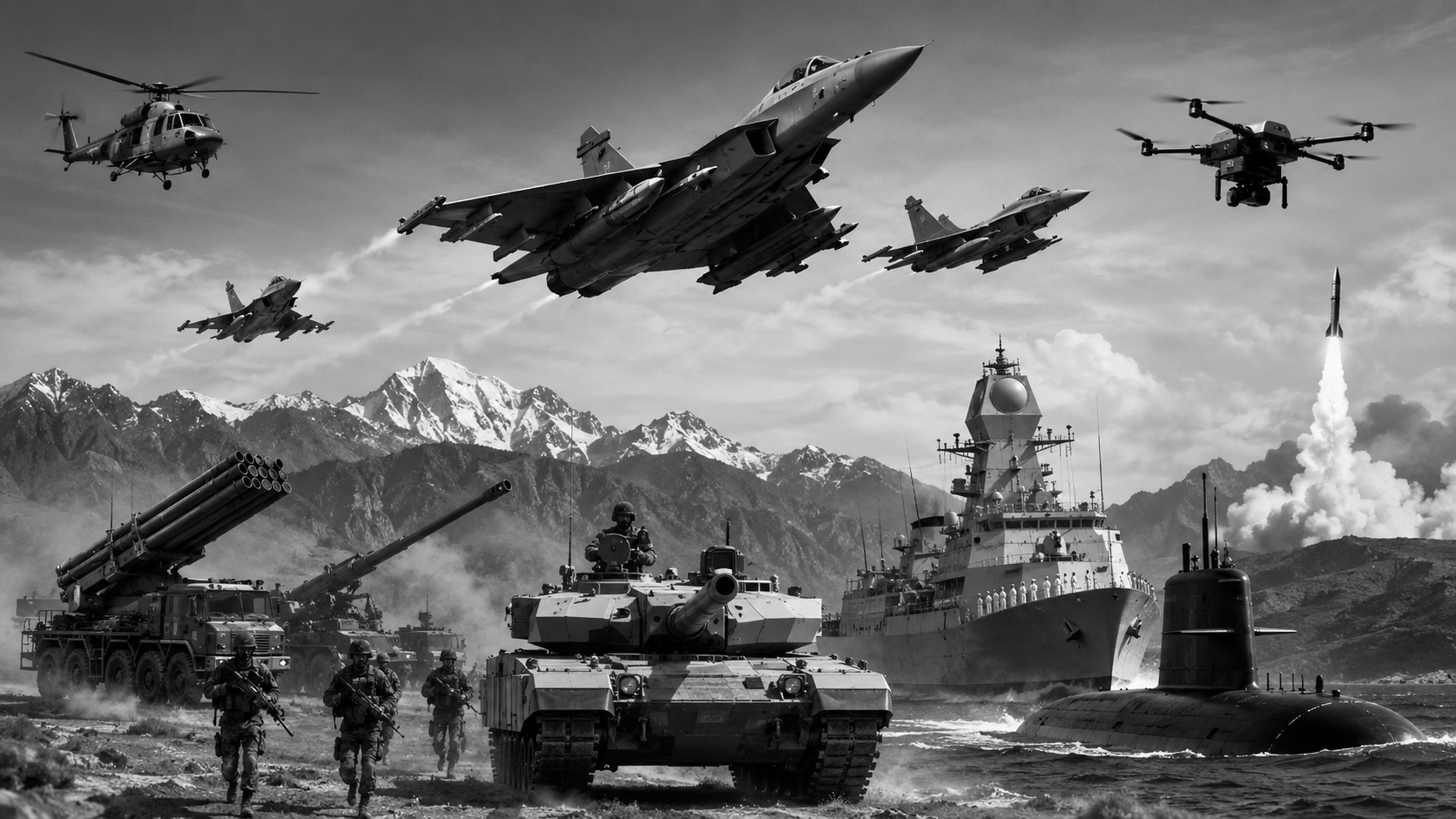
India's defence transformation is now being driven by four forces: restoring military capability, adopting next-generation technology, building domestic industry and strengthening strategic autonomy. The Rafale and Tejas programmes address the immediate and medium-term fighter gap; AMCA represents the long-term aerospace ambition; ATAGS, Dhanush, K9 and Pinaka are reshaping land firepower; drones and electronic warfare are transforming the battlefield; naval construction is expanding maritime power; and the SSBN programme strengthens nuclear deterrence.
But the biggest challenge is execution. An AoN is not a contract, a contract is not production, and production is not induction. Delays, engine shortages, technology-transfer limits, production capacity, skilled manpower, ammunition stocks and lifecycle support can determine whether India's ambitious procurement pipeline becomes real combat power.
The strategic question facing New Delhi is therefore no longer whether India has begun a defence reset. It clearly has. The decisive question is whether its factories, laboratories, shipyards and armed forces can execute that transformation fast enough to keep pace with an increasingly demanding security environment.