
India's Ethanol Mission: Balancing Energy, Economy and Environment
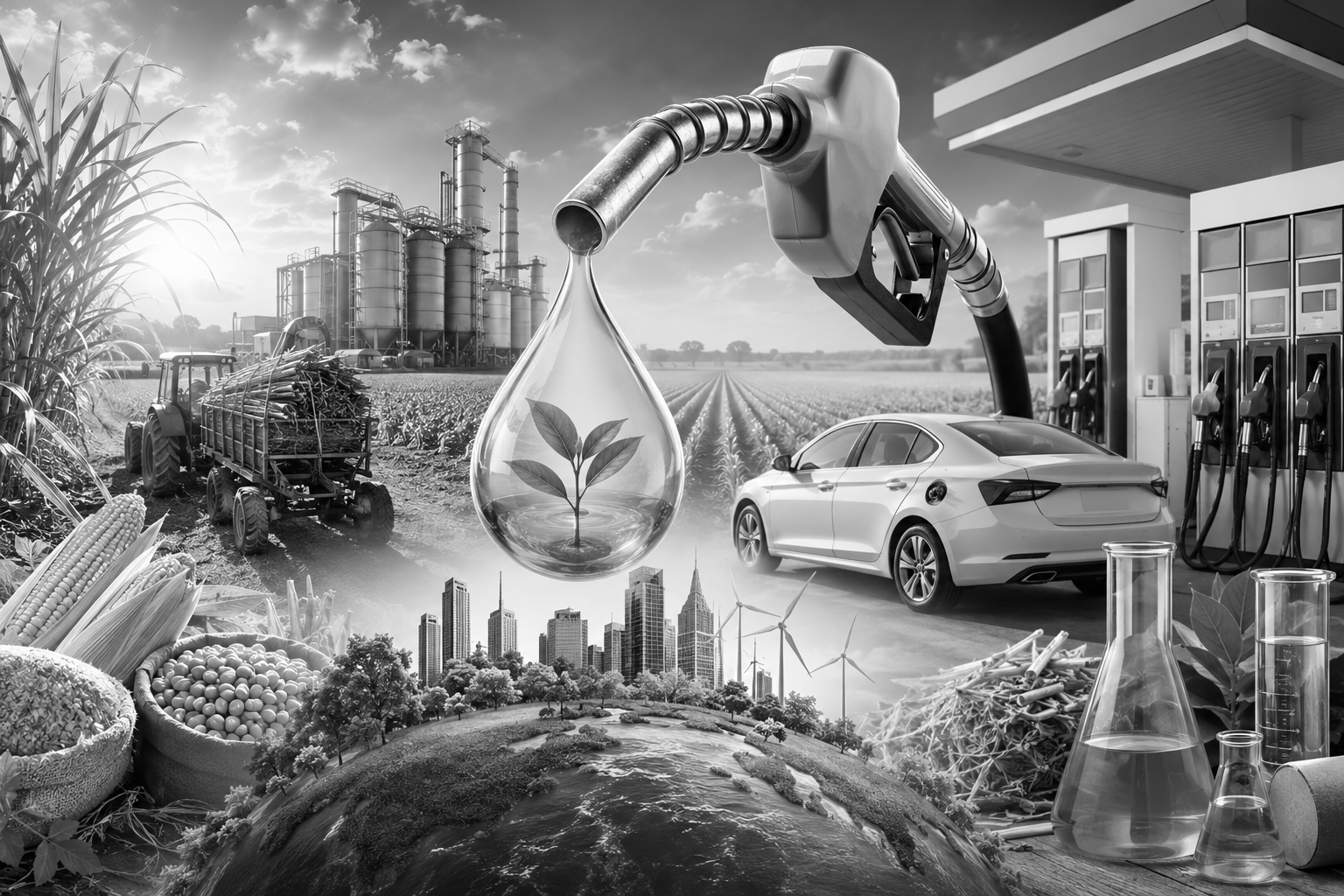
India's ambitious Ethanol Blended Petrol (EBP) Programme has quietly evolved into one of the country's most transformative energy reforms. What began as a modest initiative to blend ethanol with petrol has grown into a nationwide mission connecting farmers, sugar mills, distilleries, automobile manufacturers, oil companies, fuel retailers and consumers in a single economic ecosystem. More than a fuel policy, it is a strategic effort to reduce India's dependence on imported crude oil, strengthen energy security, improve rural incomes, lower carbon emissions and build a globally competitive biofuel industry.
The government's vision extends well beyond increasing ethanol consumption. It aims to make India less vulnerable to volatile global oil prices and geopolitical disruptions while creating new opportunities for the agricultural sector. As India celebrates achieving 20% ethanol blending (E20) five years ahead of its original target, the programme is drawing both praise and scrutiny. Supporters view it as a milestone in India's march towards energy independence, while critics question whether the transition has adequately addressed the concerns of millions of owners of older vehicles.
Why India Is Betting Big on Ethanol
India's dependence on imported crude oil remains one of the biggest drivers behind the ethanol mission. The country imports nearly 88.5% of its crude oil requirements , exposing the economy to fluctuations in international oil prices and disruptions in global supply chains. Every increase in domestic ethanol blending reduces the amount of imported petrol required, thereby lowering foreign exchange outflows and strengthening the country's energy security. Instead of relying entirely on fossil fuels sourced overseas, India is increasingly producing part of its transport fuel from sugarcane juice, B-heavy and C-heavy molasses, maize, damaged food grains and surplus rice held by the Food Corporation of India .
The transformation has been remarkable. Ethanol blending has risen from less than 1.5% in 2013-14 to 20% in 2025-26 , while India's ethanol production capacity has expanded from 421 crore litres in 2014 to nearly 2,000 crore litres . Annual procurement by oil marketing companies has increased from just 38 crore litres to well over 1,200 crore litres , allowing the country to achieve its E20 target well ahead of schedule. According to government estimates, the programme has saved more than ₹1.90 lakh crore in foreign exchange , replaced over 310 lakh metric tonnes of crude oil , reduced nearly 930 lakh metric tonnes of carbon dioxide emissions , and generated over ₹1.60 lakh crore in additional income for farmers since 2014-15. These achievements illustrate why policymakers increasingly describe ethanol not simply as an alternative fuel but as a strategic economic asset.
From Farms to Fuel: A New Rural Economy
Perhaps the most significant yet least discussed aspect of the ethanol programme is the emergence of a "farm-to-fuel economy." Traditionally, crops such as sugarcane and maize were cultivated primarily for sugar production and food consumption. Today, they have become valuable energy resources as well. Farmers are no longer dependent solely on food markets because the energy sector has emerged as another reliable buyer. This has strengthened rural incomes while stimulating investment in sugar mills, distilleries, logistics, engineering equipment and storage infrastructure. In effect, the ethanol programme has become as much an agricultural and industrial policy as it is an environmental initiative.
Engineering the E20 Revolution
The success of the programme has also required a quiet revolution within India's automobile industry. Contrary to popular perception, an E20-compatible vehicle does not require a completely new engine. Instead, manufacturers have redesigned key components of the fuel system to safely accommodate higher ethanol concentrations. Modern vehicles now incorporate corrosion-resistant fuel tanks and fuel lines, ethanol-resistant rubber hoses and seals, upgraded fuel injectors and recalibrated Engine Control Unit (ECU) software. Engineers have also revised ignition timing and combustion mapping while improving cold-start systems to account for ethanol's different combustion characteristics. Although ethanol contains less energy per litre than petrol, it possesses a much higher octane rating, enabling smoother combustion when engines are specifically calibrated for higher ethanol blends.
The Challenge Facing Millions of Existing Vehicles
The transition, however, has raised understandable concerns among millions of owners of older vehicles. Most cars and motorcycles manufactured before widespread E20 adoption were originally designed for E5 or E10 petrol . Many consumers worry that prolonged use of E20 could accelerate wear of rubber hoses and seals, corrode older metallic fuel-system components, create injector deposits or increase maintenance costs. A modest reduction in mileage is also expected because ethanol contains less energy than conventional petrol. The government and leading automobile manufacturers, including Maruti Suzuki , Hero MotoCorp and Toyota , maintain that extensive testing has found no evidence of widespread engine damage in existing vehicles, although they acknowledge that fuel efficiency may decline by around 3 to 3.5% . Nevertheless, many vehicle owners argue that replacing or upgrading a perfectly functional vehicle represents a significant financial burden, and the debate has intensified as E20 has become the standard fuel across the country.
How the Ethanol Mission Is Funded
Another aspect that receives little public attention is how the programme is financed. Unlike flagship welfare schemes, the ethanol mission does not have a single dedicated allocation in the Union Budget. Instead, the government has adopted a public-private financing model that encourages investment through policy support rather than direct expenditure. Interest subvention schemes have helped establish new grain- and molasses-based distilleries, while government-backed procurement policies provide long-term price assurance for ethanol producers. Public sector oil marketing companies— Indian Oil Corporation , Bharat Petroleum Corporation Limited and Hindustan Petroleum Corporation Limited have invested heavily in storage facilities, blending terminals, depot modernisation and logistics infrastructure. Banks have also extended concessional financing to ethanol projects. Rather than constructing every distillery itself, the government has effectively created a stable market that encourages private companies to invest with confidence.
States Leading India's Biofuel Transformation
Although E20 is now a nationwide programme, ethanol production remains concentrated in a handful of states. Uttar Pradesh has emerged as India's undisputed leader because of its extensive sugarcane cultivation, dense network of sugar mills and integrated distillery infrastructure. Maharashtra and Karnataka also contribute significantly through their well-developed sugar industries, while Bihar is rapidly establishing itself as a major grain-based ethanol producer using maize and surplus food grains. Gujarat has focused on developing integrated bio-refineries and expanding biofuel infrastructure. Together, these states form the backbone of India's ethanol supply chain and demonstrate how regional agricultural strengths are shaping the country's new energy economy.
The Roadmap Behind the Rollout
The rollout of E20 was neither sudden nor unplanned. The implementation framework was designed by NITI Aayog in partnership with the Ministry of Petroleum and Natural Gas , the Department of Food and Public Distribution , oil marketing companies, automobile manufacturers and technical institutions. The strategy first expanded ethanol production by permitting multiple feedstocks beyond conventional molasses. It then encouraged investment in new distilleries through concessional financing, upgraded storage and blending infrastructure across oil depots, directed automobile manufacturers to produce E20-compatible vehicles, and gradually expanded fuel availability until E20 reached nearly 90,000 petrol pumps across the country. Having achieved the 20% blending milestone, the government has already notified standards for E22, E25, E27 and E30 , while simultaneously promoting Flex-Fuel Vehicles (FFVs) capable of operating on a much wider range of ethanol blends.
What the World Can Teach India
India's approach differs significantly from that of other countries that have embraced biofuels. Brazil , regarded as the global benchmark, gradually expanded ethanol blending over several decades while encouraging widespread adoption of flex-fuel vehicles capable of running on petrol, E27, E85 or even E100 . This allows consumers to choose the fuel most suitable for their vehicles and prevailing prices. The United States has followed a similarly flexible model. While E10 remains the standard petrol, E15 and E85 are available as optional fuels for compatible vehicles rather than mandatory replacements. India's nationwide transition to E20 has therefore been much faster than those undertaken in either Brazil or the United States, reflecting its determination to reduce oil imports but also highlighting the importance of carefully managing consumer expectations.
Making the Transition Fairer
The international experience also offers valuable lessons for India's next phase. Many experts believe the country could ease the transition by allowing lower ethanol blends to coexist temporarily for older vehicles while accelerating the introduction of Flex-Fuel Vehicles , which automatically adjust to different ethanol concentrations. Others have proposed government-certified retrofit programmes involving ethanol-resistant fuel lines, upgraded seals and ECU recalibration, enabling older vehicles to remain roadworthy without requiring complete replacement. Financial incentives such as scrappage bonuses, tax rebates and concessional vehicle loans could also reduce the burden on consumers while encouraging faster adoption of newer technology.
The Sustainability Question
Looking ahead, one of the most important questions is whether India can sustainably produce enough ethanol to support higher blending targets. Sugarcane, currently the dominant feedstock, is among the most water-intensive crops cultivated in the country. As blending levels rise beyond E20, dependence on sugarcane alone may not be environmentally sustainable. Recognising this challenge, policymakers are increasingly promoting maize-based ethanol as well as second-generation (2G) ethanol produced from agricultural residues such as rice straw, wheat straw and bagasse. These technologies have the potential to reduce pressure on food crops, conserve water and minimise the long-standing global debate over using food resources for fuel production.
Beyond Ethanol: India's Broader Energy Future
India's ethanol mission also represents only one component of a much broader energy transition. Future mobility is expected to be supported by a combination of higher ethanol blends, flex-fuel vehicles, compressed biogas, sustainable aviation fuel, green hydrogen and electric mobility . Rather than competing with electric vehicles, ethanol is increasingly viewed as a bridge fuel that can immediately reduce fossil-fuel dependence while newer zero-emission technologies mature and become more affordable.
The Road Ahead
Ultimately, India's ethanol programme is about far more than blending alcohol with petrol. It is reshaping agriculture, transforming automobile engineering, attracting private investment, reducing dependence on imported crude oil and creating a new biofuel economy that touches nearly every sector of the country. The policy has already demonstrated measurable economic and environmental benefits, but its long-term success will depend on maintaining a careful balance between national energy security and consumer convenience, environmental sustainability and agricultural realities, and ambitious policy goals and technological readiness .
The experiences of Brazil and the United States suggest that the most successful biofuel economies are those that combine strong government support with phased implementation, consumer choice, technological innovation and flexible fuel systems. If India can continue refining its approach while addressing legitimate public concerns, its ethanol revolution could emerge as one of the defining energy success stories of the 21st century.