
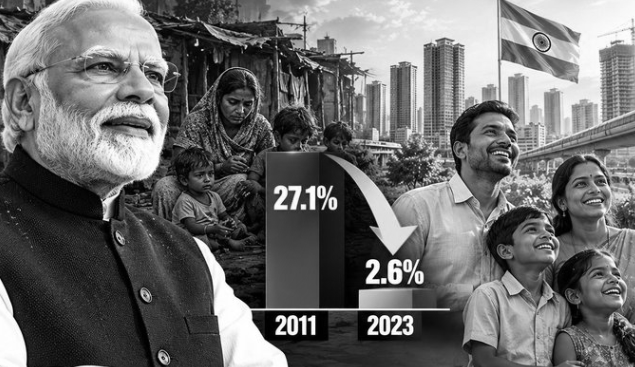
India's Extreme Poverty Falls From 27.1% To 2.6% In 12 Years, 496 Million Lifted Out: World Bank
India has recorded a dramatic decline in poverty over the past 12 years, with the share of people living in extreme poverty falling from 27.1 per cent in 2011 to 2.6 per cent in 2023, according to the World Bank's latest report. The decline means an estimated 496 million people moved out of poverty, marking one of the fastest reductions in poverty recorded globally.
The findings, published in the World Bank's India Poverty and Equity Brief: October 2026, highlight significant improvements in household consumption, employment and access to government welfare support. The report measures extreme poverty using the international poverty line of USD 3 per person per day, based on 2021 purchasing power parity (PPP).
The improvement is also visible at the lower-middle-income poverty threshold of USD 4.20 per day. The proportion of India's population living below this threshold fell from 57.7 per cent in 2011 to 16.1 per cent in 2023, reflecting a substantial improvement in living standards.
The World Bank attributed the progress primarily to strong consumption growth, rising employment, particularly among women, and expanded social transfers, including food subsidies. Between 2017 and 2023, employment increased by approximately 134 million people, nearly twice the growth of the working-age population. A significant share of this increase came from rural women entering paid employment, adding more earning members to households.
Finance Minister Nirmala Sitharaman welcomed the findings, saying the report recognised the impact of rising employment, consumption and expanded welfare support. She credited the government's sustained policy efforts under Prime Minister Narendra Modi with strengthening inclusive growth and creating greater economic opportunities.
The report also highlighted improvements in multidimensional poverty, which considers factors beyond income, including education, health and living standards. According to the Oxford Poverty and Human Development Initiative's Multidimensional Poverty Index, poverty declined from 53.8 per cent in 2005-06 to 16.4 per cent in 2019-21. The World Bank's own multidimensional poverty measure stood at 15.5 per cent in 2022-23.
However, the report cautioned that significant economic disparities remain. The median earnings of the top 10 per cent of workers were around 13 times those of the bottom 10 per cent in 2023, highlighting the continuing gap in income distribution.
Poverty is also increasingly concentrated in specific geographical regions. A contiguous belt stretching from Uttar Pradesh to West Bengal accounts for approximately 57 per cent of India's poor population. Although rural households have recorded substantial improvements and the rural-urban welfare gap has narrowed, poverty remains more prevalent in rural areas, where productivity is lower and access to better-paying non-farm jobs is limited.
The labour market has also shown some areas of concern. While overall employment conditions remained broadly stable, youth unemployment increased from 14.6 per cent in the first quarter of FY2026 to 15.9 per cent in the first quarter of FY2027, particularly among rural young women. Real earnings also remained largely unchanged, with much of the employment growth concentrated in relatively low-productivity activities.
Looking ahead, the World Bank expects poverty reduction to continue, although at a slower pace. The poverty rate under the USD 4.20 threshold is projected to decline from 14.2 per cent in 2026 to 12.1 per cent by 2028.
The report said sustaining this progress will increasingly depend on generating productive employment, improving household incomes and expanding access to better economic opportunities, particularly in states where poverty remains concentrated.