
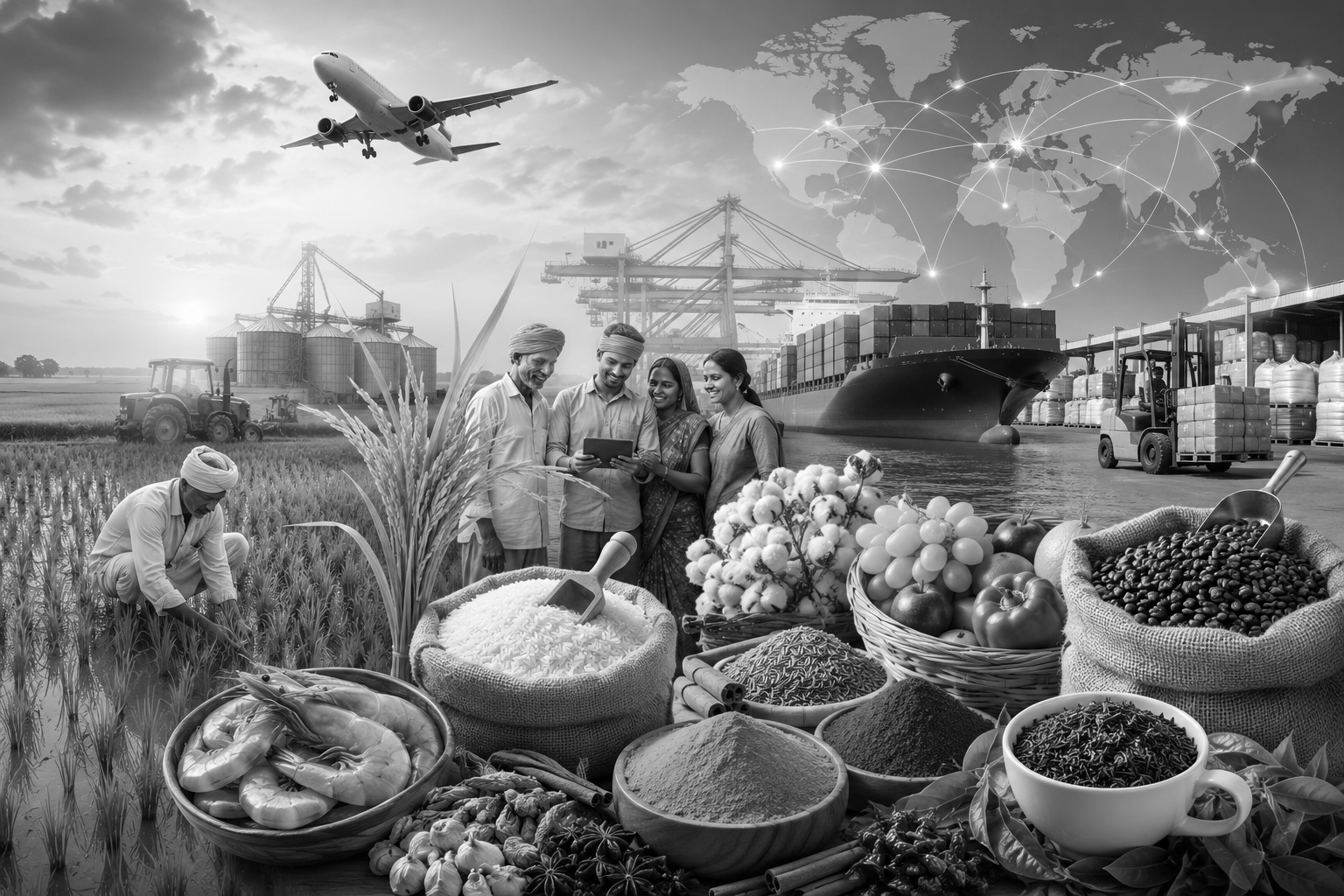
India’s Farm Exports Hit $52.5 Billion: Highlighting Global Reach and MSP Expansion
India's agricultural sector has undergone a remarkable transformation over the past decade, strengthening its position in global food markets and emerging as a leading supplier of rice, spices, seafood, tea, coffee and processed foods. The latest milestone came in FY2025-26 when agricultural exports reached a record USD 52.55 billion , up from USD 32.08 billion in FY2014-15 , reflecting a growth of nearly 64 percent .
The achievement was highlighted by the Department of Commerce during an interaction with exporters in Kochi, where Ujjwal Kumar Ghosh , Joint Secretary, described the performance as a reflection of India's growing competitiveness and resilience in global agricultural trade.
Yet, behind the record export figures lies a larger story. India's agricultural success has unfolded alongside a significant expansion of the Minimum Support Price (MSP) system, creating a unique model that combines export growth with strong government support for farmers.
Record Exports Despite Global Challenges
Agricultural exports grew by 2.8 percent in FY2025-26 from USD 51.12 billion a year earlier, despite global economic uncertainty, geopolitical tensions and increasingly stringent food safety regulations.
The sector has maintained a steady upward trajectory over the past decade, registering an estimated annual growth rate of around 4.5-5 percent . The latest growth has been driven by both traditional export strengths and emerging high-value segments.
Rice Remains King, But Diversification Is Underway
Rice continues to dominate India's agricultural export basket, generating approximately USD 11.5 billion in FY2025-26. India remains the world's largest rice exporter, supported by strong demand for both Basmati and non-Basmati varieties.
The second-largest contributor was the marine sector. Marine exports rose by 13.4 percent , increasing from USD 7.4 billion in FY2024-25 to USD 8.4 billion in FY2025-26. Shrimp and value-added seafood products have emerged as major growth drivers.
Meanwhile, spice exports remained robust at USD 4.3 billion , with products such as chilli, cumin, turmeric, pepper and cardamom continuing to enjoy strong international demand.
Other significant export categories include cotton, sugar, tea, coffee, fruits, vegetables, oilseeds and processed foods. Coffee exports have already crossed USD 1.8 billion , while specialty tea, organic products and nutraceutical ingredients are emerging as promising high-value segments.
The Shift Towards High-Value Agricultural Trade
India's future export strategy is increasingly focused on value addition rather than bulk commodity exports.
Products such as organic foods, millet-based products, processed fruits and vegetables, ready-to-eat meals, nutraceutical ingredients, specialty tea and coffee are expected to drive the next phase of growth. These categories generate higher returns and help integrate farmers into more profitable global value chains.
Free Trade Agreements Open New Doors
The government believes that recently concluded and proposed Free Trade Agreements (FTAs) with the United Kingdom, European Union, Australia, New Zealand, UAE, Oman and EFTA countries will significantly expand export opportunities.
Improved market access is expected to benefit marine products, premium rice varieties, spices, tea, fruits, vegetables, organic foods and processed products. These agreements could help India move from volume-based exports to value-driven exports.
India's Biggest Agricultural Markets
India's agricultural exports are supported by a broad network of international buyers.
The UAE, Saudi Arabia, Bangladesh, United States, China, Vietnam, Malaysia, Iran, United Kingdom and Nepal remain among India's largest agricultural trading partners.
The Gulf region continues to be a crucial market because of its dependence on imported food, while Europe and North America are becoming increasingly important destinations for premium and specialty products.
The Growing Role of Private Sector Champions
India's export success is increasingly supported by private industry.
Companies such as KRBL, LT Foods, Kohinoor Foods, Avanti Feeds, Apex Frozen Foods, Synthite Industries and Tata Consumer Products have played a major role in building global demand for Indian products.
Thousands of exporters, MSMEs, food processors and Farmer Producer Organisations (FPOs) are also helping integrate Indian agriculture into international supply chains and promoting value-added exports.
The MSP Story: Rising Alongside Exports
While exports have expanded significantly, government support through MSP has grown even faster.
The MSP for common paddy has increased from around ₹1,360 per quintal in FY2014-15 to more than ₹2,400 per quintal , while wheat MSP has risen from approximately ₹1,400 to over ₹2,500 per quintal .
Procurement payments have also increased sharply. Government data show that paddy farmers received around ₹16.08 lakh crore through MSP procurement between FY2015 and FY2026, while total MSP-linked payments across major Kharif crops approached ₹19 lakh crore .
The Export-MSP Paradox
One of the most striking aspects of India's agricultural story is that exports and MSP support have grown simultaneously.
Agricultural exports have risen by about 64 percent since FY2015, while MSP payments have expanded by more than three times. This indicates that India has pursued an "exports plus MSP" strategy rather than replacing government support with export-led growth.
While exporters and agribusinesses have benefited from global opportunities, millions of small and marginal farmers continue to depend on MSP-backed procurement systems.
Quality Standards Become the New Battleground
As global markets become more demanding, India's future export growth will depend increasingly on quality, traceability and compliance.
Exporters are facing tighter standards related to pesticide residues, antibiotic traces, sustainability requirements and food safety regulations. Compliance is becoming as important as production in determining export success.
Technology-Driven Reforms Strengthen Exports
The Export Inspection Council (EIC) has become a critical component of India's export ecosystem.
The number of recognized laboratories increased from 22 in FY2014-15 to 89 in FY2025-26 , while approved export establishments rose from 645 to 1,499 . Export certificates accepted by importing countries increased from 60,978 to more than 1.7 lakh during the same period.
Technology-driven initiatives such as the Risk-Based Inspection System (RBIS) and Laboratory Information Management System (LIMS) are helping streamline compliance and improve efficiency.
The Fertilizer Challenge Beneath the Success Story
Despite becoming a major agricultural exporter, India remains dependent on imported fertilizer inputs.
The country consumes more than 60 million tonnes of fertilizers annually , including 20-22 million tonnes of nitrogen , 8-10 million tonnes of phosphorus and 3-4 million tonnes of potash .
While India is largely self-sufficient in urea and NPK production, around 60 percent of DAP requirements are imported , while Muriate of Potash (MOP) remains almost entirely import-dependent. Major suppliers include Russia, Morocco, Saudi Arabia, Oman, Jordan, Canada and Belarus .
The Road Ahead
India's agricultural future appears promising. Rising global food demand, stronger logistics networks, digital agriculture, climate-smart farming, food processing expansion and new FTAs are expected to create fresh growth opportunities.
However, the next phase of agricultural transformation will depend not only on increasing exports but also on improving farmer incomes, ensuring sustainability, strengthening quality standards and reducing dependence on imported inputs.
India has firmly established itself as a major agricultural exporter. The challenge now is ensuring that this global success translates into broader prosperity for millions of farmers while building a more resilient and self-reliant agricultural economy.