
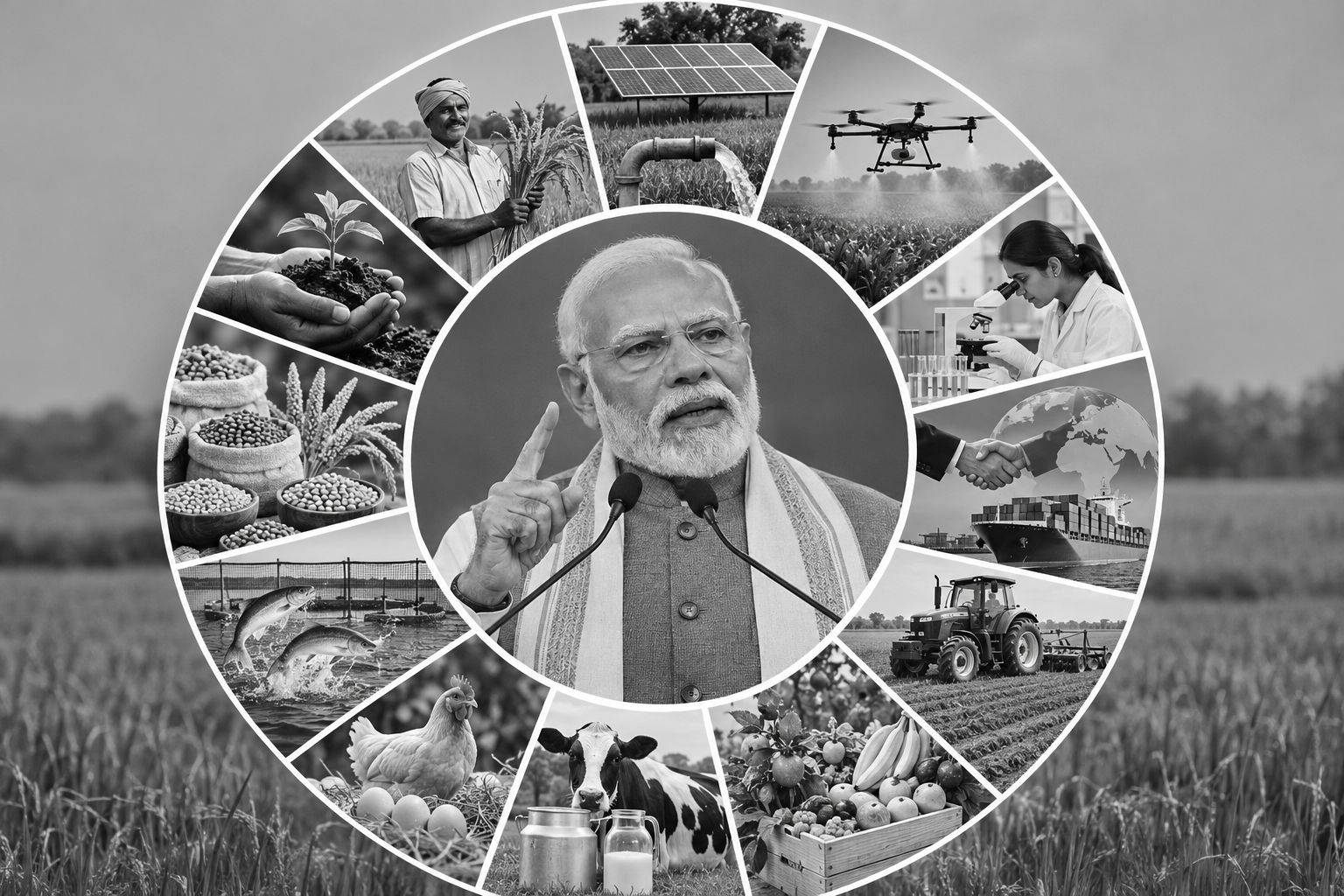
India’s Farm Sector Records 4.45% Growth Over a Decade: PM Modi
Prime Minister Narendra Modi on Thursday said India's agricultural sector had recorded an average annual growth rate of more than 4 per cent during the past decade, marking the first such period since Independence. Addressing the Kisan Tak Bharat Agriculture Conference organised by the India Today Group, he said nearly 50 crore people had escaped poverty over the past 12–13 years, according to a World Bank report cited by him, and stressed that empowering farmers was essential to achieving Viksit Bharat.
Modi highlighted the Centre's agricultural support measures, stating that nearly Rs 16 lakh crore had been spent on fertiliser subsidies in 12 years. A 50-kg DAP bag costing around Rs 5,000 internationally was being supplied to Indian farmers at Rs 1,300. He said the government had absorbed Rs 43 of an approximately Rs 50-per-litre diesel price increase, limiting the rise for consumers to Rs 7, at a monthly cost of about Rs 14,000 crore.
He cited rising production across agriculture and allied sectors, including a 70 per cent increase in milk production, 90 per cent growth in egg production and more than doubling of fish output over a decade. Honey production rose from 80,000 tonnes to 1.5 lakh tonnes, while horticulture output increased from around 280 million tonnes to over 350 million tonnes. India now exports agricultural produce worth more than Rs 4 lakh crore annually, he said.
The Prime Minister also pointed to 12 lakh solar pumps under PM-KUSUM, more than 8,400 soil-testing laboratories, over 7,500 Krishi Vigyan Kendras and 10,000 Farmer Producer Organisations (FPOs). He urged farmers to diversify beyond wheat, rice and sugarcane, adopt natural farming and use solar-powered machinery.
The Economic Survey 2025–26 reported average annual real growth of 4.45 per cent in agriculture and allied activities between FY2015–16 and FY2024–25. Livestock grew by 7.1 per cent and fisheries by 8.8 per cent, compared with 3.5 per cent for crops. Foodgrain production reached 357.73 million tonnes in 2024–25, with the 2025–26 estimate rising to 376.56 million tonnes. Horticulture output increased from 280.70 million tonnes in 2013–14 to 370.74 million tonnes in 2024–25, and was estimated at 377.78 million tonnes for 2025–26.
Agricultural exports rose from USD 32.08 billion in 2014–15 to USD 51.12 billion in 2024–25 and USD 52.55 billion in 2025–26. Rice, marine products and spices were major contributors.
The Minimum Support Price (MSP) debate remains central to farm-income security. The government fixes MSP for 22 crops—14 Kharif, six Rabi and two commercial crops—while sugarcane has a separate Fair and Remunerative Price. For 2026–27, common paddy MSP is Rs 2,441 per quintal, tur Rs 8,450, moong Rs 8,780 and soybean Rs 5,708. For Rabi 2027–28, wheat MSP is Rs 2,610, gram Rs 5,958, masur Rs 7,390 and mustard Rs 6,613.
The government says MSP is fixed at least 1.5 times the A2+FL production cost. Farmer groups demand 1.5 times the broader C2 cost, which includes imputed land rent and interest on fixed capital. Procurement increased to 12,819 lakh metric tonnes during 2014–June 2026, involving Rs 27.80 lakh crore in MSP payments, compared with 6,987 lakh tonnes and Rs 7.41 lakh crore during 2004–14. However, procurement remains concentrated in rice and wheat and selected states; an announced MSP does not guarantee that every farmer receives it from private buyers.
Schemes such as PM-AASHA, including physical procurement, price-deficiency payments and market intervention, seek to widen support. A Rs 448.42-crore procurement allocation was approved for soybean, moong and sunflower in Telangana for 2026–27. The Mission for Aatmanirbharta in Pulses, running from 2025–26 to 2030–31, targets greater domestic production of tur, urad and masur.
Agricultural trade agreements offer export opportunities but also expose producers to import competition and demanding quality standards. Meanwhile, horticulture, dairy, poultry, fisheries, pulses, oilseeds and millets offer diversification opportunities. Drones, AI-based crop advice, precision irrigation, soil sensors, climate-resilient seeds, cold chains and food processing could improve productivity and value realisation. The challenge is ensuring small farmers can access these technologies through FPOs and shared machinery facilities.