
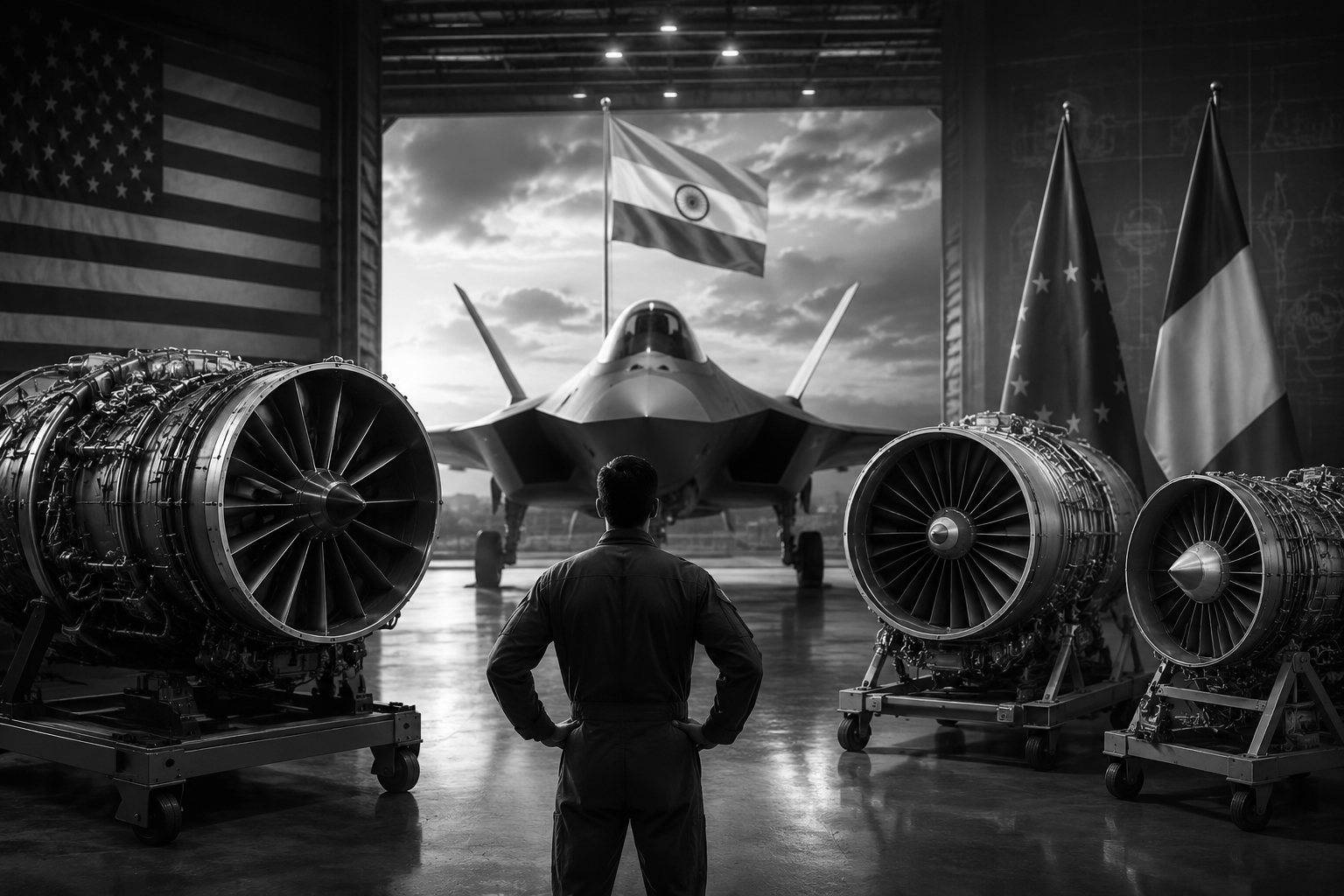
India's Fighter Jet Dream Stalls Over a Tripled GE Engine Bill, Plan B in Motion
Negotiations between India and General Electric over critical engines for the Advanced Medium Combat Aircraft (AMCA) have hit serious turbulence, with a steep rise in pricing for the F414 engines forcing a wider rethink within India’s defence establishment.
Defence sources indicate that the cost of the F414 INS6 variant , originally estimated at around ₹70–80 crore per unit , has now surged beyond ₹200 crore , a jump that is seen as potentially disruptive for a programme already facing delays. The escalation has raised concerns about affordability and long term production planning for India’s next generation stealth fighter.
The F414 engine was intended to power the first batch of AMCA Mk1 aircraft, with Hindustan Aeronautics Limited expected to manufacture the engines in India under a technology transfer arrangement agreed during Prime Minister Narendra Modi’s 2023 visit to Washington. However, officials say progress has been complicated by ongoing disagreements over critical technologies, particularly the so-called “hot section” components such as turbine blades and thermal coatings, which remain closely guarded by GE.
Alongside the pricing issue, GE has also sought nearly $800 million to establish a dedicated assembly line in India, further adding to cost considerations as India evaluates the overall value of the partnership. The combined financial and technological constraints are now being seen as key factors behind the current impasse.
The situation has accelerated India’s exploration of alternative suppliers for the more powerful AMCA Mk2 variant . Britain’s Rolls-Royce has reportedly made a detailed offer for a 120 kN plus engine , promising full technology transfer, joint intellectual property ownership, and a development roadmap that includes a 2030 core test, 2034 first flight, and 2036 production , provided a deal is signed this year.
France’s Safran is also in contention, building on a broader bilateral aerospace cooperation framework. Its proposal is based on an evolved version of the M88 engine that powers the Rafale, and reportedly includes full intellectual property rights for India under a long term co-development agreement valued at around ₹61,000 crore .
The developments have revived comparisons with India’s earlier Kaveri engine programme , developed by the Defence Research and Development Organisation (DRDO) , which struggled to meet thrust requirements and was eventually removed from the Tejas fighter project after prolonged delays and cost overruns.
Officials now believe that while the current dispute with GE complicates near term timelines for AMCA, it could also mark a turning point in India’s search for genuine self reliance in fighter jet propulsion technology , depending on the depth of technology transfer secured from future partners.