
India's Floriculture Industry Blooms as Flower Production Rises 14.45% to 48.82 Lakh Tonnes
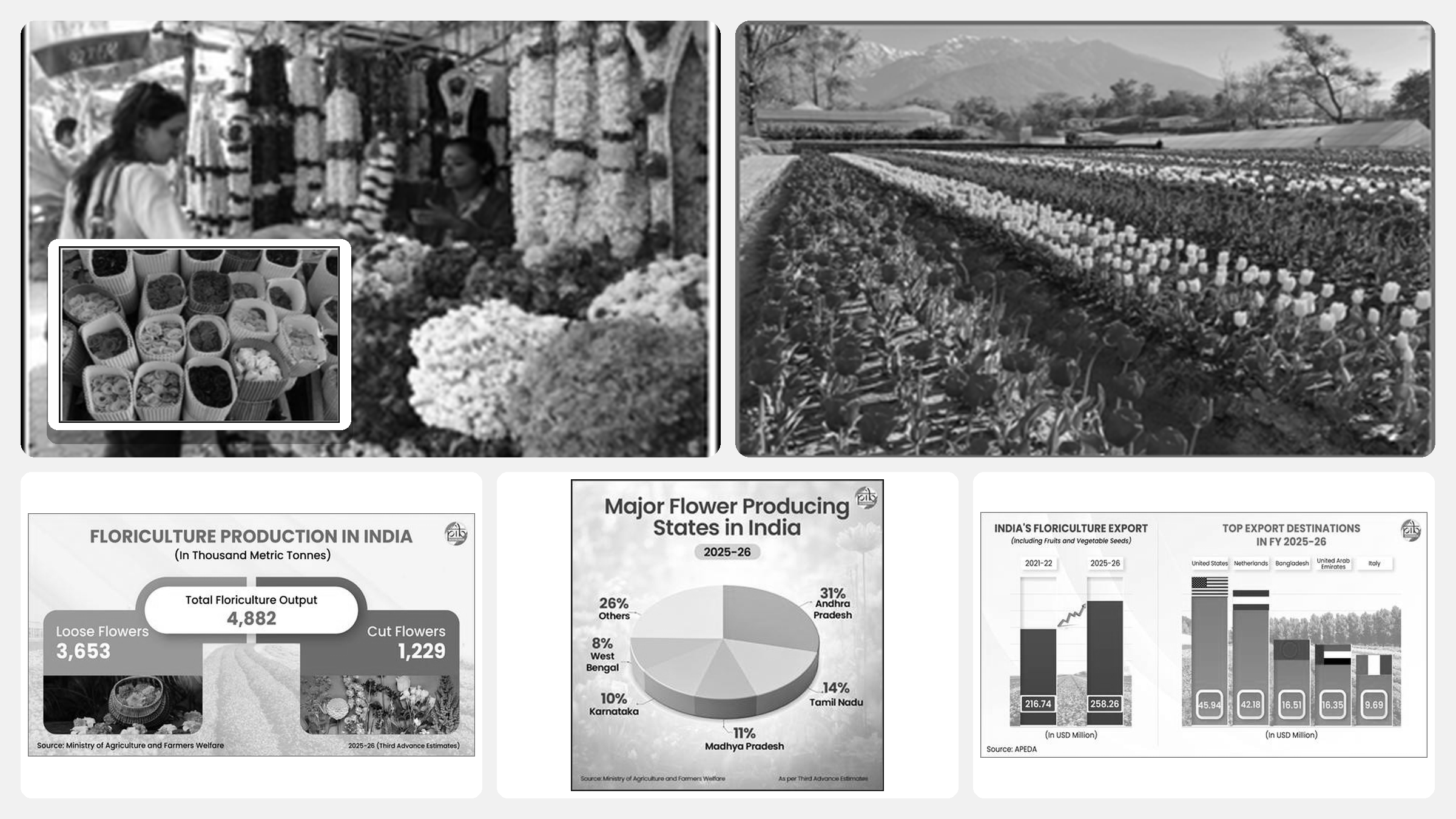
India's floriculture sector is emerging as a high-value agricultural industry, with flower production increasing by 14.45 per cent to 48.82 lakh metric tonnes in 2025–26, supported by expanding cultivation, scientific research, technological advancements and growing domestic and international demand. Andhra Pradesh emerged as the country's largest flower-producing state, accounting for approximately 31 per cent of total production, followed by Tamil Nadu, Madhya Pradesh, Karnataka and West Bengal. With exports expanding and government-backed research initiatives creating new cultivation opportunities, floriculture is increasingly contributing to agricultural diversification, rural employment, entrepreneurship and foreign exchange earnings.
According to the Third Advance Estimates for 2025–26, the area under floriculture reached 4.10 lakh hectares, with loose flowers contributing 36.53 lakh tonnes and cut flowers 12.29 lakh tonnes. Andhra Pradesh accounted for 31 per cent of production, followed by Tamil Nadu (14 per cent), Madhya Pradesh (11 per cent), Karnataka (10 per cent) and West Bengal (8 per cent). Northeastern states collectively contributed around four per cent.
India cultivates roses, marigolds, carnations, chrysanthemums, gerberas, lilies, orchids and anthuriums. Beyond traditional religious and decorative uses, flowers support perfumery, cosmetics, pharmaceuticals, natural dyes, landscaping and ornamental horticulture. Greenhouses, precision irrigation and controlled cultivation are improving quality and year-round availability, particularly for export-oriented flowers.
According to the PIB backgrounder, combined exports of floriculture products, including fruits and vegetable seeds, increased from USD 216.74 million in 2021–22 to USD 258.26 million in 2025–26. The United States led with USD 45.94 million, followed by the Netherlands (USD 42.18 million), Bangladesh (USD 16.51 million), UAE (USD 16.35 million) and Italy (USD 9.69 million). Dried flowers constitute a major export segment.
Government initiatives under MIDH, NABARD and APEDA support protected cultivation, financial assistance, infrastructure and export promotion. The CSIR Floriculture Mission, launched in 2021, brought over 2,208 hectares under cultivation, benefiting 16,220 individuals across 399 clusters in 26 states and Union Territories by December 2025.
Research has enabled tulip cultivation in Palampur and Eustoma production in Odisha. Mizoram exported its first consignment of 1,024 anthurium flowers to Singapore in February 2025. CSIR has also developed indigenous ornamental varieties and post-harvest technologies.
However, inadequate cold storage, transportation and processing facilities remain challenges. Traditional flowers face estimated post-harvest losses of 30–40 per cent. Greater investment in value addition, including essential oils, dried flowers, natural pigments and floral products, could improve farmer incomes and employment opportunities.