
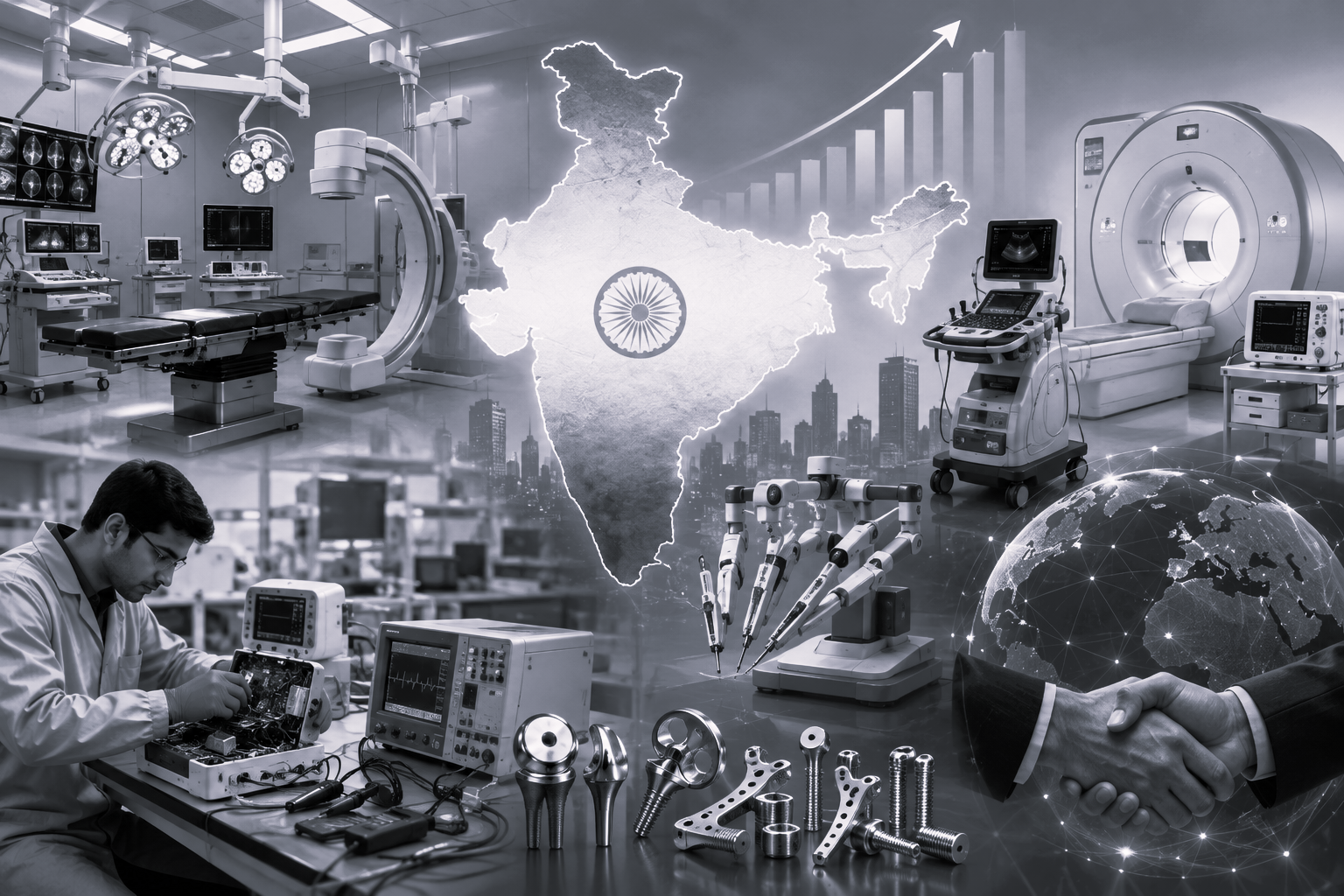
India's Medical Device Industry Set to Hit $250 Billion by 2047
India's medical device industry is poised to become a global MedTech powerhouse with a projected market size of $250 billion by 2047, according to the FICCI-DUA Consulting White Paper titled 'Service and Maintenance of Medical Equipment in Indian Healthcare – Towards a Safe, Reliable and Sustainable Medical Device Maintenance Ecosystem'. The White Paper was released during the inaugural session of the 9th edition of India Medical Device 2026, organised by the Department of Pharmaceuticals in association with FICCI.
The report estimates that the sector, currently valued at around $14 billion, is expected to grow to $30-50 billion by the end of this decade before reaching $250 billion by 2047. The expansion is expected to be driven by rising healthcare demand, increasing adoption of advanced medical technologies, government support for indigenous manufacturing and India's ambition to become a global MedTech hub.
The White Paper notes that the industry has gained momentum through initiatives such as the National Medical Devices Policy 2023, the Production Linked Incentive (PLI) Scheme and the Strengthening of Medical Devices Industry Scheme, which have strengthened domestic manufacturing and improved India's global competitiveness. The ₹3,420-crore PLI Scheme has supported 22 greenfield manufacturing projects and enabled domestic production of 55 categories of advanced medical devices, while exports have increased from $2.9 billion in FY22 to over $4 billion in FY25.
Despite the progress, India continues to rely on imports for nearly 75-80 per cent of high-end medical devices, including MRI and CT scanners, robotic surgical systems and advanced implants. The report says reducing this dependence through innovation, investment and manufacturing will be critical for achieving self-reliance.
It emphasises that the next phase of growth will depend not only on manufacturing but also on building a robust ecosystem for servicing, maintenance, calibration and lifecycle management of medical equipment. Modern healthcare increasingly depends on advanced technologies such as ventilators, dialysis systems, patient monitors and imaging equipment, making regular maintenance essential for patient safety, timely diagnosis and uninterrupted clinical care.
To address these challenges, the White Paper proposes a risk-tiered hybrid maintenance framework based on the Central Drugs Standard Control Organisation (CDSCO) device classification system. It recommends a national certification framework for service engineers, stronger technical training, innovative maintenance models and wider adoption of AI-enabled predictive maintenance, digital monitoring and lifecycle management systems to improve equipment reliability and minimise downtime.
The report concludes that building a safe, reliable and sustainable medical device maintenance ecosystem, alongside continued policy support and technological innovation, will be essential for positioning India as a globally competitive medical device manufacturing and innovation hub by 2047.