
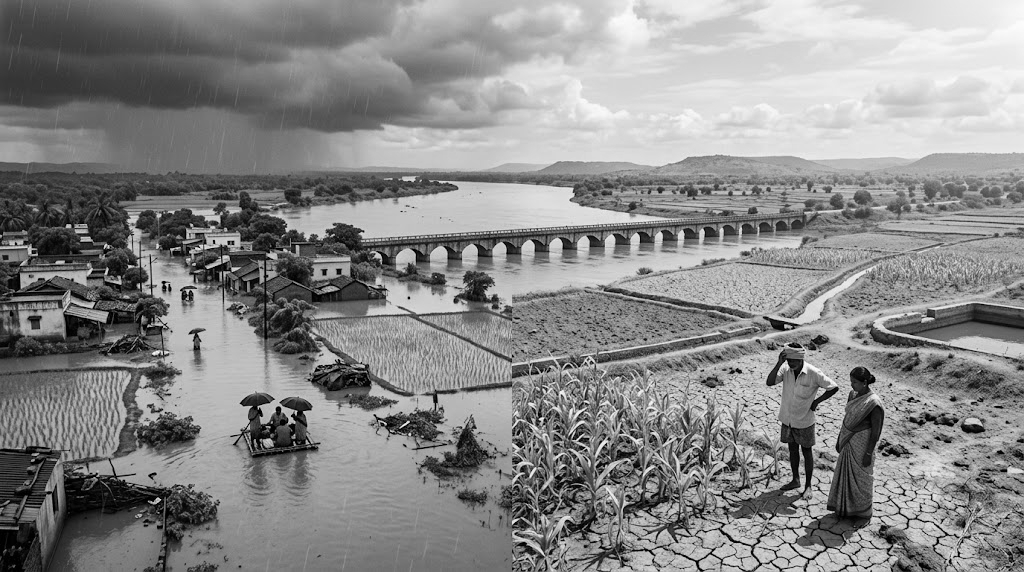
India’s Monsoon Puzzle: Why Are Some Regions Flooded While Others Wait for Rain?
India’s 2026 southwest monsoon is entering its final phase, but it has left behind a weather map marked by sharp contrasts. While some parts of the country have witnessed heavy downpours, flooding and waterlogging, several other regions are still struggling with inadequate rainfall. The contrast raises a larger question: how can the same monsoon bring too much water to one region and too little to another?
The answer lies in one of the defining characteristics of the Indian monsoon: its rainfall is not distributed evenly across the country or even consistently throughout the four-month season. Where, when and how intensely rain falls can matter as much as the overall seasonal total. This year, the national rainfall figure has also concealed significant differences between regions, districts and even neighbouring areas.
According to the India Meteorological Department (IMD), the country had recorded an overall monsoon rainfall deficit of around 15 per cent as of September 13. But the regional numbers were considerably more uneven. The South Peninsular region had a deficit of about 28 per cent, East and Northeast India around 25 per cent, Northwest India around 10 per cent, while Central India was relatively better placed, with rainfall close to the normal range. Around 43 per cent of the country was still classified as rain deficient at that stage.
The state-level picture makes the divide even clearer. Meghalaya had a rainfall deficit of around 59 per cent, while Andhra Pradesh faced a deficit of about 43 per cent and Arunachal Pradesh around 42 per cent. Punjab was around 40 per cent below normal, Bihar about 35 per cent, Karnataka around 29 per cent, Kerala 27 per cent, Tamil Nadu 26 per cent, Rajasthan 25 per cent, Haryana 23 per cent and Telangana around 20 per cent. These numbers show why an all-India rainfall figure cannot fully describe what farmers, communities and water managers are experiencing on the ground.
At the same time, several parts of the country have continued to receive heavy rainfall. The IMD's forecasts around September 19 pointed to rain activity over parts of the northwest, central, eastern, western and southern regions, with states including Gujarat, Maharashtra, Karnataka, Rajasthan, Odisha, West Bengal, Madhya Pradesh, Chhattisgarh, Telangana and Andhra Pradesh seeing varying degrees of rainfall activity. The fact that some of these areas can receive intense rain while remaining seasonally deficient illustrates the complexity of the monsoon.
This is the heart of India's monsoon puzzle. A seasonal rainfall deficit is calculated over several months, while a flood can be created by rainfall concentrated into a few hours or days. A region may remain dry for weeks and then receive an extremely heavy spell that overwhelms rivers, drainage systems and low-lying areas. That downpour can cause severe flooding without necessarily erasing the accumulated rainfall deficit.
The 2026 season itself demonstrates how quickly the national picture can change. The monsoon began over Kerala on June 4, but its progress was initially sluggish. June ended with a rainfall deficit of about 35 per cent. July then brought a sharp improvement, with rainfall close to or slightly above normal, reducing the national shortfall considerably. The improvement did not last. August again recorded below-normal rainfall, while September continued to show a deficit. From June 1 to September 13, cumulative rainfall remained about 14.7 per cent below the long-period average.
That sequence is important because it shows why simply describing the 2026 monsoon as either a "failed" or "normal" monsoon would miss the larger story. It has been an uneven monsoon, with a very weak beginning, a temporary July recovery and renewed rainfall stress later in the season. The distribution has also been more important than the national average.
Central India has emerged as one of the relatively better-performing broad regions. Repeated rainfall activity during the core monsoon months helped parts of the region avoid the sharper deficits seen elsewhere. Yet even here, the situation has not been uniform. District-level variations can be substantial, and a regional average can hide both areas that received excessive rainfall and areas that remained comparatively dry.
The situation has been particularly difficult in South Peninsular India, where the seasonal deficit has been around 28 per cent. Andhra Pradesh, Karnataka, Tamil Nadu, Kerala and Telangana have all recorded significant rainfall shortages. For states where agriculture and water availability depend heavily on the southwest monsoon, prolonged dry spells can have consequences beyond the immediate weather forecast. Reduced soil moisture, lower groundwater recharge and weaker reservoir inflows can affect farming and water availability well beyond the end of the monsoon season.
East and Northeast India present another striking contrast. The broader region has recorded a deficit of around 25 per cent, with Meghalaya, Arunachal Pradesh, Assam and other northeastern states among those facing significant shortages. Yet parts of the Northeast have also experienced episodes of heavy rain and flooding. This demonstrates that flood risk and seasonal rainfall deficit can exist together. River flooding is influenced not only by seasonal rainfall but also by rainfall intensity, upstream catchments, river levels and the timing of individual weather systems.
Northwest India has also experienced a rainfall shortfall, although the regional deficit is smaller than in the south and east. Punjab, Haryana and Rajasthan have recorded significant state-level deficits. The timing of rainfall is especially important in this agricultural belt, where irrigation and monsoon rainfall together support major kharif and subsequent agricultural operations.
For farmers across India, the problem is not simply whether rain arrives but whether it arrives at the right time. A dry spell during a critical crop-growth period can be damaging even if heavy rainfall follows later. Conversely, excessive rain during harvesting can waterlog fields, damage standing crops, erode soil and disrupt the movement of agricultural produce. The uneven monsoon therefore creates different problems for different farming communities at the same time.
The impact is already visible in the rice sector. Industry officials cited by Reuters expect India's rice production to fall by around 10 million tonnes in 2026, or about 6.5 per cent from last year's record output. The decline would be the largest in nearly two decades. Rainfall shortages in important southern and eastern rice-growing areas have reduced yield potential, while the area under summer-sown rice was about four per cent lower than a year earlier as of September 11.
However, India's large rice reserves provide an important cushion. Stocks, including unmilled paddy, were reported at around 59.6 million tonnes on September 1, well above the government's target. That means lower production does not automatically translate into an immediate food shortage or a halt in exports. But weaker output can still put pressure on domestic prices and farm incomes, particularly if rainfall problems extend into the next agricultural cycle.
Reservoirs add another dimension to the monsoon story. Heavy rain falling in one river basin cannot automatically compensate for inadequate rainfall elsewhere. Reservoir storage depends on the location and intensity of rainfall, catchment inflows, river flows, existing storage and water demand. A city can experience flooding from intense rain while a reservoir serving another agricultural area remains below its desired level.
The 2026 monsoon has also unfolded against the backdrop of El Niño, which strengthened during the season. The IMD had earlier warned of below-normal rainfall risks associated with the climate pattern. El Niño can influence India's monsoon circulation, but it does not determine the weather in every district or explain every individual flood or dry spell. Local atmospheric systems, low-pressure areas and other ocean-atmosphere interactions also play major roles.
That brings the climate-change question into focus. Scientists are increasingly examining whether a warmer atmosphere is contributing to more intense rainfall events and longer or more pronounced dry spells. A warmer atmosphere can hold more moisture, potentially increasing the intensity of rainfall when suitable weather systems develop. But one extreme rainfall event cannot by itself be attributed to climate change. The more meaningful question is whether the frequency, intensity and distribution of such extremes are changing over a much longer period.
For India, this distinction is becoming increasingly important. Infrastructure, reservoirs, drainage systems and agricultural planning have traditionally been based heavily on historical rainfall patterns. If rainfall becomes more concentrated into shorter periods, existing systems may face simultaneous drought and flood pressures too little water during one part of the season and too much arriving too quickly during another.
Urban India is particularly exposed. Rapid construction, shrinking natural drainage channels, encroachment on water bodies and inadequate storm-water systems can amplify the effects of intense rainfall. A city can therefore face severe waterlogging after a short spell of rain even if the wider region has experienced a rainfall deficit for the season.
As the southwest monsoon begins its retreat, the remaining weeks will be closely watched. The IMD indicated that conditions were becoming favourable for the monsoon to begin withdrawing from West Rajasthan around September 19, slightly later than its normal withdrawal date of September 17. But withdrawal from northwest India does not mean that rainfall immediately ends across the country. Rain was still forecast over parts of eastern, central and southern India.
The IMD forecast rainfall activity over areas including Tamil Nadu, Puducherry, coastal Andhra Pradesh, Telangana, Madhya Pradesh, Chhattisgarh, Vidarbha, West Bengal, Sikkim and Odisha around the final phase of the season. This means deficit-hit areas may still receive some late-season rainfall, although the benefits will depend on the intensity and distribution of that rain.
For farmers, however, the window is narrowing. Late-season rain can improve soil moisture and provide some relief, but it may not completely reverse the impact of months of deficient rainfall. In areas that have already received excessive rain, another intense spell could instead create additional crop damage and flooding.
The 2026 monsoon therefore offers a lesson that goes beyond this year's rainfall numbers. India's water problem is increasingly about distribution, timing and intensity not simply about the total amount of rain received. A farmer in Andhra Pradesh may be waiting for rain while another farmer elsewhere is trying to protect crops from excess water. A reservoir may be short of inflows even as a nearby city battles flooding.
The real question facing India is therefore not merely whether the country gets enough rain. It is whether rainfall arrives in the right places, at the right time and at an intensity that can be safely absorbed and productively used.
As the monsoon retreats, that unevenness will remain its most important story. The 2026 season has shown that floods and rainfall deficits are not necessarily opposing outcomes. They can be two sides of the same changing monsoon one that is increasingly defined not by how much rain falls across India as a whole, but by where it falls, when it falls and what happens when it arrives.