
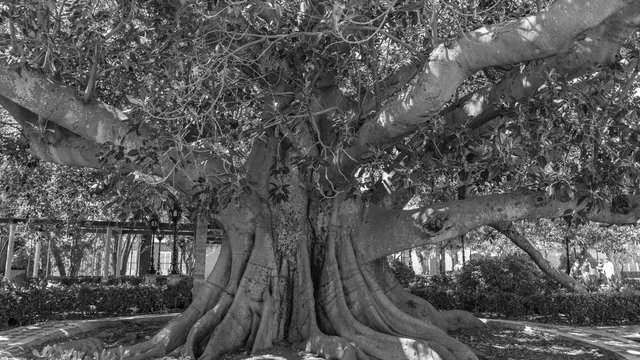
India's Oldest Scientifically Dated Banyan Found in Bihar, Estimated at 700 Years
In a remarkable scientific breakthrough, researchers have confirmed that a majestic banyan tree in Munger, Bihar , is approximately 700 years old , making it the oldest accurately and scientifically dated banyan tree in India . The discovery not only settles a long standing historical mystery but also marks a major milestone in the scientific study and conservation of ancient tropical trees.
For generations, the age of banyan trees was largely based on folklore, historical accounts, or local beliefs because these trees do not produce clear annual growth rings like many temperate species. This made conventional tree dating methods ineffective. To overcome this challenge, scientists developed an innovative approach using high precision radiocarbon dating , providing reliable scientific evidence instead of estimates based on tradition.
The research was led by Dr. Trina Bose of the Birbal Sahni Institute of Palaeosciences, Lucknow , along with Dr. Mayank Shekhar and Dr. Akhilesh K. Yadava . Invited by the Bihar Forest Department to determine the tree's age, the team extracted alpha cellulose , the most stable component of plant cell walls, from carefully collected wood samples. These samples were then analysed using Accelerator Mass Spectrometry (AMS) radiocarbon dating and calibrated with advanced scientific software, enabling the researchers to accurately estimate the tree's age.
The findings have also rewritten a part of Bihar's local history. Earlier beliefs suggested that the banyan was planted alongside the historic Burra Bunglow , a structure believed to be around 300 to 350 years old . However, the scientific evidence reveals that the banyan predates the building by several centuries, indicating that it is likely a surviving remnant of an ancient natural forest that once covered the region. In fact, the tree may have witnessed the construction of the historic building itself.
Published in the international journal Quaternary Research , the study introduces a reliable scientific method for dating heritage trees across tropical regions. Experts believe this technique will help governments, forest departments, and conservation agencies identify and protect ecologically and culturally significant trees with greater accuracy.
Beyond its historical importance, the breakthrough is expected to strengthen heritage conservation , biodiversity protection , environmental education, and climate related research. The methodology can also be applied to ancient tropical trees in other parts of the world, opening new possibilities for understanding natural history through science.
Standing tall for nearly seven centuries, the Munger banyan is no longer just a symbol of tradition. It is now a scientifically verified witness to India's past, bridging history, culture, and modern research in one extraordinary living monument.