
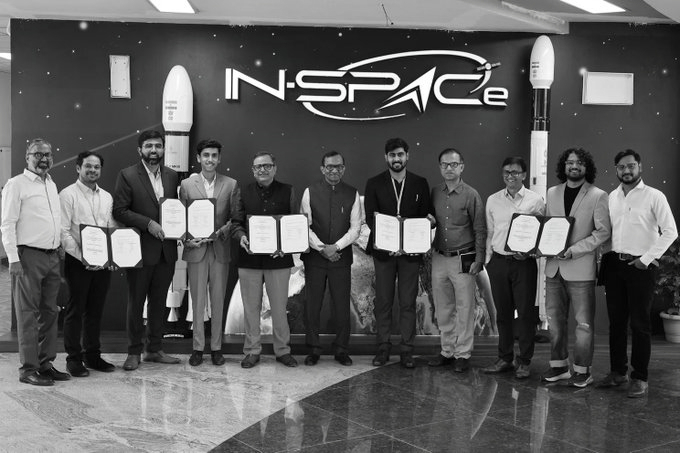
India's Private Space Sector Gets ₹67 Crore Boost as Four Companies Secure IN-SPACe Funding
India's private space industry has received a boost, with the Indian National Space Promotion and Authorisation Centre (IN-SPACe) offering ₹67.15 crore to four Indian companies to develop indigenous technologies for satellites, propulsion systems, navigation and in-orbit servicing.
The selected companies are Maharashtra-based Manastu Space, MumbaiSemi and Inspecity Space Laboratories, along with Bengaluru-based VyomIC. They have been selected under IN-SPACe's Technology Adoption Fund (TAF) to strengthen domestic capabilities and reduce dependence on imported space technologies.
Manastu Space will receive ₹22.08 crore to develop an iodine-based Hall Effect Thruster for small satellites. The company has previously demonstrated its propulsion technology in space. Its Vyom-2U system flew aboard ISRO's PSLV-C60 mission in December 2024, completing more than 700 seconds of cumulative in-orbit firing, according to the company. Its latest project involves a separate propulsion technology.
Inspecity Space Laboratories, offered ₹21.18 crore, will develop a refuellable propulsion system for microsatellites. The technology could eventually allow satellites to be refuelled and repositioned in orbit. The company has also won two iDEX Prime X challenges issued by the Defence Space Agency for developing a space-grade robotic arm and an object-identification system using LiDAR and optical sensors.
VyomIC will receive ₹12.55 crore to develop precision timing systems using miniature atomic clocks and high-performance crystal oscillators. These could support satellite navigation, communication networks and future low Earth orbit navigation systems.
MumbaiSemi, offered ₹11.34 crore, will develop an indigenous multi-channel NavIC and GPS receiver chip. Its DhruvaPro navigation technology has undergone silicon development and commercial pilot projects, building on research originating at IIT Bombay.
The projects are at an early development stage, with completion expected over the next two to three years, potentially bringing them closer to commercial deployment by 2028-2029. However, no specific upcoming ISRO mission has been assigned to these technologies.
The latest selection follows the June 2026 funding round, which supported three other companies: Astrobase Space Technologies, SatSure Analytics India and TM2SPACE Technologies.
Launched in February 2025 with a ₹500 crore corpus, TAF supports private companies in developing and commercialising advanced space technologies. The latest announcement takes the number of selected companies to seven.