
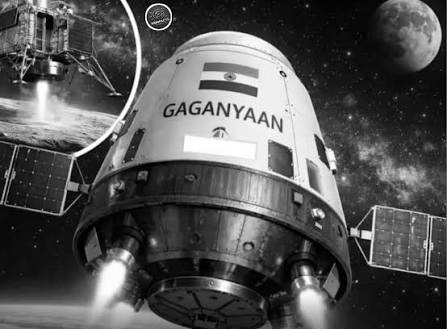
India’s Space Dream Takes Flight: Gaganyaan Mission Clears Major Hurdles, First Crew Mission Set for 2027
India’s ambitious human spaceflight programme has entered a crucial phase, with several key technologies and infrastructure systems for the Gaganyaan mission successfully developed, tested and validated, the government informed Parliament on Wednesday.
The mission, which aims to send Indian astronauts into low Earth orbit, is targeted for its first crewed flight in 2027. The Department of Space said extensive progress has been achieved in making the launch vehicle, spacecraft systems and astronaut support infrastructure ready for human spaceflight.
The Human Rated Launch Vehicle (HLVM3), the rocket that will carry astronauts into space, has completed the development and ground testing of all propulsion stages and major structures. Critical systems of the Orbital Module, including propulsion systems for the Crew Module and Service Module, have also been developed, tested and qualified.
Several safety systems designed to protect astronauts during the mission have reached advanced stages. The Crew Escape System (CES), a vital emergency mechanism that can separate astronauts from the launch vehicle during a failure, has undergone major testing, with five types of motors developed and static tested.
ISRO has also completed important test missions to demonstrate the reliability of the spacecraft. The first Test Vehicle mission, TV-D1, successfully validated the Crew Escape System during flight. Two Integrated Air Drop Tests were also completed to test the spacecraft’s deceleration system, which will help ensure a safe landing after the mission.
Infrastructure required for India’s first human spaceflight has also been established, including the Gaganyaan Control Centre, astronaut training facilities, Orbital Module Preparation Facility and modifications to the second launch pad.
India’s selected astronauts, known as Gaganyatris, have completed general training at Glavkosmos in Russia, while mission-specific training is underway at the Astronaut Training Facility in Bengaluru.
Beyond Gaganyaan, India is preparing for its next major space milestone — the Bharatiya Antariksh Station (BAS). The government has approved the development of the first module of the indigenous space station, with operations targeted by 2035. The planned station will consist of five modules.
The government has also approved the development of critical technologies required for future human space missions, including indigenous flight suits, crew seats, viewing systems and docking technology.
The update was provided by Minister of State for Space Dr Jitendra Singh in a written reply in the Lok Sabha, highlighting India’s rapid progress towards becoming one of the few nations capable of conducting independent human space missions.