
India’s Space Race Is About to Get Bigger! ISRO Targets Four Launch Pads by 2029
India is preparing for a major expansion of its space programme, with the Indian Space Research Organisation (ISRO) targeting four functional launch pads by 2029. But as the country pursues human spaceflight, lunar exploration and a larger commercial space industry, funding could prove critical to turning these ambitions into reality.
ISRO Chairman V Narayanan announced the expansion plan on Saturday, stressing that partnerships with startups and private companies would help meet growing domestic and global demand for satellite launches. He clarified that ISRO would not be privatised, but said technology transfers and industry collaboration could boost investment and create high-skilled jobs.
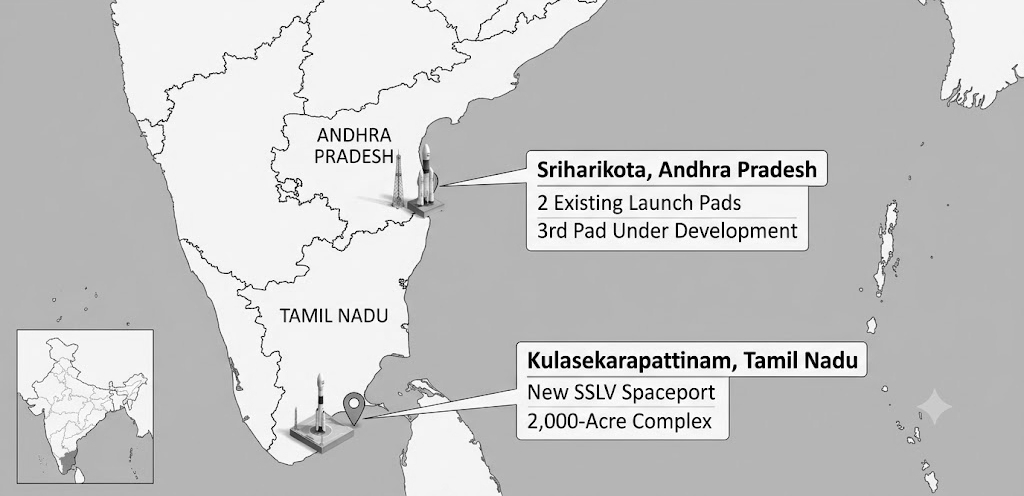
A key project is a 2,000-acre Small Satellite Launch Vehicle (SSLV) complex at Kulasekarapattinam in Tamil Nadu’s Thoothukudi district. Sriharikota in Andhra Pradesh, which already has two operational launch pads, is also developing a third. ISRO has yet to clarify the precise configuration of all four pads mentioned in the announcement.
The financial picture, however, raises questions about the pace of expansion. The Union Budget 2026–27 allocated ₹13,705.63 crore to the Department of Space, around 2.2% above the previous year’s original budget estimate. Yet the allocation is nearly ₹1,899 crore below the department’s request of ₹15,604.80 crore, leaving a gap between its proposed spending and the funds approved.
The department’s revised allocation for 2025–26 was also lower than its original estimate, underscoring the importance of both adequate funding and timely project execution.
Meanwhile, Gaganyaan remains a major priority, with the first uncrewed test planned within the next two months, followed by two more before a crewed mission. ISRO has conducted around 8,000 ground-based experiments for the programme. India is also planning Chandrayaan-5, a joint lunar mission with Japan featuring a 350-kg rover designed for 100 days of surface experiments.
With India’s space economy valued at approximately $9 billion in 2026 and projected to reach $40-45 billion over the following decade, the challenge is to match expanding ambitions with predictable funding, efficient execution and private investment.