
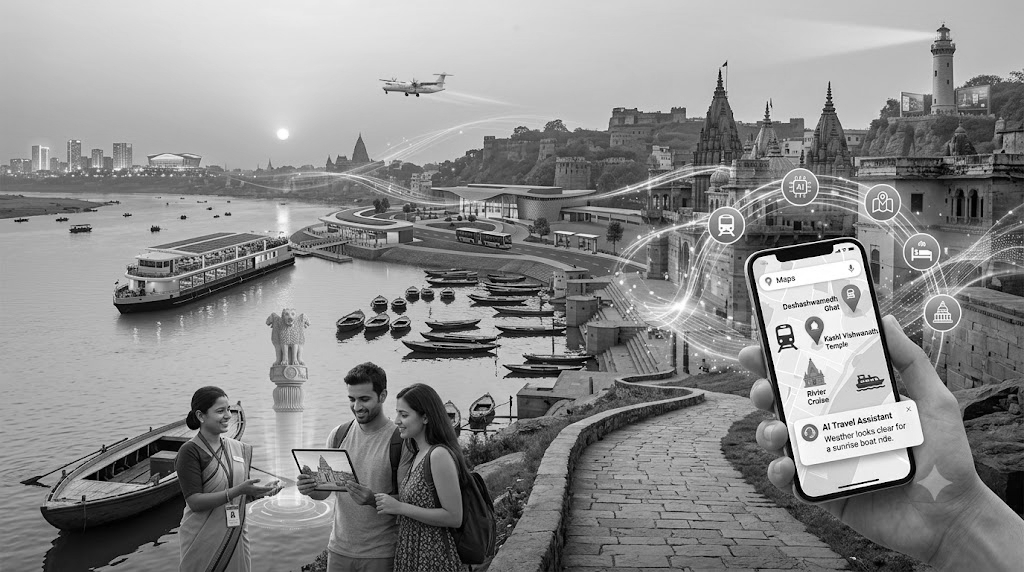
India’s Tourism Journey Goes Digital As AI Reshapes Travel
For millions of travellers, the journey now begins long before they reach an airport, railway station or tourist destination. It starts with a smartphone search, an online booking, a digital map or an artificial intelligence-powered recommendation. As technology becomes an increasingly important part of travel, India is attempting to transform its tourism sector from a collection of destinations into a connected, digital and experience-driven ecosystem.
On World Tourism Day today, the spotlight is firmly on this transformation, with the global theme “Digital Agenda and Artificial Intelligence to Redesign Tourism” highlighting how emerging technologies could change the way people discover, plan and experience travel.
For India, the shift comes at a time when tourism is already emerging as a major contributor to the economy. According to the Ministry of Tourism, the sector contributed 5.22% to India’s GDP and supported 8.46 crore jobs in 2023-24. Domestic tourism has expanded sharply after the pandemic, with domestic tourist visits reaching 428.55 crore in 2025, compared with 67.7 crore in 2021. Foreign tourist visits stood at 2.53 crore in 2025, while foreign exchange earnings from tourism rose to ₹2,76,831 crore, from ₹63,978 crore in 2021.
The numbers underline the scale of India's tourism market, but the next phase is expected to depend increasingly on how effectively technology can connect travellers, businesses and destinations.
At the centre of this transformation is the proposed National Digital Tourism Stack, an open digital public infrastructure intended to make tourism offerings easier to discover, access and trust. The idea is to create a more connected ecosystem in which destinations, tourism service providers and travellers can interact through digital platforms.
The government is also expanding the Dekho Apna Desh 2.0 initiative, with a focus on lesser-known destinations that have tourism potential. The broader objective is to spread tourist activity beyond heavily visited locations, encourage new experiences and enable local communities to benefit from tourism.
The growing importance of artificial intelligence can already be seen on the revamped Incredible India Digital Platform. The platform offers virtual experiences covering cultural, heritage, adventure, gastronomy, wellness, arts and crafts and rural tourism. Its AI-powered tools are designed to personalise travel experiences by providing information such as real-time weather updates, city exploration options and travel services. The platform is also integrated with online travel agencies for bookings involving flights, hotels, cabs, buses and tickets for ASI monuments.
This means that the traditional tourism journey research, booking, navigation and experience is increasingly becoming one digital chain. A traveller can discover a destination online, check weather conditions, find attractions, book accommodation and transport and even explore monuments virtually before arriving.
Digital transformation is also changing the way tourism businesses operate. The National Integrated Database of Hospitality Industry (NIDHI+) provides a unified digital system for registration, recognition and classification of hospitality and tourism service providers. It offers online processing, integrated payments and transparent approvals, helping businesses interact with the government through a single digital framework.
The government's partnership with Google India is another part of this effort. The collaboration is aimed at strengthening digital promotion, using data insights and artificial intelligence, understanding changing traveller behaviour and improving digital engagement. Capacity-building programmes are also intended to help tourism officials make better use of digital marketing, content and AI-based tools.
The transformation is not limited to large companies. India's travel and tourism sector had 1,497 DPIIT-recognised startups across 262 districts, according to government data available for April 2023. Around 58% of these startups were located in Tier II and Tier III cities, showing that tourism technology is spreading beyond the major metropolitan centres.
Companies such as Highway Delite, VilloTale and udChalo illustrate the variety of solutions emerging in the sector from digitally connected highway services and rural tourism to technology-enabled travel services for defence personnel, veterans and their dependants.
But India's tourism story is much larger than digital platforms.
The country's strength lies in the enormous variety of experiences available to travellers. Pilgrimage and spiritual tourism remain major segments, with destinations such as Ayodhya, Varanasi, Bodh Gaya, Amritsar, Tirupati and Puri attracting visitors throughout the year. Buddhist circuits connect places such as Bodh Gaya, Sarnath and Kushinagar with India's wider civilisational links across Asia.
Heritage tourism offers another vast opportunity. Forts, palaces, temples, museums, archaeological sites and historic cities are increasingly being presented alongside living traditions such as classical music and dance, festivals, handicrafts and regional cuisine.
At the same time, wellness and yoga, medical tourism, wildlife, eco-tourism, rural tourism, homestays, coastal tourism, cruises and adventure travel are expanding the choices available to visitors.
This diversification is important because India's tourism future cannot depend only on a handful of iconic monuments or major cities. The emphasis is increasingly moving towards creating complete destinations where visitors can stay longer, spend more locally and interact with communities.
Government programmes such as Swadesh Darshan reflect this changing approach. The original scheme sanctioned 76 projects worth more than ₹5,295 crore across thematic circuits, with 75 projects physically completed. Its successor, Swadesh Darshan 2.0, takes a more destination-centric approach, with 53 projects worth ₹2,207.08 crore sanctioned to promote sustainable and experience-based tourism.
The PRASHAD scheme, meanwhile, focuses on pilgrimage and heritage destinations. Fifty-four projects worth more than ₹1,726 crore have been sanctioned for facilities such as tourist facilitation centres, parking, ghats, waste management systems, solar facilities and other visitor amenities.
Connectivity is another crucial part of this transformation. Tourism cannot grow sustainably if attractive destinations remain difficult or expensive to reach. The government has therefore linked tourism development with airports, roads, regional air connectivity and destination infrastructure.
Under the regional connectivity framework, 687 routes connecting 95 airports have been operationalised. The Modified UDAN programme for 2026-27 to 2035-36 has an outlay of ₹28,840 crore and plans to support the development of 100 airports and 200 helipads.
Cruise tourism is another area showing significant expansion. Passenger traffic in the sea cruise sector increased from 1.08 lakh in 2014-15 to 4.62 lakh in 2025-26, according to the government. International cruise terminals at Visakhapatnam, Mumbai and Chennai have been upgraded, while the East Coast Cruise Circuit has been expanded to include Puducherry.
Technology is being introduced here too. QR-based immigration clearance can reduce processing time to around 30 seconds per passenger, while customs processes and group visa systems have also been digitised.
India's historic lighthouses are being brought into the tourism economy as well. Under the Marine Aids to Navigation Act, 2021, provisions allow lighthouses to be used for educational, cultural and tourism purposes. Museums and tourism facilities have been developed at several locations, including Chennai, Mahabalipuram, Alappuzha, Kannur, Muttom, Dwarka and Gopnath.
Another emerging area is MICE tourism Meetings, Incentives, Conferences and Exhibitions. Large venues such as Bharat Mandapam, Yashobhoomi and Jio World Centre have strengthened India's ability to host international business events. The government sees potential for at least 10 Indian cities, particularly in South India, to develop as global MICE destinations.
India's experience during the G20 presidency demonstrated how tourism and international events can reinforce each other. More than 200 G20 meetings were organised across over 60 cities, exposing international delegates to India's monuments, crafts, cuisines and cultural traditions. The multi-city approach also helped showcase destinations outside the conventional metropolitan circuit.
India is also using international cooperation to promote tourism. During its BRICS chairship in 2026, tourism cooperation has focused on artificial intelligence, sustainable and responsible tourism, skill development, capacity building, tourism exchanges and seamless travel facilitation. The Jaipur meetings further placed digital tools and AI among the areas for cooperation among BRICS countries.
Travel facilitation itself is becoming increasingly digital. India's e-Visa system, introduced in 2014 for 43 countries, has expanded considerably over the years. Electronic visa processing now accounts for a large share of tourist visa applications, reducing paperwork and making travel arrangements easier for international visitors.
A multilingual 24x7 Tourist Helpline also provides assistance to travellers in 12 international languages, including Arabic, French, German, Italian, Japanese, Korean, Chinese, Portuguese, Russian and Spanish.
Yet, the success of digital tourism will ultimately depend on people.
Technology can recommend a destination, but local guides, drivers, hotel workers, artisans, cooks and community members create the actual experience. This is why skill development remains an important part of India's tourism strategy.
Programmes such as Capacity Building for Service Providers and Hunar Se Rozgar Tak aim to train people in hospitality and tourism-related services. According to government data, more than 1.68 lakh people were trained and over 36,000 placed through CBSP between 2020-21 and 2024-25.
The Paryatan Mitra and Paryatan Didi initiative, launched in 2024, extends this approach to people who directly interact with tourists, including cab and auto drivers, hotel and restaurant workers, homestay operators, guides, police personnel, vendors, shopkeepers and students. Around 4,382 people have been trained under the initiative.
This human element will remain important as tourism becomes more technology-driven. A completely automated tourism experience may be efficient, but it cannot replace the cultural interactions, local knowledge and personal experiences that make destinations memorable.
The larger challenge, therefore, is to ensure that AI and digital infrastructure do not simply increase tourist numbers but also improve the quality and sustainability of tourism. Technology can help manage crowds, understand visitor behaviour, promote lesser-known destinations, improve bookings and provide personalised information. Data can help governments plan infrastructure and businesses understand demand. But responsible tourism requires equal attention to the environment, heritage and communities.
For India, the opportunity is substantial. The country's tourism advantage comes from its combination of civilisational heritage, spirituality, nature, food, wellness, culture and diversity. Digital technology can provide the connecting layer that makes these experiences easier to discover and access.
The tourism industry of the future may therefore look very different from the one travellers knew a decade ago. A visitor could increasingly use AI to build an itinerary, check live conditions, book every part of a journey through connected platforms, explore a destination virtually and receive personalised recommendations throughout the trip.
But the ultimate measure of this transformation will not be how much technology India puts into tourism. It will be whether technology helps travellers experience more of India, whether local communities earn more from tourism, whether fragile destinations are protected and whether smaller businesses can compete in an increasingly digital marketplace.
On World Tourism Day today, India's tourism story is thus moving into a new phase one where AI, digital platforms, connectivity, infrastructure and human skills are expected to work together. The destination may remain ancient, but the way travellers discover and experience it is rapidly becoming digital.