
Indiaspora Project Chronicles 250 Years of Indian-American Impact
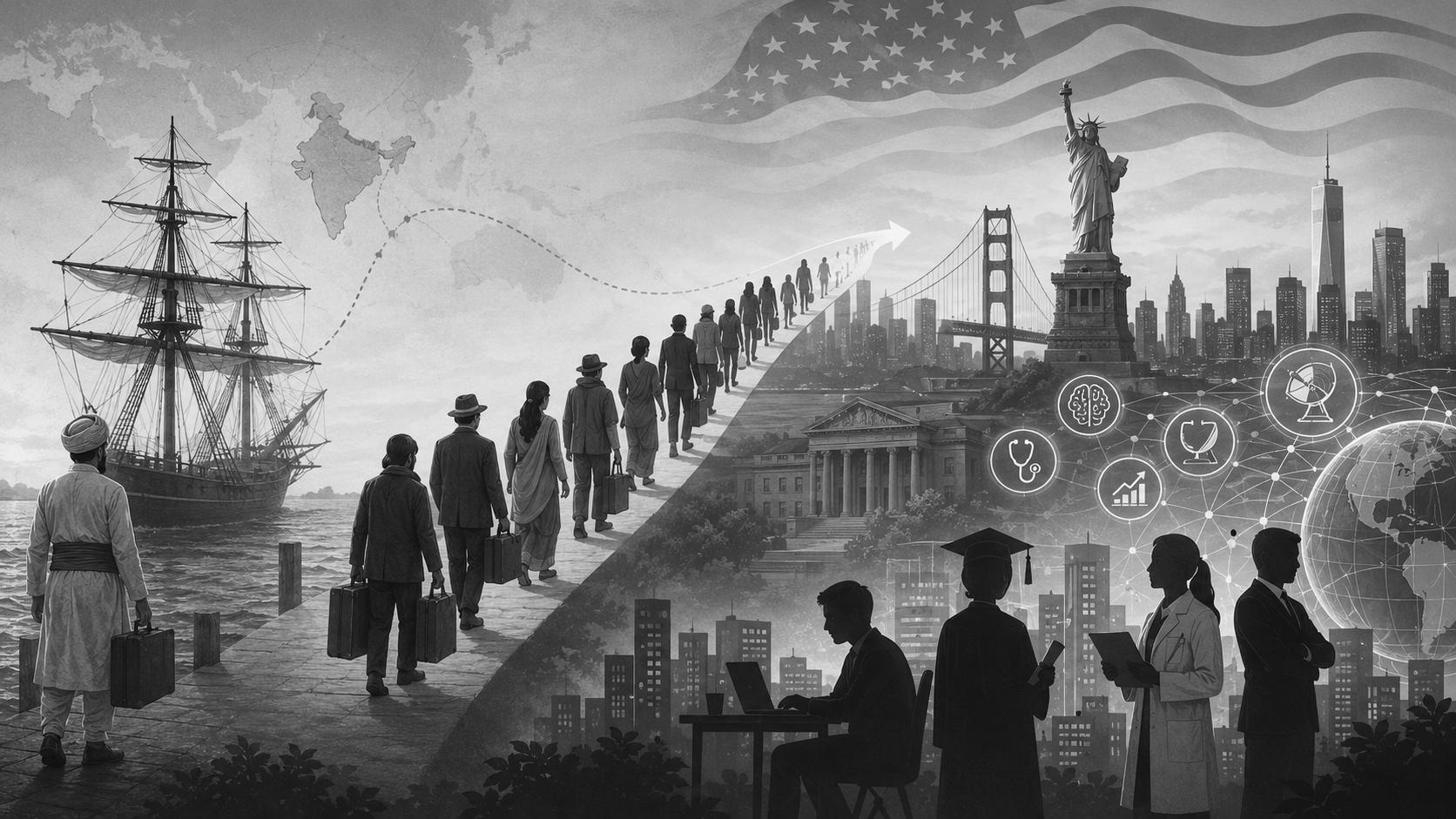
As the United States marks its 250th year of Independence , a landmark documentation project is celebrating the remarkable journey of Indian-Americans from a little-known visitor who arrived on American shores in 1790 to a thriving community that today plays a pivotal role in the country's economy, politics, science and culture.
The initiative, titled “Indiaspora 250 @ 250: The Indian American Story,” has been launched by diaspora advocacy group Indiaspora to coincide with America's semiquincentennial celebrations on July 4 . The project chronicles 250 defining moments that highlight the contributions of people of Indian origin to the United States across 15 sectors , including business, technology, healthcare, public service, education, arts and politics.
According to Niranjana Rajagopal , Managing Director of Global Forum at Indiaspora, the collection was developed through an extensive research and editorial process and reviewed by external experts. While not intended to be exhaustive, it serves as one of the most comprehensive efforts to document the evolution of the Indian-American community over the past 235 years .
The story begins with the arrival of the mysterious “Man from Madras” in Salem, Massachusetts , in 1790. Though his identity remains unknown, records maintained by Reverend William Bentley describe him as the first documented non-coerced Indian visitor to the United States. From that solitary journey emerged a community now estimated at three to five million people , widely regarded as one of the most successful immigrant groups in America.
The project highlights a series of historic milestones. In 1886 , Anandi Gopal Joshi became the first Indian woman to earn a medical degree in the United States, paving the way for future generations of women in medicine. Four years later, Eduljee Sorabjee , a Parsi entrepreneur from Bombay, became one of the earliest South Asians to obtain American citizenship despite restrictive immigration laws of the era.
A major turning point came with the Immigration and Nationality Act of 1965 , which abolished nationality-based immigration quotas and opened the door to thousands of Indian doctors, engineers, scientists and academics. The resulting wave of migration transformed the community's profile and helped establish Indian-Americans as a powerful force in American society.
Among the distinguished figures featured in the project are Nobel Prize-winning astrophysicist Subrahmanyan Chandrasekhar and fibre-optics pioneer Narinder Singh Kapany , whose groundbreaking work reshaped modern science and telecommunications. Entrepreneur Amar Bose built one of the world's most recognizable audio technology brands, while Vinod Khosla , co-founder of Sun Microsystems, emerged as one of Silicon Valley's most influential investors.
The community's economic footprint is equally striking. By 2023 , Indian-origin executives were leading 16 Fortune 500 companies , while Indian-Americans reportedly owned nearly 60% of hotels in the United States . Corporate leaders such as Satya Nadella , Sundar Pichai and Indra Nooyi have become global symbols of innovation and business leadership.
Indian-Americans have also made significant inroads into public life. In 1956 , Dalip Singh Saund became the first Asian American and first Sikh elected to the US Congress. More recently, Kamala Harris made history as the first woman and first person of Indian descent to serve as Vice President of the United States. Former South Carolina Governor Nikki Haley also mounted a presidential campaign, underscoring the community's growing political influence.
Beyond boardrooms and politics, Indian culture has left a lasting imprint on American society. B.K.S. Iyengar helped popularize yoga by presenting it as a therapeutic discipline, while entrepreneurs such as Bhagwati Amin of Deep Foods and Maya Kaimal brought authentic Indian flavours into mainstream American kitchens. The roots of Indian cuisine in the US stretch back even further, with Prince Ranji Smile introducing Indian food to American audiences as early as 1899 .
More than a celebration of success stories, the Indiaspora project serves as a historical archive of the contributions made by generations of immigrants, students, professionals, entrepreneurs and community leaders. It also underscores the growing role of the Indian diaspora as a bridge between India and the United States , strengthening ties in trade, technology, education and diplomacy. As America celebrates 250 years of nationhood, the project offers a powerful reminder of how deeply the Indian-American experience has become woven into the fabric of the nation.