
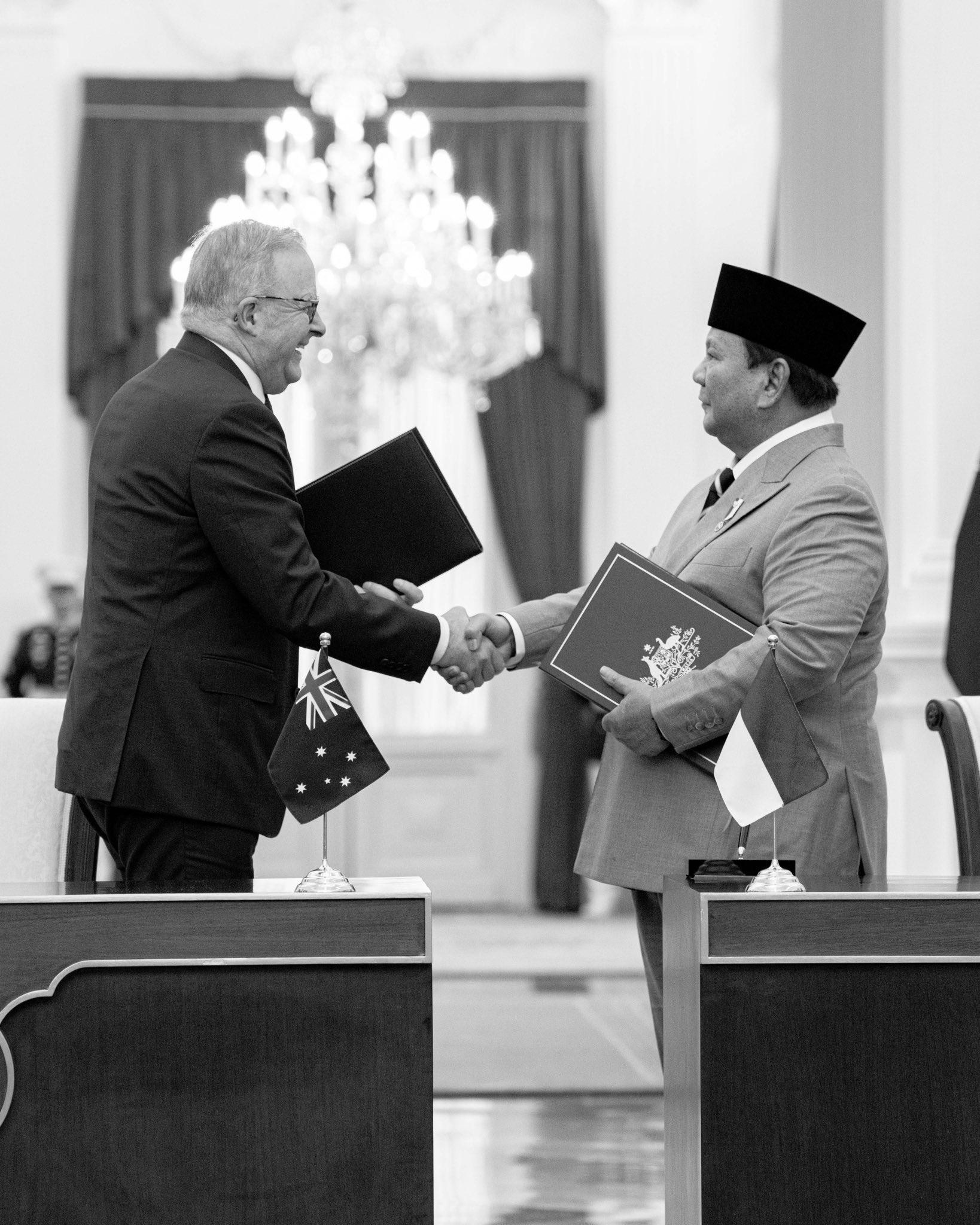
Indonesia, Australia sign new security treaty to deepen strategic ties
Indonesia and Australia on Friday signed a new bilateral security treaty, a move both governments say will significantly deepen ties between the often-testy neighbours and mark a new phase in their strategic partnership.
The agreement was signed in Jakarta , three months after Australian Prime Minister Anthony Albanese and Indonesian President Prabowo Subianto announced in Sydney that negotiations on the pact had been substantively concluded. The treaty reflects the two countries’ ambition to better utilise and build upon earlier security arrangements signed in 1995 and 2006.
Prime Minister Albanese described the agreement as a “watershed moment” in relations with Australia’s closest major neighbour. In a statement issued ahead of his arrival in Jakarta late Thursday, he said the treaty represented a major extension of existing security and defence cooperation and reflected a relationship “as strong as it has ever been.” Albanese is accompanied on the visit by Foreign Minister Penny Wong , who called the pact the most important step in the bilateral partnership in three decades.
Australia and Indonesia share a long but uneven relationship shaped by geography , security concerns and differing worldviews . While Australia supported Indonesia’s independence in 1945 , ties have periodically strained, most notably after Australia led a peacekeeping mission in East Timor in 1999, prompting Jakarta to terminate the 1995 security pact. Relations were later reset through counterterrorism and defence cooperation, culminating in the 2006 Lombok Treaty , which was expanded further in 2014.
Analysts say the new treaty has taken on added significance for Australia amid growing regional tensions, particularly in relation to China. While the agreement is not explicitly directed at Beijing , it comes against the backdrop of China’s expanding maritime presence in Southeast Asia and repeated incidents involving Chinese vessels near Indonesia’s Natuna Islands. Indonesia does not view China as an adversary, but such developments have heightened Jakarta’s focus on maritime security and regional stability.
However, analysts note that the agreement is expected to echo elements of the 1995 security pact signed between then Australian Prime Minister Paul Keating and Indonesia’s former authoritarian leader Suharto , who was Prabowo’s father-in-law. That agreement committed both countries to consult on security issues and respond to adverse challenges, but stopped short of mutual defence obligations.
Susannah Patton of the Lowy Institute , a Sydney-based international policy think tank, said the text of the new agreement has not yet been made public and appears to focus largely on political commitment rather than binding guarantees. She described it as a “symbolic agreement,” noting that a separate defence cooperation accord signed in 2024 was more focused on practical military collaboration.
Patton said the treaty sits below Australia’s alliance with the United States and its security agreement with Papua New Guinea in terms of obligations, and is unlikely to clarify whether Indonesia would come to Australia’s defence in the event of a regional security threat. “ It is very much not a mutual defence treaty ,” she said, noting that such an arrangement would not be politically acceptable to Indonesia, which maintains a long-standing non-aligned “free and active” foreign policy.
Despite these limits, Patton said the agreement represents a significant diplomatic success for Albanese, given Indonesia’s traditional caution about formal security alignments. She added that Australia has benefited from the fact that Indonesia is now led by Prabowo, a president she described as more willing to depart from foreign policy convention and pursue leader-driven agreements while still maintaining strategic autonomy and balancing ties with major powers.
Albanese’s office said the visit his fifth official trip to Indonesia was part of a broader push to expand cooperation beyond security into trade, investment, education and development. The prime minister is scheduled to meet President Prabowo and other Indonesian officials through Sunday before returning to Australia.