
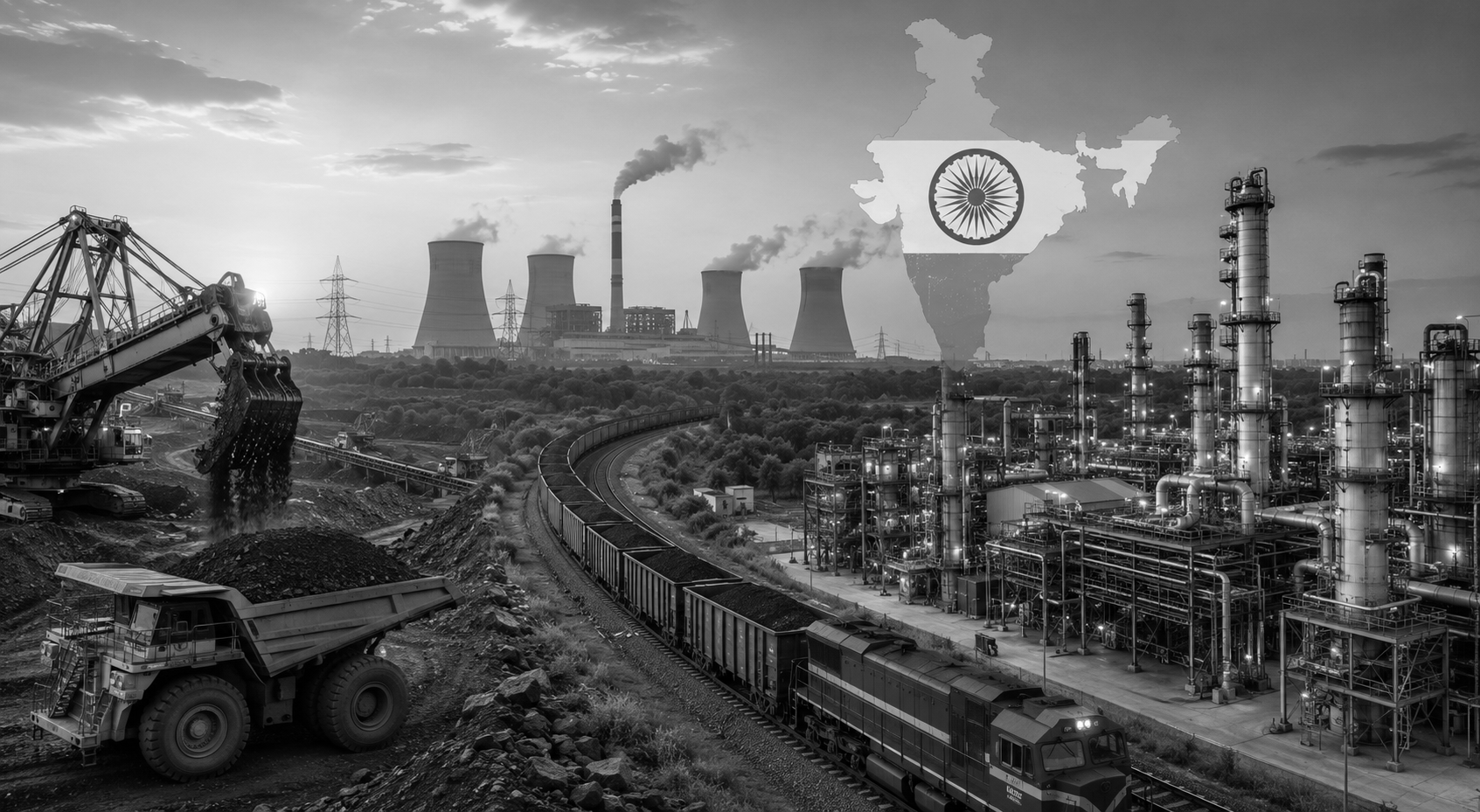
Infrastructure, Policy, Technology: India's Coal Roadmap to 2030
As the world races toward cleaner energy, India is increasingly positioning coal not merely as a fuel for power generation but as a strategic industrial resource. This vision took center stage at the recent BRICS Side Event on Clean Coal Technologies, organized by the Ministry of Coal, where government officials, industry leaders, technology providers and delegates from Russia, Ethiopia and the UAE discussed the future of coal gasification.
Delivering the keynote address, Sanoj Kumar Jha , Additional Secretary in the Ministry of Coal, underscored the role of coal gasification in strengthening India's energy security and industrial competitiveness. Coal gasification converts coal into syngas , which can be used to produce ammonia, methanol, hydrogen, synthetic fuels, Direct Reduced Iron (DRI) and other value-added products. The Government of India has set an ambitious target of gasifying 100 million tonnes of coal annually by 2030 , supported by policy incentives, financial assistance, assured coal linkages and inter-ministerial coordination.
The message from the BRICS platform was clear: coal may be an old fuel, but new technologies can transform it into a cornerstone of industrial development.
BRICS Dominates the Global Coal Landscape
The significance of the discussion becomes evident when viewed through the lens of global coal economics. The original BRICS nations Brazil, Russia, India, China and South Africa—together account for nearly 70 percent of global coal production . China and India dominate this landscape, while Russia remains one of the world's largest reserve holders and exporters.
China currently produces around 4.8 billion tonnes of coal annually , accounting for more than half of global output. India follows with approximately 1.04 billion tonnes , making it the world's second-largest producer and contributing roughly 11–12 percent of global production . Russia produces around 440 million tonnes , while South Africa contributes approximately 230 million tonnes . Brazil's coal production remains relatively small, at less than 10 million tonnes annually . With global coal output estimated at around 8.8–9 billion tonnes each year , the influence of BRICS countries on global coal markets is immense.
Coal Reserves: India Is Closer to China Than Production Suggests
A striking feature of the global coal industry is that reserve ownership does not necessarily translate into production. Russia possesses approximately 162 billion tonnes of proven coal reserves , the largest among BRICS nations. China follows with around 143 billion tonnes , while India holds nearly 126 billion tonnes , making it the world's third-largest holder of proven coal reserves. South Africa and Brazil possess comparatively smaller reserve bases of around 9 billion tonnes and 7 billion tonnes , respectively.
These figures reveal that India's coal resource base is far closer to China's than commonly perceived. India possesses nearly 88 percent of China's coal reserves and around 78 percent of Russia's reserves . Yet the production picture tells a different story. China produces roughly 4.6 times more coal than India , while India produces about 2.4 times more than Russia . This discrepancy highlights how policy, infrastructure and industrial demand often matter more than resource availability.
Why China Pulled Far Ahead
The answer lies not beneath the ground but above it. Beginning with the economic reforms introduced by Deng Xiaoping in 1978, China adopted a long-term industrial strategy that made coal the backbone of economic expansion. Massive investments were directed towards mining, railways, power generation, steel manufacturing, cement production and chemical industries. Coal became the foundation upon which China's export-oriented manufacturing economy was built.
China also invested heavily in coal-to-chemicals technologies, creating large industries based on coal-derived methanol, ammonia, hydrogen, olefins and synthetic fuels. Today, China gasifies more than 200 million tonnes of coal annually , a figure that exceeds India's entire 2030 target. The country also developed extensive mining clusters, dedicated freight corridors and integrated industrial zones that enabled coal to move efficiently from mines to factories and ports. India is now attempting to replicate parts of this strategy through infrastructure expansion and coal gasification initiatives.
Coal: One of India's Biggest Revenue Engines
Despite growing investments in renewable energy, coal remains one of India's most important sources of government revenue. Income is generated through royalties paid by mining companies to states, GST Compensation Cess collections, coal block auction premiums, District Mineral Foundation contributions, corporate taxes and dividends paid by public-sector enterprises.
Over the last five years, revenue generated from the coal sector has grown steadily. During FY21, total government collections from the sector were estimated at around ₹40,000–45,000 crore . As economic activity recovered and coal demand increased, revenues rose to approximately ₹55,000–60,000 crore in FY22 and ₹65,000–70,000 crore in FY23 . By FY24, the sector was contributing between ₹75,000 crore and ₹85,000 crore , while FY25 estimates place total revenues in the range of ₹70,000–90,000 crore .
A major contributor to this performance has been Coal India Limited , which accounts for nearly three-fourths of India's coal production. The company now generates annual revenues exceeding ₹1.4 lakh crore and provides substantial dividends and taxes to the government. Overall, the broader coal economy is valued at nearly ₹2 lakh crore annually , while also supporting sectors such as railways, electricity generation, steel, cement and fertilizers.
Building the Infrastructure for a Coal-to-Chemicals Future
Recognizing that production targets alone are insufficient without logistics support, India has launched one of its largest coal transportation expansion programmes. The Ministry of Coal has identified 14 major rail projects that are expected to unlock more than 200 million tonnes per annum of additional coal evacuation capacity .
Among the most significant projects are the Chhattisgarh East Rail Corridor and the Chhattisgarh East-West Rail Corridor , which will connect major mining regions with industrial and power-generation centres. The Shivpur-Kathautia Rail Project in Jharkhand is expected to enhance connectivity for coal blocks operated by Central Coalfields Limited. Additional capacity is being created through the expansion of the Tori-Shivpur and Jharsuguda-Barpali-Sardega corridors, both of which are critical for moving coal from eastern India to consuming markets.
In Odisha, rail connectivity around the Talcher coalfields is being strengthened to support one of India's most productive mining regions. Telangana is also expected to benefit from the proposed Bhadrachalam Road-Sattupalli railway line , which will improve transportation links to the Singareni coalfields. Together, these projects reflect an infrastructure strategy similar to the one that enabled China's rapid industrial expansion.
Complementing these efforts is the government's ₹8,500 crore coal gasification incentive scheme , which aims to encourage investment in coal-to-chemicals projects and accelerate progress toward the 2030 gasification target.
Can India Achieve 100 Million Tonnes of Gasification by 2030?
From a resource perspective, the target appears achievable. India already produces more than 1 billion tonnes of coal annually , meaning that gasifying 100 million tonnes would require diverting only about 10 percent of existing production toward higher-value industrial applications.
However, success will depend on a series of policy reforms. Investors require long-term certainty regarding coal pricing and supply agreements, particularly because gasification projects involve investments of ₹10,000–20,000 crore and have operating lifespans extending several decades. Faster environmental clearances, streamlined land acquisition processes and dedicated coal-to-chemicals industrial clusters will also be essential. Technology partnerships, greater indigenous research and development, and the creation of carbon-capture frameworks could further improve project viability.
The challenges are equally significant. Indian coal typically contains 35–50 percent ash , making it more difficult and expensive to gasify than coal used in many international projects. Coal gasification is also highly water-intensive, raising concerns in regions already facing water stress. Financing remains another hurdle, as global investors and financial institutions have become increasingly cautious about funding coal-related projects amid climate concerns.
The Road Ahead
Most industry experts believe India can realistically achieve 50–70 million tonnes of coal gasification by 2030 , while reaching the full 100-million-tonne target will require flawless execution of multiple large-scale projects. Nevertheless, the potential rewards are considerable. Success would reduce dependence on imported fuels, fertilizers and chemicals, strengthen energy security, create new industrial value chains and generate significant economic value from domestic resources.
The discussions at the BRICS forum underscored a fundamental shift in thinking. Coal is no longer being viewed solely as a fuel for electricity generation. Instead, it is increasingly being seen as a feedstock for chemicals, synthetic fuels and advanced industrial products. If India succeeds in building a robust coal-to-chemicals ecosystem, coal gasification could emerge as one of the most consequential industrial transformations in the country's energy and manufacturing landscape over the coming decade.