
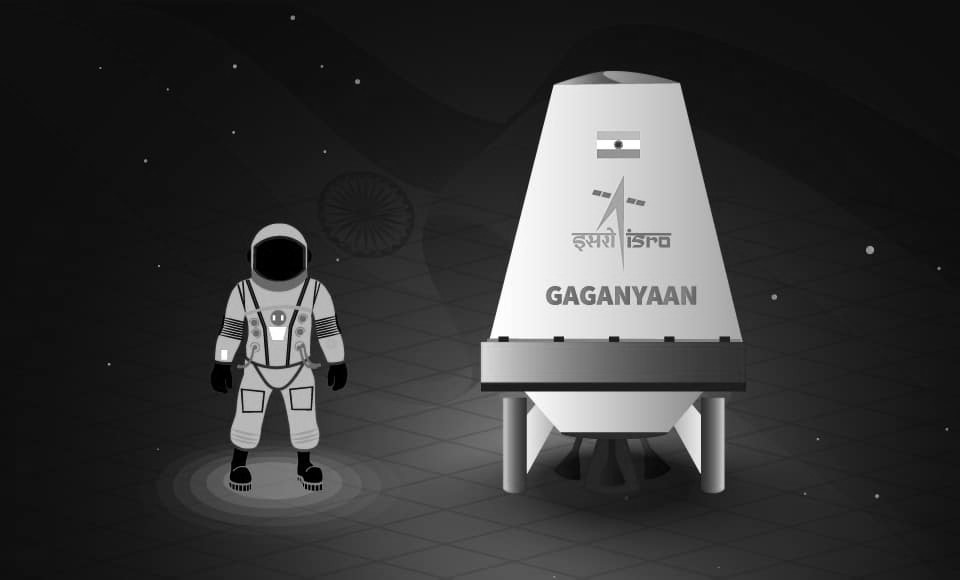
ISRO Achieves Key Gaganyaan Milestones, Charts Course for Bharatiya Space Station
India has moved a significant step closer to launching its first indigenous human spaceflight mission, with the government confirming that Gaganyaan has crossed several critical technology and safety milestones. Speaking in the Rajya Sabha, Union Minister Dr. Jitendra Singh outlined the country's progress and reaffirmed the long-term vision of establishing the Bharatiya Antariksh Station (BAS) by 2035.
The minister said the Human Rated Launch Vehicle (HLVM3) has completed the development and ground testing of all propulsion stages and structural systems. Key technologies, including the Crew Module, Service Module, Environmental Control and Life Support System, Thermal Protection System, Deceleration System, and integrated avionics, have also been successfully developed and qualified.
Crew safety preparations have advanced considerably. All five motors of the Crew Escape System have been developed and successfully tested, while supporting infrastructure such as the Gaganyaan Control Centre, Crew Training Facility, Orbital Module Preparation Facility, and upgraded launch pad is now in place.
Dr. Singh informed Parliament that the TV-D1 mission successfully validated the in-flight Crew Escape System, while two integrated air-drop tests confirmed the reliability of the deceleration system. Preparations are now underway for the TV-D2 mission, alongside continued ground qualification of newly developed technologies and mission support systems.
According to the roadmap, the first uncrewed Gaganyaan mission carrying the Vyommitra humanoid is targeted for the fourth quarter of 2026. Two additional uncrewed missions, configured like the first crewed flight, are planned during 2027 before India's maiden human orbital mission.
The minister also highlighted the government's approval of ₹20,193 crore for eight missions under the Human Spaceflight Programme. ISRO continues to strengthen international partnerships with ESA, Australian Space Agency, CNES, and Roscosmos for network support, recovery operations, specialised training, and critical technologies.
The progress, Dr. Singh said, reflects India's growing capability to build a self-reliant human spaceflight programme while laying the technological foundation for sustained space exploration in the coming decades.