
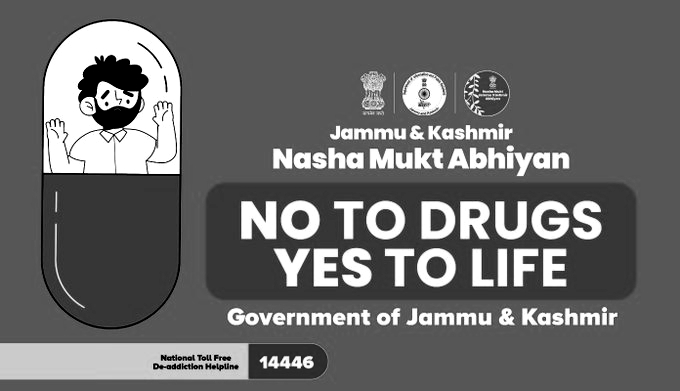
Jammu and Kashmir’s Anti-Narcotics Campaign Seizes 341 Kg Drugs, Targets Terror Funding
The first 50 days of the ‘Nasha Mukt Jammu Kashmir Abhiyaan’ have resulted in the arrest of more than 1,000 drug peddlers , seizure of 341 kg of narcotics , and action against properties linked to drug networks, marking one of the most extensive anti-drug operations undertaken in Jammu and Kashmir.
Launched on April 11 by Lieutenant Governor Manoj Sinha , the campaign aims to dismantle the narcotics ecosystem and disrupt the financial networks that sustain drug trafficking and terrorism in the Union Territory.
According to official data, police registered 923 FIRs and arrested 1,018 individuals for narcotics-related offences between April 11 and May 29. Authorities seized narcotics worth hundreds of crores, including 12 kg of heroin valued at ₹120 crore , and detained 55 individuals under the PIT-NDPS Act.
The crackdown also targeted the economic backbone of drug syndicates. Authorities attached 89 immovable properties and demolished 63 others, taking action against assets worth more than ₹83 crore . In addition, licences of chemists, driving permits, vehicle registrations and passports linked to narcotics offences faced punitive measures.
Alongside enforcement, the campaign emphasized prevention and rehabilitation. More than 16 lakh awareness programmes were conducted across Jammu and Kashmir, while government-run de-addiction and counselling centres provided treatment and support to thousands of individuals struggling with substance abuse.
Officials said the initiative represents a twin assault on drug trafficking and narco-terrorism , noting that narcotics networks have long been used as a source of terror financing in the region. By targeting both traffickers and their financial infrastructure, authorities believe the campaign is weakening criminal and terror-linked ecosystems simultaneously.
Sinha has reiterated that the drive will continue until every drug smuggler and narco-terror operative is brought to justice, describing drug abuse as a form of “silent terrorism” that threatens the future of the region’s youth.