
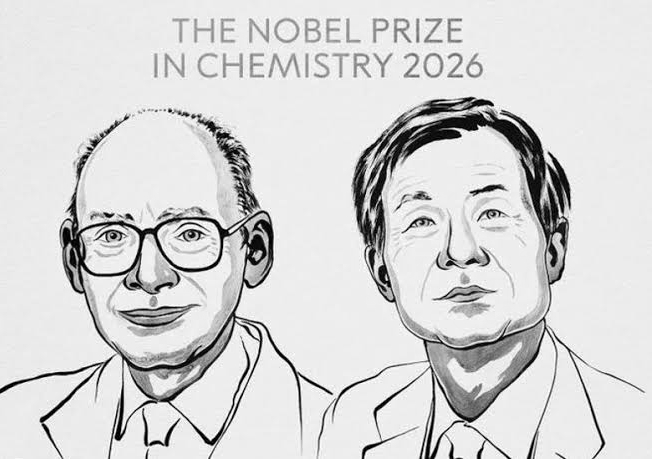
Kagan, Soai Win Nobel Chemistry Prize For Solving A Century-Old Molecular Mystery
French chemist Henri B. Kagan and Japanese scientist Kenso Soai won the 2026 Nobel Prize in Chemistry on Wednesday for helping solve a long-standing question in chemistry: how chemical reactions can develop a preference for one of two mirror-image forms of a molecule.
The Royal Swedish Academy of Sciences recognised the scientists for their work on non-linear effects and autocatalysis in asymmetric organic synthesis. Their research helped explain how a small initial advantage for one molecular form can grow until that form becomes dominant.
A simple way to understand the phenomenon is to think of left and right hands. They are mirror images of each other but cannot be placed exactly on top of one another. Some molecules are similarly “left-handed” or “right-handed”. A chemical reaction can produce both, but a tiny early advantage for one form can be amplified, causing one form to dominate.
This phenomenon, known as homochirality, is particularly important in biology. Many molecules found in living organisms have two possible mirror-image forms, but life overwhelmingly uses just one. Amino acids, for example, can exist in two such forms, while proteins in living organisms are built using predominantly one of them. How this preference developed has remained an important question in chemistry and the study of the origins of life.
Kagan and Soai’s work showed how chemical reactions can amplify this molecular preference rather than simply producing an equal mixture of both forms. Their research on asymmetric synthesis and autocatalysis gave scientists a better understanding of how such molecular “handedness” can emerge and strengthen.
The discovery also has practical importance. The two mirror-image versions of a molecule can behave differently in the human body, even though they contain the same atoms. Being able to produce the desired version is therefore important in pharmaceutical research and drug manufacturing.
Kagan, 95, was born in France and is affiliated with Universite Paris-Sud in Orsay. Soai, born in Japan, is associated with the Tokyo University of Science. Soai said he was shopping near his home when he received the call from the Nobel committee informing him of the award.
“The chemical reactions they have developed are spectacular,” said Heiner Linke, chair of the Nobel Committee for Chemistry, describing their contribution to a chemical problem that has puzzled scientists for more than a century.
The chemistry award is the third Nobel announced this week, following the medicine prize on Monday and the physics prize on Tuesday. The literature prize will be announced Thursday, followed by the peace prize on Friday and the Nobel Memorial Prize in Economic Sciences on Monday.
The 2026 Nobel Prize carries 12 million Swedish kronor, about USD 1.2 million, whether awarded to an individual, a group of laureates or an organisation.
Kagan and Soai’s work has helped answer a fundamental question about how one molecular form can gain an advantage over its mirror image, with implications for chemistry, biology, the origins of life and modern medicine.