
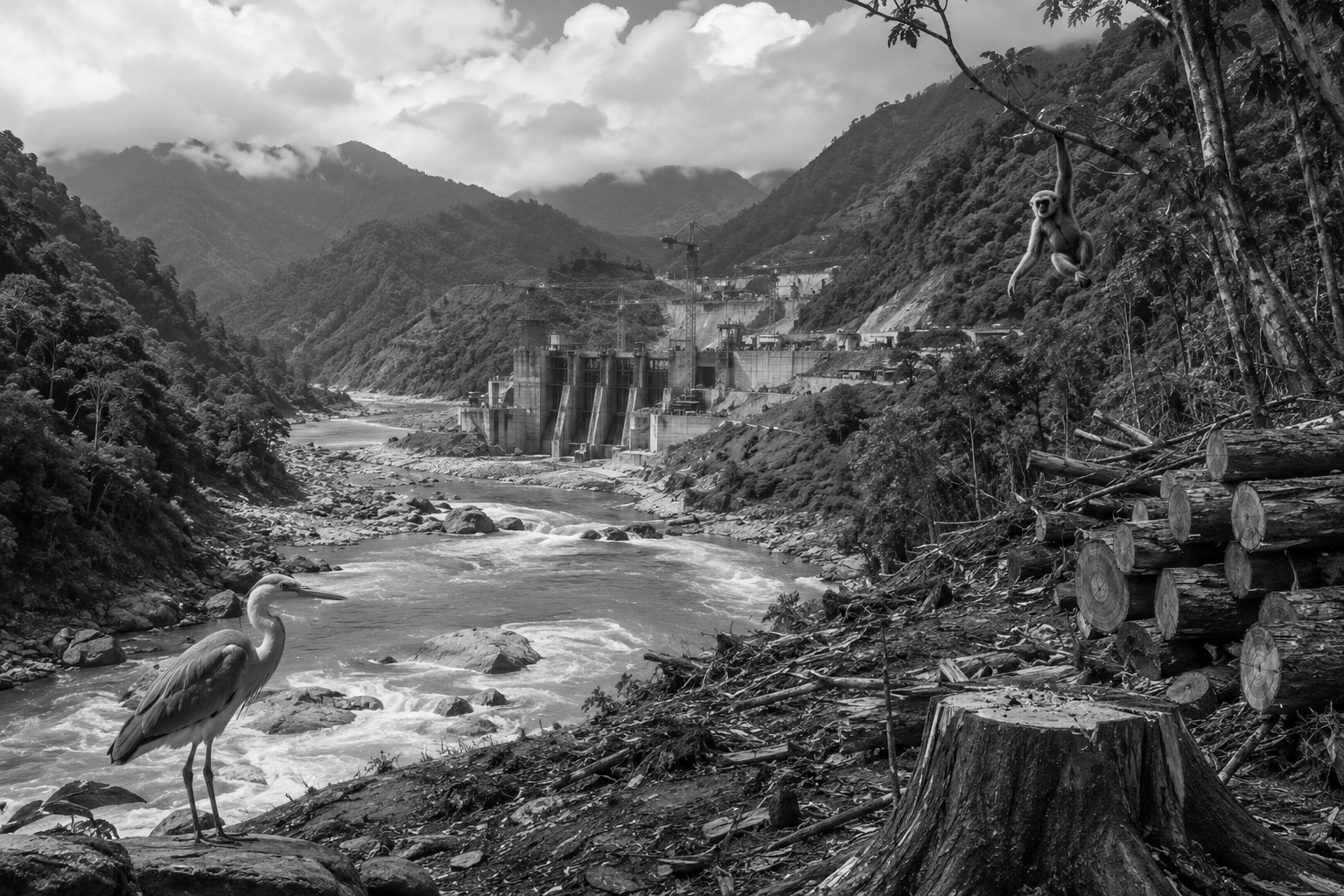
Kalai-II Hydropower Project Gets Forest Nod Despite Wildlife Concerns in Arunachal
The Centre has granted Stage-I forest clearance for the proposed 1,200 MW Kalai-II Hydroelectric Project in Arunachal Pradesh, advancing a key renewable energy project while reigniting concerns over its environmental footprint in one of India's most biodiverse regions.
The Forest Advisory Committee (FAC) under the Environment Ministry has approved the diversion of more than 860 hectares of forest land for the project on the Lohit River , subject to a series of conditions. The approval will require the felling of 33,338 trees , including 16,848 trees in the Namsai Forest Division and 16,490 in the Anjaw Forest Division.
The project, estimated to cost over ₹14,100 crore , is part of a broader push to harness Arunachal Pradesh's vast hydropower potential and strengthen energy infrastructure in the Northeast. Officials project annual power generation of nearly 4,853 million units , positioning the project as a significant contributor to India's clean energy ambitions.
However, the clearance has also drawn attention to the ecological sensitivity of the project area. According to FAC records, the forest landscape supports the critically endangered White-bellied Heron , one of the world's rarest bird species. While the state government's nodal office informed the committee that the bird had not been sighted within the immediate project zone, the FAC directed the Wildlife Institute of India (WII) to review the project's wildlife management plan.
The committee emphasized the need for a landscape-level conservation approach , particularly because multiple hydropower projects are being planned across the Lohit basin. It also called for special measures to protect White-bellied Heron habitat. Other wildlife reported from the area include the Hoolock Gibbon , leopard, deer, capped langur and Assamese macaque.
The Kalai-II clearance comes at a time when Arunachal Pradesh is witnessing an accelerated hydropower expansion drive. Projects such as Etalin , Dibang , Demwe Lower , Siang Upper Multipurpose Project and Lower Subansiri are being pursued as part of efforts to transform the state into a major power-generation hub.
Yet these ambitions continue to face environmental scrutiny. The proposed Etalin project has been criticized over plans to divert large tracts of forest and fell nearly 2.7 lakh trees , while the Lower Subansiri project has faced years of opposition over ecological and safety concerns.
The debate reflects a broader challenge confronting the Northeast. Located within the Eastern Himalaya and Indo-Burma biodiversity hotspots , the region is home to exceptional wildlife and fragile ecosystems. As governments push ahead with hydropower development to support economic growth, renewable energy generation and strategic infrastructure, projects such as Kalai-II underscore how development priorities continue colliding with ecological concerns .
Before the project can receive final forest clearance, authorities must fulfil conditions including compensatory afforestation , wildlife protection measures and other environmental safeguards mandated under the Stage-I approval.