
Landmark Narmada Pact: MP, Gujarat, Rajasthan and Maharashtra End Decades-Old Dispute
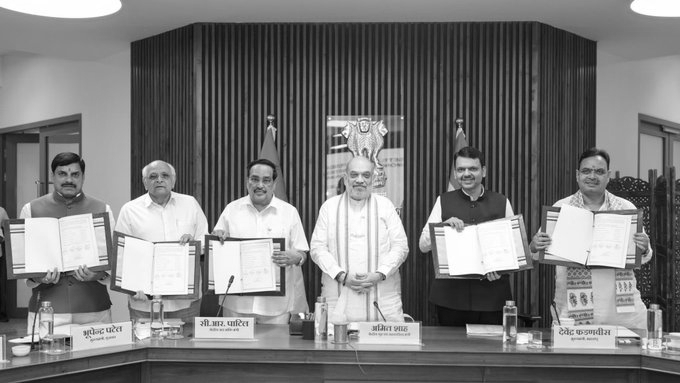
A financial dispute stretching back nearly five decades over the Narmada Project was formally settled on Tuesday, as Madhya Pradesh , Gujarat , Rajasthan and Maharashtra signed a one-time cost-sharing agreement in the presence of Union Home Minister Amit Shah and Jal Shakti Minister C.R. Patil . The pact was signed by Maharashtra CM Devendra Fadnavis , Gujarat CM Bhupendra Patel , Rajasthan CM Bhajan Lal Sharma and Madhya Pradesh CM Mohan Yadav .
The dispute traces back to the 1979 Narmada Water Disputes Tribunal award, which cleared construction of the Sardar Sarovar dam, now 163 metres tall and among the world's largest concrete gravity dams, while requiring Gujarat, as the state hosting the dam and drawing the bulk of its irrigation, drinking water and power, to bear a substantial share of resettlement and rehabilitation costs in upstream Madhya Pradesh and Maharashtra, where villages and farmland were submerged. Under the tribunal's water-sharing formula, Madhya Pradesh draws the largest allocation of Narmada water and the biggest share of hydropower (57%), followed by Maharashtra (27%) and Gujarat (16%), even though Gujarat receives virtually all the irrigation and drinking-water benefit, supplying over 9,000 villages and towns across Gujarat and Rajasthan. That asymmetry, upstream states bearing displacement, Gujarat reaping the water, is precisely what made cost-sharing so contentious for 47 years.
The breakthrough came via a February 2026 opinion from the Attorney General of India on splitting resettlement costs. Under the revised formula, Gujarat's share of the liability rises from 50% to 75% , cutting Madhya Pradesh's outstanding bill from roughly Rs 1,500 crore to a one-time payment of just Rs 217 crore , a fraction of the Rs 7,669 crore MP had originally sought in submergence compensation. Rajasthan has separately cleared its own obligations under the same agreement, though figures were not disclosed, while Maharashtra's exact financial position was not detailed in official statements. Gujarat, despite absorbing the larger share, remains the project's principal beneficiary and can now proceed without pending litigation.
Shah described the pact as a milestone in cooperative federalism, crediting "double-engine" governments across the four states for the pace of resolution, and linked it to two other recent settlements, the Rajasthan-Haryana Yamuna Water Project agreement of June 29 and the Kishau Multipurpose Project MoU of June 16, as part of a broader Centre-led push to resolve inter-state water disputes through negotiation rather than the courts.
Reaction has been mixed. Sections in Madhya Pradesh feel Rs 217 crore is inadequate given the scale of submergence, while some in Gujarat argue even a 75% share is unfair given its outsized benefit. Notably, the settlement addresses only inter-government dues, it makes no reference to the roughly 41,000 families originally displaced by the dam, and activists linked to the long-running Narmada Bachao Andolan movement are yet to respond to Tuesday's agreement.