
Lipulekh Pass Reopens After Six Years, Reviving a Historic Himalayan Corridor
After a six-year hiatus , the ancient India-Tibet border trade through the Lipulekh Pass is set to resume on June 26 , marking far more than the reopening of a seasonal trading route. The development signals the revival of a centuries-old commercial corridor, offers fresh hope to border communities in Uttarakhand, reflects the gradual thaw in India-China relations , and once again draws attention to the geopolitical sensitivities surrounding the India-Nepal-China tri-junction .
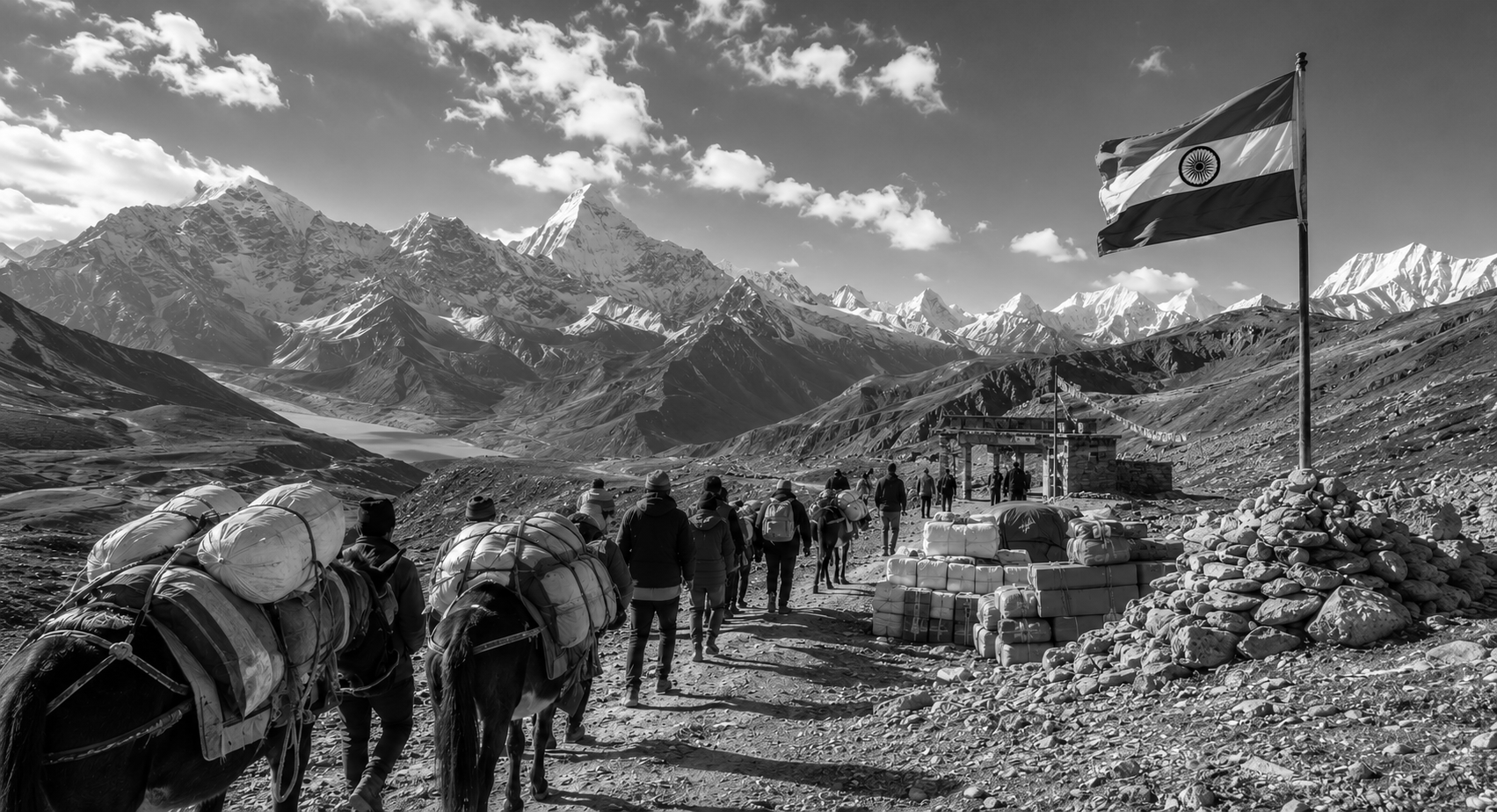
The first batch of 26 Indian traders , comprising 17 traders and nine helpers , is expected to cross into Tibet after receiving official trade passes. Authorities have established a customs office at Gunji , while more than 103 traders have already applied for permits. The administration is preparing to issue passes to a second batch of 25 traders , with arrangements made near Nabhidhang for mules and horses to transport goods to the pass, located about 600 metres away.
For the traders, however, the reopening is bittersweet. Their first task will not be to sell new merchandise but to inspect goods that have remained locked inside warehouses in Taklakot (Purang) in Tibet since the trade route was abruptly shut in 2020.
A Trade Route Older Than Modern Borders
Long before modern nation-states emerged, the Lipulekh Pass , perched at an altitude of about 5,300 metres (16,780 feet) in Uttarakhand's Pithoragarh district , served as one of the busiest trans-Himalayan corridors linking India's Kumaon region with western Tibet.
For centuries, the Rung (Shauka) community carried jaggery, spices, tea, rice, pulses, textiles, utensils and other consumer goods across the Himalayas, returning with Tibetan products such as raw wool, borax, rock salt, silk, sheep, goats and medicinal herbs . The route was not merely a commercial passage but also a cultural bridge connecting Himalayan communities.
Trade came to a halt after the 1962 India-China War , before being restored under a bilateral agreement in 1991 , making Lipulekh the first border trading post reopened between the two countries. Since then, seasonal trade has traditionally taken place between June and September , until operations were suspended again in 2020 .
Why Was Trade Suspended?
Although the immediate trigger for the closure was the COVID-19 pandemic , the route remained shut long after pandemic restrictions eased because bilateral relations deteriorated sharply following the Galwan Valley clash in June 2020.
The deadly confrontation in eastern Ladakh fundamentally altered India-China relations, resulting in military stand-offs along the Line of Actual Control (LAC) , suspension of several people-to-people exchanges and heightened security concerns across the Himalayan frontier. While the Galwan clash did not occur anywhere near Lipulekh, it cast a long shadow over border cooperation, delaying the reopening of trade routes despite improving infrastructure on the Indian side.
The revival of trade now reflects a gradual improvement in diplomatic engagement after multiple rounds of military and diplomatic talks between the two countries. It is widely viewed as a confidence-building measure , even though the broader boundary dispute remains unresolved.
Traders Count Their Losses
For the border trading community, the six-year suspension carried a heavy economic cost.
According to the India-China Border Trade Association , nearly 40 Indian traders had left merchandise worth around ₹2 crore in warehouses and shops at Taklakot when the border closed in 2020. That figure represents only the value of stranded goods.
The actual losses are believed to be much higher, as traders missed six consecutive trading seasons , while transport operators, porters, mule owners, warehouse operators, hotels, restaurants and small businesses across the border economy lost vital seasonal income. No official government assessment of the total economic loss has yet been released.
Upon reaching Tibet, traders plan to inspect the condition of the merchandise before approaching the government for a compensation package to offset losses caused by prolonged storage.
Why the Reopening Matters
In national trade terms, commerce through Lipulekh is relatively modest. However, for remote Himalayan settlements such as Dharchula, Gunji, Nabi, Kuti and Garbyang , the reopening is economically transformative.
The seasonal trade supports an entire ecosystem involving traders, transporters, labourers, pony and mule operators, warehouse owners, hotels, restaurants and local shopkeepers. For many frontier villages with limited employment opportunities, border trade provides one of the most important annual sources of income.
Improved infrastructure has also enhanced the route's commercial prospects. During the closure, India completed major connectivity projects, including the Tawaghat-Dharchula-Lipulekh road , significantly reducing travel time and improving logistics. Better road connectivity, customs facilities and communications are expected to make trade more efficient than before.
The reopening also follows sustained representations by the Rung trading community , which argued that Indian traders should receive the same opportunity after Nepali traders were reportedly allowed to resume trade with Tibet in 2024.
The Tri-Junction That Shapes Himalayan Geopolitics
Lipulekh's significance extends far beyond economics.
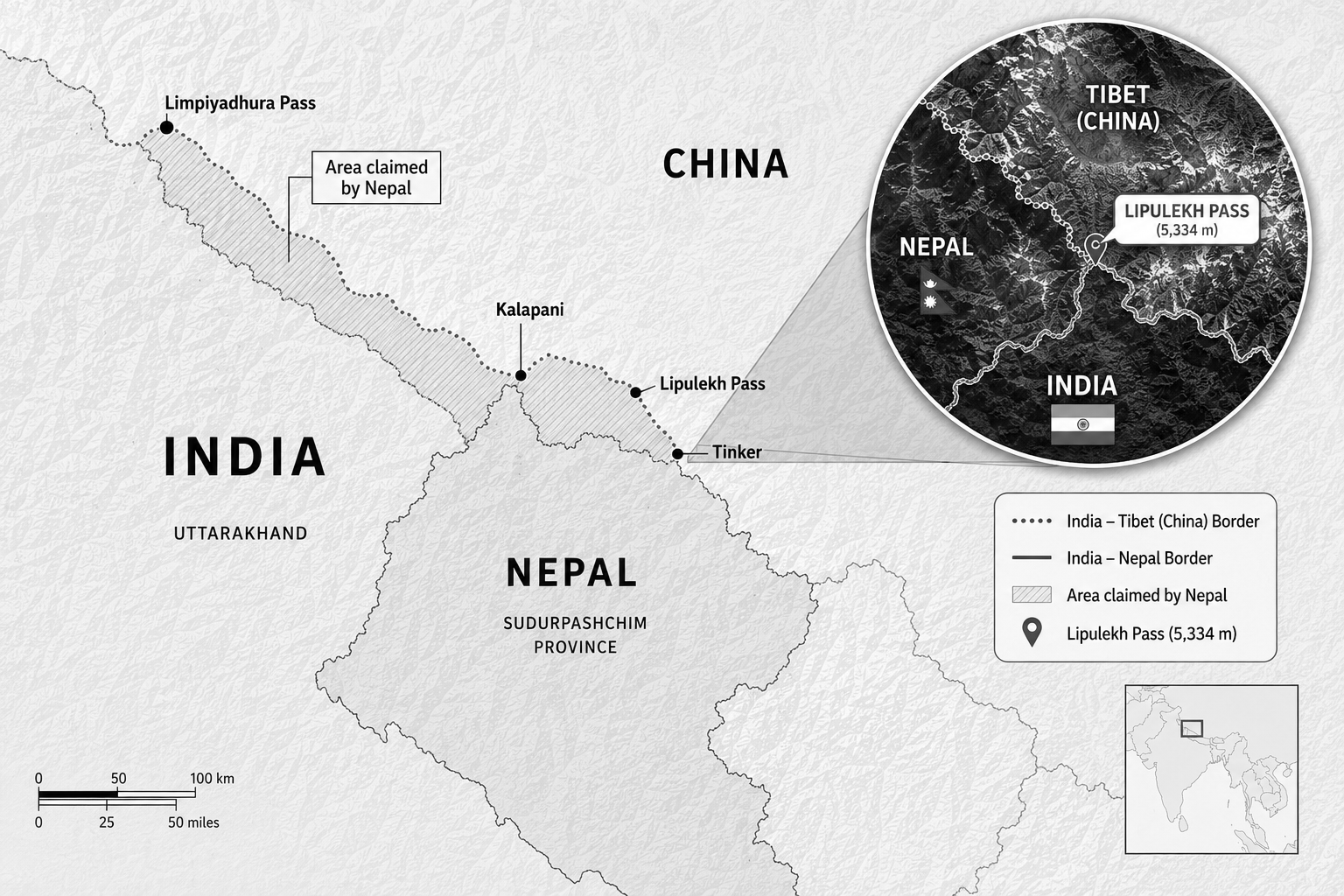
Situated close to the India-Nepal-China tri-junction , the pass occupies one of the most strategically sensitive locations in the Himalayas. It serves as an important route for border surveillance, military logistics and coordination between the Indian Army and China's People's Liberation Army , while also supporting the deployment of the Indo-Tibetan Border Police (ITBP) .
The pass is also one of the principal routes for the Kailash Mansarovar Yatra , one of Hinduism's holiest pilgrimages. Every year, Indian pilgrims travel through Lipulekh to reach Mount Kailash and Lake Mansarovar , sites revered by Hindus, Buddhists, Jains and followers of the Bon faith.
The pilgrimage generates seasonal employment for local residents through transport services, trekking support, hospitality, food, homestays and handicrafts, making tourism another crucial pillar of the border economy.
Why Nepal Objects
Despite India's administration of the region, Nepal continues to claim Lipulekh, Kalapani and Limpiyadhura as its sovereign territory.
The dispute originates from differing interpretations of the 1816 Treaty of Sugauli , signed after the Anglo-Nepalese War. The treaty states that the Kali (Mahakali) River forms Nepal's western boundary.
Nepal argues that the river originates at Limpiyadhura , meaning Lipulekh, Kalapani and surrounding areas fall east of the river and therefore belong to Nepal.
India, however, maintains that the Kali River originates from the Kalapani springs , placing the disputed territory on the Indian side. It also points to decades of uninterrupted administration, including elections, taxation, census operations and the presence of Indian security forces since the 1962 war , as evidence supporting its position.
The dispute intensified in 2020 , when India inaugurated the Dharchula-Lipulekh road . Nepal protested, claiming part of the road passed through its territory, and later issued a new political map incorporating Kalapani, Lipulekh and Limpiyadhura within Nepal's borders. The map was subsequently endorsed through a constitutional amendment, a move rejected by India.
More Than a Trade Route
The reopening of Lipulekh does not resolve the longstanding territorial dispute involving India and Nepal, nor does it eliminate strategic competition with China. Instead, it represents a pragmatic effort to revive traditional commerce while broader diplomatic issues continue to be addressed through established mechanisms.
For the people of Uttarakhand's frontier villages, however, the significance is immediate and tangible. After six years of uncertainty, the reopening restores a centuries-old trading tradition, revives livelihoods, supports pilgrimage tourism, strengthens border infrastructure and reconnects Himalayan communities whose economic and cultural ties long predate modern international boundaries.
In many ways, the reopening of Lipulekh is not merely the return of a trade route—it is the revival of one of the Himalayas' oldest civilisational corridors, where commerce, culture, faith and geopolitics continue to intersect.