
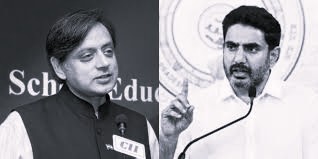
Lokesh Counters Tharoor, Says More Lok Sabha Seats Mean Better Representation
As the debate over Lok Sabha delimitation gathers momentum ahead of a crucial review expected after 2026, Andhra Pradesh IT and Electronics Minister Nara Lokesh has made a strong case for expanding the strength of Parliament. Responding to concerns raised by Congress MP Shashi Tharoor , Lokesh argued that increasing the number of Lok Sabha seats is a democratic necessity aimed at ensuring better representation for India's growing population, rather than a move that would unfairly benefit any particular state.
The exchange comes at a time when questions surrounding population-based representation, federal balance, and states' rights are increasingly shaping the national political discourse. While Tharoor has expressed concerns that larger states could gain greater political influence through seat expansion, Lokesh maintained that the issue should be viewed from the perspective of democratic fairness and effective governance.
In a post on social media platform X, Lokesh pointed out that India's population has grown dramatically over the past five decades—from about 55 crore in 1971 to nearly 146 crore today . Despite this sharp increase, the strength of the Lok Sabha has remained largely unchanged. As a result, each Member of Parliament now represents significantly more people than was the case when the current framework was established.
According to Lokesh, this growing gap highlights the need for a larger Parliament that can provide citizens with more effective representation. He stressed that expanding the number of MPs is not about political advantage but about strengthening democratic institutions and improving the connection between elected representatives and the people they serve.
Referring to Article 81 of the Constitution , Lokesh noted that parliamentary representation is intended to be linked to population. He also pointed out that the freeze on seat redistribution based on the 1971 Census was introduced as a temporary arrangement and was never meant to be permanent. Given the country's demographic transformation, he said it is reasonable to revisit the representation framework.
Addressing concerns that states which successfully implemented population-control measures could be disadvantaged, Lokesh argued that maintaining the current proportional share of states while increasing the overall number of seats would prevent any loss of representation. Such an approach, he said, would allow all states to benefit from enhanced parliamentary representation without disturbing the existing balance.
He also rejected Tharoor's analogy comparing seat expansion to a uniform salary hike. Parliamentary influence, Lokesh argued, is determined by voting strength and legislative majorities. If all states receive seat increases in the same proportion, the overall political equilibrium remains intact.
With delimitation set to become one of India's most consequential constitutional and political issues in the coming years, the Lokesh–Tharoor debate has brought renewed attention to how the world's largest democracy should balance population growth with equitable representation in Parliament.