
Maharashtra Issues 331 Notices to Auto, Taxi Drivers in Marathi Language Drive
Maharashtra's statewide enforcement drive requiring autorickshaw and taxi drivers to demonstrate a working knowledge of Marathi has intensified, with Regional Transport Offices (RTOs) issuing 331 notices to drivers on August 24, including 139 in the Mumbai Metropolitan Region (MMR), after they failed to demonstrate the required level of Marathi proficiency.
On August 24, RTO teams checked 1,392 drivers in the MMR, of whom 139 were found lacking the required Marathi knowledge. Across the rest of Maharashtra, another 3,415 drivers were checked and 192 notices were issued. The five-day tally since the drive began on August 20 reached 35,190 vehicles checked statewide, including 14,399 in the MMR, with 4,729 notices issued, of which 2,239 were in the MMR. The month-long campaign is scheduled to continue until September 30, 2026.
The latest enforcement follows an earlier 105-day Marathi training programme launched on May 1 for non-Marathi-speaking commercial drivers. About 1.65 lakh drivers reportedly completed the training and received certificates. In Mumbai, nearly 1.25 lakh drivers completed the programme, while around 7,750 failed the assessment and more than 14,000 had not completed the training. The government says the requirement is for working knowledge, not fluency, with assessments focused on everyday situations involving destinations, directions, fares, meters and routes.
The government has also sought to clarify the consequences of failing the assessment. Drivers who do not demonstrate adequate Marathi knowledge are first issued a one-month notice to improve their skills. Continued non-compliance can lead to suspension of the driver's badge and licence for three months, with further action possible for repeated failure. Chief Minister Devendra Fadnavis said on August 24 that drivers do not need to be Marathi experts, while Transport Minister Pratap Sarnaik has defended the requirement as necessary for passenger communication, convenience and safety.
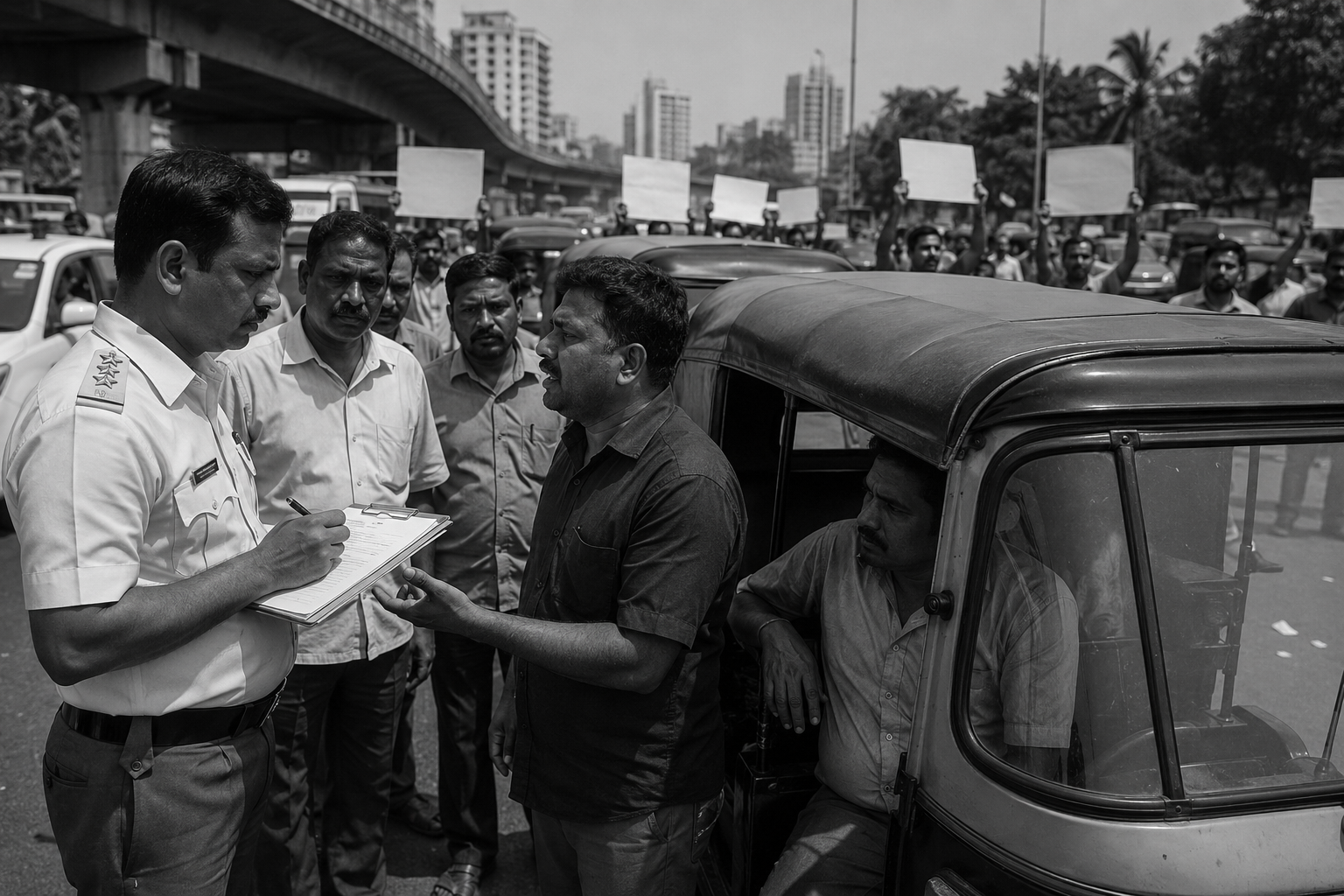
However, the testing process itself has become controversial. Several drivers allege that some roadside assessments included questions outside the training syllabus, raising concerns over whether "working knowledge" is being assessed uniformly. The dispute is particularly sensitive because Mumbai's transport sector includes a large migrant workforce, making language proficiency a potential livelihood issue rather than merely a training requirement.
The controversy also has a long legal history. Maharashtra has argued that Marathi-related requirements have existed in its transport rules for decades, but an earlier attempt to impose a similar condition on autorickshaw permits was challenged in the Bombay High Court in 2017. The state subsequently amended its regulatory framework and now maintains that the current rules provide a stronger legal basis for enforcement.
The policy has triggered a three-day autorickshaw strike beginning August 24, with protests and road blockades reported in parts of Mumbai. The disruption affected commuters, particularly on feeder routes connecting residential areas with railway stations.
The dispute is now moving toward the courts. A Public Interest Litigation was filed before the Bombay High Court on August 25, challenging the August 12 notification making working knowledge of Marathi compulsory for autorickshaw, taxi and app-based cab drivers.
At its core, the controversy reflects a clash between Maharashtra's linguistic identity, Mumbai's migrant workforce and drivers' right to earn a livelihood. With inspections continuing until September 30, the August 24 notices are likely to be only the latest phase of a dispute that could increasingly play out on both the streets and in court.