
Maharashtra’s Next Railway Revolution: 2,052-km Freight Corridor, Bullet Train and 238 New Locals
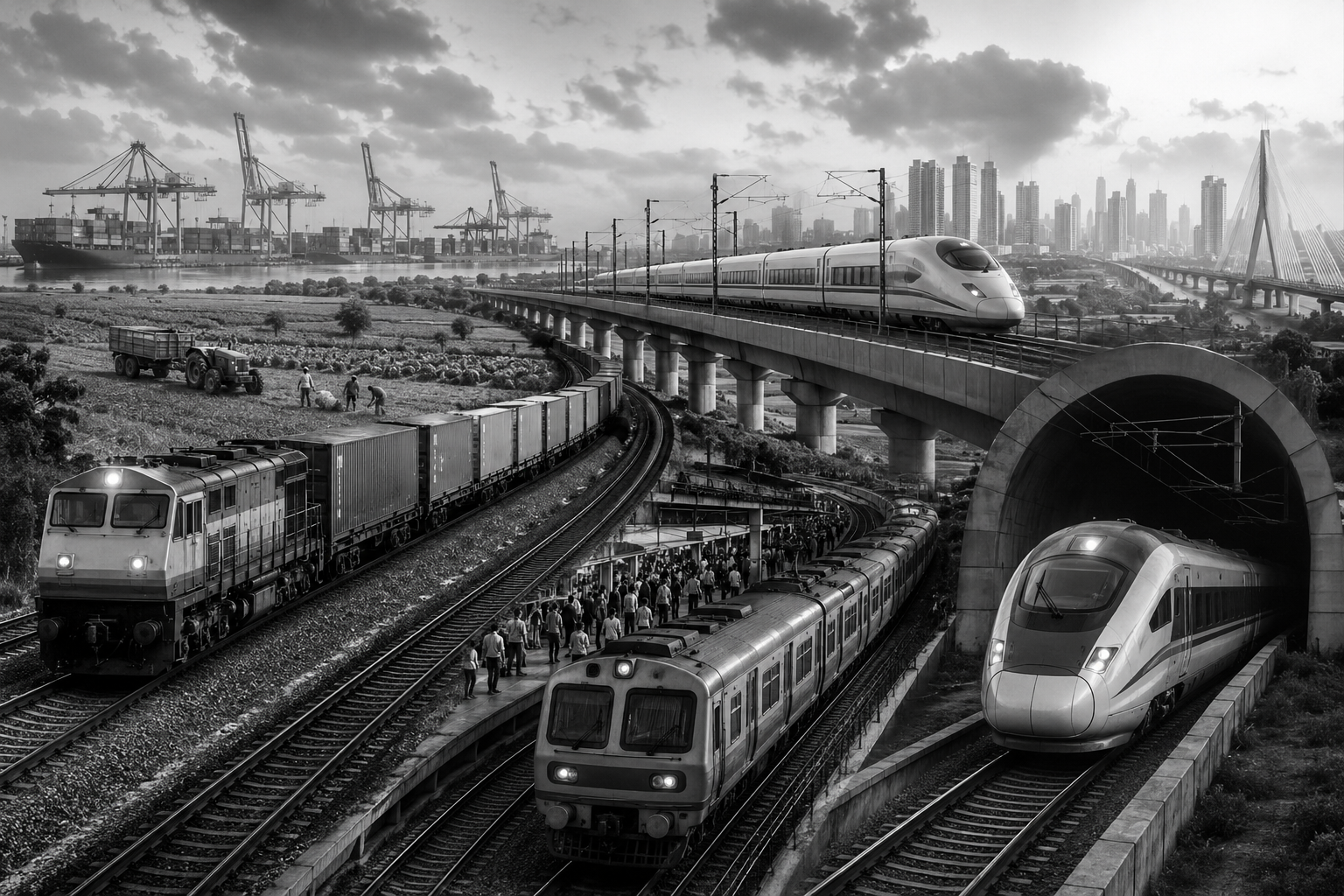
Maharashtra is emerging as the centrepiece of a sweeping railway transformation that is set to change how people, goods and agricultural produce move across the state and the country. From a proposed 2,052-km east-west freight corridor to 238 new suburban train rakes, Vande Bharat Sleeper services and India's first bullet train, a new railway architecture is taking shape around Maharashtra.
The scale of the change was highlighted by Railway Minister Ashwini Vaishnaw on Thursday while addressing, through video link from Delhi, the flag-off ceremony of the new CSMT–Sawantwadi Road daily Express. He said the proposed Dankuni–Surat East-West Dedicated Freight Corridor (DFC) would bring railway connectivity to several parts of Maharashtra that have never been connected before and provide a major push to industrial as well as rural development.
Announced in the Union Budget 2026-27, the 2,052-km greenfield corridor will pass through West Bengal, Odisha, Chhattisgarh, Madhya Pradesh, Maharashtra and Gujarat. Its eastern end at Dankuni and western end at Surat are strategically important because the new line is intended to integrate with India's existing freight network and improve east-west movement of goods. The government has earmarked nearly ₹1.20 lakh crore for the project, while its DPR is being prepared or updated.
For Maharashtra, the proposal emerged after Chief Minister Devendra Fadnavis suggested linking the eastern and western freight corridors with new industrial development zones. Vaishnaw said the proposed route is being designed to connect previously unserved areas, including parts of western Maharashtra and Nashik.
A new economic spine
The corridor's importance goes beyond railway connectivity. The existing Eastern DFC, stretching 1,337 km from Ludhiana to Sonnagar, and the Western DFC, extending 1,506 km between Dadri and JNPT, have created a dedicated freight network capable of carrying heavier and faster trains while freeing capacity on conventional railway routes. More than 443 freight trains are operated daily on the DFC network, with growing movement of containers, coal and bulk cargo.
The Dankuni–Surat link could eventually create a broader east-west freight chain. Coal, iron ore, steel, minerals and industrial raw materials from eastern and central India could move towards western manufacturing centres and ports, while chemicals, pharmaceuticals, engineering goods, automobiles, textiles and other manufactured products could travel in the opposite direction.
The government has not yet published a final commodity-wise cargo forecast or trade-value estimate for the new corridor. But its potential lies in creating faster, more reliable and lower-cost logistics between India's major production and consumption regions.
Farmers could gain a larger market
One of the most important long-term benefits could come from agriculture.
For regions such as Nashik and western Maharashtra, better freight connectivity could potentially make it easier to move onions, grapes, pomegranates, vegetables and other perishables to distant markets. The real benefit, however, will depend on whether railway terminals are supported by warehouses, cold chains, aggregation centres, food-processing units and last-mile roads.
The ideal supply chain would be: Farm → FPO/aggregation centre → grading/cold storage → processing → freight terminal → national market or export destination.
Such an ecosystem could widen the market available to farmers, reduce dependence on nearby markets and encourage food-processing industries closer to agricultural production centres. The railway alone cannot guarantee higher farm incomes, but it can become an important link in reducing the distance between farm and consumer.
Mumbai's local trains get a major capacity push
While the freight corridor looks towards the next decade, Mumbai's railway challenge is immediate. Around 3,200 suburban services operate daily, with official figures putting the number at 3,230 EMU services, including AC services.
Vaishnaw said the Railways is targeting roughly a 10% increase in services, supported by capacity expansion and improved signalling.
The government has also sanctioned 238 AC EMU rakes of 12 cars each at a cost of around ₹19,293 crore under Mumbai's urban transport programme. Production is scheduled to begin in 2027, with the fleet targeted for completion by 2030.
The trains will be manufactured at Integral Coach Factory, Chennai; Rail Coach Factory, Kapurthala; and Modern Coach Factory, Raebareli. Together with track, signalling and station improvements, the programme is expected to substantially increase Mumbai's suburban carrying capacity.
From Vande Bharat Sleeper to Bullet Train: Maharashtra’s Long-Distance Rail Revolution
The next phase of Maharashtra’s railway transformation combines modern overnight travel with high-speed daytime connectivity. The Vande Bharat Sleeper is designed to bridge the gap between conventional overnight trains and premium high-speed services, offering passengers modern accommodation while allowing them to travel long distances overnight.
India’s first regular Vande Bharat Sleeper service, Howrah–Kamakhya, began operations in January 2026 after extensive testing. The trains are designed for long-distance travel, with a design speed of 180 kmph and an operating speed of 160 kmph. They feature Kavach, crashworthy coaches, fire-safety systems, automatic doors, CCTV, emergency communication facilities and improved passenger amenities.
Indian Railways has planned 260 Vande Bharat Sleeper rakes, with production being undertaken in phases by BEML, Integral Coach Factory and technology partners. For Maharashtra, one of the most important proposed connections is Mumbai - Bengaluru. Railway Minister Ashwini Vaishnaw announced in May that the service was expected to begin soon.
While Vande Bharat Sleeper trains will improve overnight inter-city travel, the 508-km Mumbai - Ahmedabad High-Speed Rail project is being developed for rapid daytime journeys. The project is considerably further advanced than the proposed Dankuni - Surat freight corridor, with the entire 1,389.5 hectares of required land acquired, all statutory clearances obtained and 1,651 utilities shifted.
Construction has reached 430 km of piers, 341 km of girders, 174 km of track bed and 153 km of overhead-electrification masts. The corridor will have 12 stations, connecting Mumbai and Thane with Ahmedabad and Sabarmati through Virar, Boisar, Vapi, Bilimora, Surat, Bharuch, Vadodara and Anand.
The most challenging engineering component is the 21-km underground section, which includes a 7-km undersea tunnel beneath Thane Creek. Two tunnel-boring machines are working on the Mumbai section, while construction is also progressing on the underground BKC station.
The first bullet-train services are targeted for 2027, with phased commissioning. The trains are designed to operate at speeds of up to 320 kmph, significantly reducing travel time between Mumbai and Ahmedabad.
The project is also important because it could serve as a test bed for India’s wider high-speed rail ambitions. The 2026-27 Union Budget has proposed seven high-speed rail corridors covering nearly 4,000 km, with potential investment of around ₹16 lakh crore. Together, Vande Bharat Sleeper and bullet-train services represent two complementary models of future rail travel: one focused on comfortable overnight journeys and the other on rapid daytime connections between major economic centres.
Konkan gets an immediate boost
Amid these mega-projects, the new CSMT–Sawantwadi Road daily Express provides an immediate connectivity benefit. It links Mumbai with major Konkan centres including Ratnagiri, Kankavli, Kudal and Sawantwadi, strengthening access for tourism, employment, education and business.
The timing is significant as the Ganesh festival approaches. Vaishnaw said the Railways would operate 350 special trains, with the number capable of rising to 375 if required.
A railway network with different layers
The emerging picture is therefore bigger than any single project.
Suburban trains will move Mumbai's daily workforce.
Vande Bharat Sleeper will modernise overnight inter-city travel.
Bullet trains will connect major economic centres at very high speed.
Dedicated Freight Corridors will move industrial and agricultural goods.
JNPT and emerging port infrastructure will connect production with global markets.
The Dankuni–Surat corridor is still at the DPR and early land-acquisition stage, with no official full commissioning date. The bullet train is already deep into construction, while Vande Bharat Sleeper has entered regular service but is still being rolled out across the network.
If these projects are supported by efficient last-mile connectivity, logistics parks, cold chains, industrial clusters and multimodal terminals, Maharashtra could emerge with a railway system designed not merely to connect places, but to connect farms to markets, factories to ports and people to economic opportunities.
That is the real significance of the railway transformation now underway.