
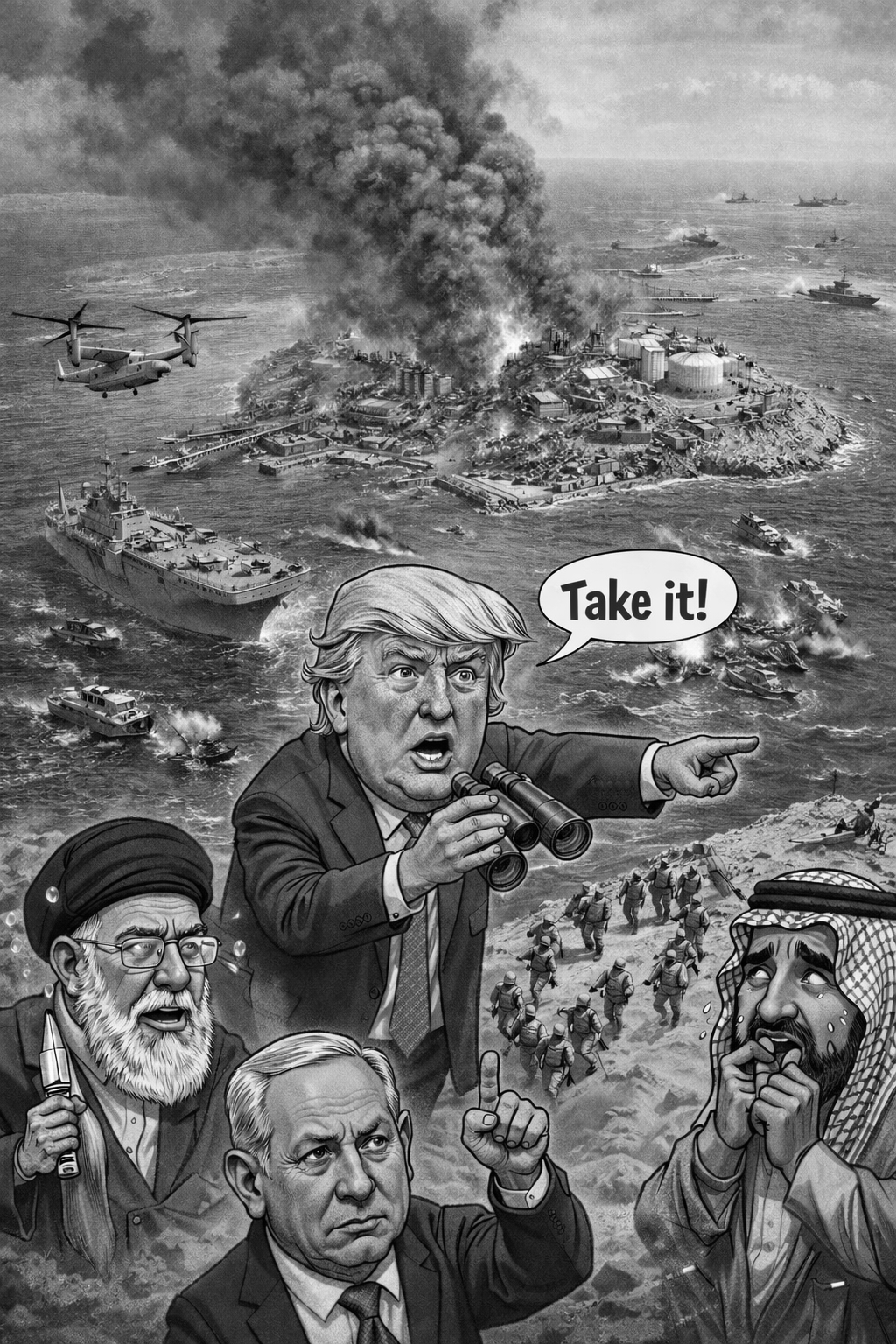
Middle East War Day 15: After the Bombs, Will US Boots Land on Kharg Island?
The war nobody wanted and everyone feared has entered its most dangerous chapter yet. One question is dominating every war room, every trading floor, and every foreign ministry on the planet: after bombing Kharg Island into submission, is Trump about to send in the Marines?
Trump confirmed on Day 15* that US forces have carried out a massive precision strike on every military installation on *Kharg Island* Iran's self-described "crown jewel" through which roughly *90% of the country's oil exports* flow. Naval mine storage facilities, missile bunkers, military infrastructure all destroyed. Trump spared the oil terminals, he said, *"for reasons of decency."* But he warned on Truth Social that any Iranian interference with the *Strait of Hormuz* would instantly reverse that restraint. Then he went further announcing the US would bomb *"the hell out of the shoreline"* and shoot Iranian boats *"out of the water,"* adding that *"one way or the other, we will soon get the Hormuz Strait open, safe, and free."
But the most chilling signal came not from Trump's words but from what is floating in the water right now. The USS Tripoli , an amphibious assault ship carrying 2,500 Marines units specifically designed and trained for rapid island seizure operations is heading directly toward the region. The White House has been actively considering a ground operation to capture Kharg Island . Hegseth has refused to rule out deploying American ground forces in Iran , carefully stating only that the US "won't get bogged down" there. Military analysts say seizing the island would require approximately 5,000 ground combat troops . The USS Tripoli's Marines are exactly that kind of force. The option is not theoretical it is operational.
The strategic logic is stark: control Kharg Island, control Iran’s oil revenue . A Villanova military geography expert said, “To win quickly, you destroy or capture Kharg immediately.” Trump likely seeks leverage over the Strait of Hormuz , not permanent occupation. Yet with oil up 40% since the war began and US gas at a 22-month high of $3.63 , even the threat rattles global markets. Full seizure could push Brent crude past $150 - a number that terrifies Washington's own economists as much as Tehran's generals.
Iran knows this too. Tehran has directly threatened that US-linked oil facilities across the Gulf would be reduced to "a pile of ashes" if Kharg's oil structures are touched meaning Saudi Aramco, UAE terminals, and Qatar's LNG facilities all become immediate targets. An occupation triggers a regional energy catastrophe that would dwarf the war itself.
Meanwhile, Iran's missile war is dying and fast. It entered this conflict with an estimated 2,500 ballistic missiles , firing 480 on Day 1 alone . By Day 10 that number had collapsed 92% to just 40 per day, with 60% of its missile launchers destroyed . Today, Iran retains fewer than 200 active launchers . The salvoes that once shook Tel Aviv have shrunk to isolated, desperate one-or-two missile strikes a force burning through its final reserves. Analysts project Iran's ballistic missile capability against Israel could be functionally exhausted within days . What replaces it is a grinding drone war targeting energy infrastructure and Gulf ports cheaper, harder to intercept, and grimly sustainable. The State Department slapped a $10 million bounty on Khamenei and other top officials.
Then came a scene that would have been unimaginable two weeks ago. Explosions struck near a pro-government rally in Tehran attended by senior officials including security chief Ali Larijani , President Masoud Pezeshkian , and Foreign Minister Abbas Araghchi , killing at least one person. Nowhere inside Iran is safe anymore not even a government rally in the capital.
The human toll is staggering. Since February 28, 1,444 people have died in Iran and 18,551 injured, including 223 women and girls. Fifteen Israelis are dead, over 2,000 wounded, and 11 US soldiers confirmed dead, including four lost when a refueling plane was downed over western Iraq. In Lebanon , 773 have died since March 2, including 12 medical workers killed in an Israeli strike on a healthcare center in Borj Qalaouiye. Israeli shells also hit a UN Nepalese peacekeeping HQ. Over 800,000 people are displaced , with Israeli Defence Minister Katz claiming the number exceeds one million. Israel has carried out roughly 7,600 strikes in Iran and 1,100 in Lebanon since the campaign began.
The most internationally condemned attack was the Day 1 strike on Shajareh Tayyebeh girls’ school in Minab , Iran, which killed 165 children aged 7–12 under a collapsed roof. Bellingcat, BBC Verify, and The New York Times independently confirmed a US Tomahawk cruise missile caused it, a conclusion echoed by a preliminary US military investigation. Trump blamed Iran. The world remains silent.
The conflict has engulfed the region. Iranian strikes hit Dubai International Airport and UAE hotels, with air defenses intercepting 9 ballistic missiles and 33 drones on Day 15 alone, totaling 294 missiles, 15 cruise missiles, and 1,600 drones across the war. Saudi Arabia destroyed six drones; Qatar intercepted one missile and evacuated parts of Education City. Sirens sounded in Bahrain; two died from falling debris in Oman. A US Embassy helipad in Baghdad was hit, destroying its air defense system. Iran targeted Citibank offices in Dubai and Manama , a French naval facility in the UAE, Italian installations in Iraq and Kuwait, the Russian consulate in Isfahan, and an RAF base in Cyprus.
Iran’s cultural heritage is under fire. Strikes damaged Golestan Palace, Naqsh-e Jahan Square, Chehel Sotoun, the Shah Mosque, and Falak-ol-Aflak fortress , prompting urgent UNESCO warnings.
Diplomatic efforts surfaced on Day 15. France offered to host direct ceasefire talks between Israel and Lebanon in Paris. Lebanese leaders expressed willingness, but Israel has not responded. France previously brokered the 2024 ceasefire with Hezbollah, which held 15 months.
Trump called on China, France, Japan, South Korea, and Britain to send warships to the Strait of Hormuz, though none were named. The US Navy lacks the capacity to escort tankers alone. India, France, and Italy are negotiating directly with Tehran; two Indian LPG tankers safely crossed the Strait. A retired US Army colonel warned the US is losing allies faster than wars .
The global economy is fracturing in real time. Oil prices have surged nearly 40% . KLM cancelled all Dubai flights through March 28. Emirates suspended all Dubai operations . Indian airlines have sharply hiked fares. Canada released 23.6 million barrels of emergency reserves through the IEA . Australia has ordered all non-essential officials out of the region and urged its citizens to leave while they still can. Hezbollah's Naim Qassem declared his forces ready for a "long confrontation." The Houthis remain constrained by a 2025 ceasefire with Washington for now but their leader's hands remain, in his own words, "on the trigger."
Trump claims Iran's military is "destroyed 100%." Iran's drones are still flying. Its mines are still floating. Its missiles fewer every day, but not yet gone are still launching.