
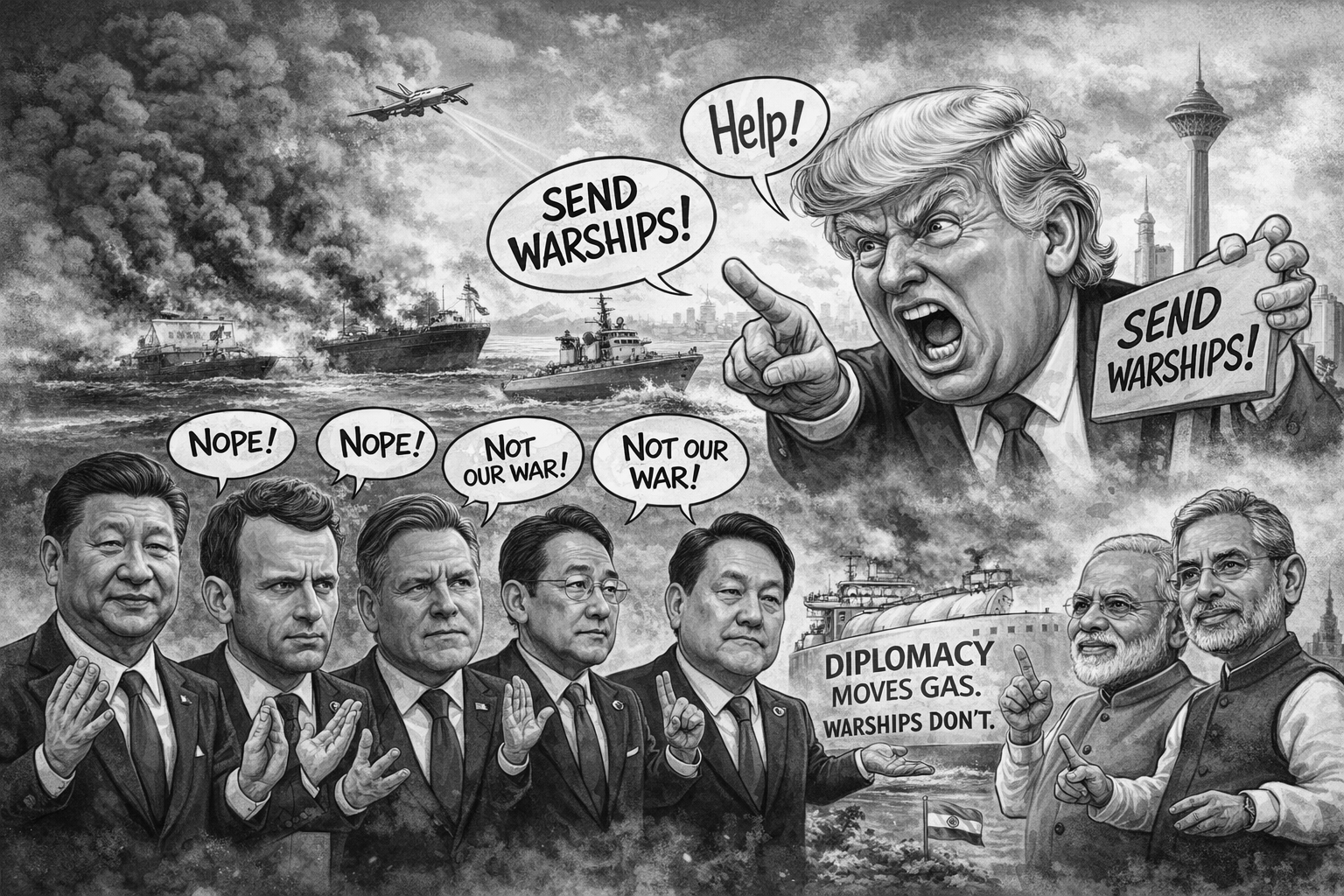
Middle East war day 17: Trump needed a squad at Hormuz - none showed up
On Saturday, President Trump took to Truth Social declaring that "many countries" would be sending warships to keep the Strait of Hormuz open. He named China, France, Japan, South Korea and the United Kingdom by name. He sounded confident. By Monday morning, not a single country had committed - with most rejecting the request outright. Trump upped the ante in an interview, warning NATO that its failure to help would be "very bad for the future of NATO" and adding: "Whether we get support or not - we will remember." The threats landed like a damp missile. The world barely flinched.
Germany's* Chancellor Merz's spokesman said flatly: _"This is not NATO's war."_ Greece ruled out military involvement. Italy said it was not involved in any naval mission. *France* said it would maintain a *"defensive and protective"* posture and would not be drawn into a US-Israeli war. *Japan and Australia* said they had no plans to deploy ships. *Britain's* PM Keir Starmer rejected Trump's warship request directly - offering only drones for mine-sweeping, which experts described as the diplomatic equivalent of sending a broom to a gunfight. *India* opted out of any coalition, choosing instead to deploy its own navy under *Operation Sankalp* - quietly but firmly telling Washington: *we guard our own ships, you guard yours.
Trump's top economic adviser Kevin Hassett confirmed the US has already spent $12 billion on the war and that's the conservative number. Democrats are demanding hearings. There is no timeline, no endgame, no exit strategy. Analysts warn a 60-day conflict could add $66 billion to the US deficit - on top of a budget already projected to breach 120% of GDP by 2035. Trump is telling Americans that high oil prices are good for the economy. Most Americans filling their tanks disagree.
Iran knows exactly what it is doing. This is not a military strategy - it is mathematics. Every day the war drags on, Trump bleeds money, approval ratings, and allies. Every day Hormuz stays shut, oil climbs, inflation bites, and the American public grows angrier. Tehran is not trying to win in a single blow. It is trying to make this war cost too much to continue. For Iran, time is not a problem. For Trump, it is becoming the only problem that matters.
The shield is cracking. Iranian cluster munition missiles have punched through Israeli defenses - one striking a synagogue shelter in Beit Shemesh , killing nine civilians , the deadliest single strike on Israeli soil since the war began. Reinforced shelters are no longer safe. The IDF denied running low on interceptors - then approved an emergency NIS 2.6 billion ($826 million) procurement package by phone, in the middle of the night. The midnight vote said what the morning press conference wouldn't. Iran engineered this drain deliberately - cluster missiles releasing dozens of warheads across a 10-kilometre radius , forcing Israel to burn multiple expensive interceptors per incoming round. A calculated, clinical bleed.
Israel and the US are swinging back - Israeli F-35s alongside US B-1 and B-52 bombers hitting Iran at three major locations, destroying 200 air defence systems, 17 warships including one submarine , pounding IRGC bases and hardened underground facilities. Inside Iran the toll is catastrophic - 1,444 dead, 18,551 wounded , over 10,000 civilian sites damaged , 65 schools, 32 medical facilities struck, millions cut off as the internet goes dark.
The UAE alone has swallowed 304 ballistic missiles, 15 cruise missiles and 1,627 drones since February 28 - nearly matching Israel. Dubai International Airport shut mid-day after a drone ignited a fuel tank; a Dublin flight turned back over Egypt eight hours in ; a Palestinian was killed in Abu Dhabi by a missile that hit his car; Fujairah's oil hub caught fire; Saudi Arabia downed 37 drones in one day; Bahrain, Kuwait and Qatar all reported interceptions; the UAE's Ruwais refinery - 922,000 barrels per day - shuttered as a precaution. Over 2,000 combined attacks across the GCC since the war began. Goldman Sachs warns Qatar and Kuwait face 14% GDP contractions if Hormuz stays shut through April. A Shahed drone costs $50,000 to build. A Patriot interceptor costs $4 million . A THAAD missile costs $12 million . The Gulf is burning millions to destroy $50,000 toys.
In Lebanon, Israel has launched over 250 strikes , evacuated border villages and pushed forces deeper south - calling it a "limited ground operation" while military analysts call it the opening act of a permanent campaign to push Hezbollah north of the Litani River and seize southern Lebanon for good . Limited is doing a lot of work in that sentence. 850 dead - over 100 children. UNIFIL's peacekeeping patrols fired upon. PMF headquarters at Jurf al-Sakhar struck in Iraq.
India chose a smarter path* . Indian External Affairs Minister *S. Jaishankar* confirmed that diplomatic back-channels with Tehran had allowed two Indian-flagged LPG tankers - *Shivalik* and *Nanda Devi* - carrying *92,712 metric tonnes of cooking gas* to transit the strait safely and dock at *Mundra and Kandla ports in Gujarat.* New Delhi's message to Washington was quiet but unmistakable: *diplomacy moves gas. Warships don't.
But India's larger nightmare struck Monday morning. US missiles targeted military facilities near Chabahar Port - India's single most strategic overseas investment. Explosions rang out near the port's trade zone. India has poured over $500 million into Chabahar's Shahid Beheshti terminal - its "golden gate" to Afghanistan and Central Asia, a corridor that bypasses Pakistan entirely. The terminal was not directly hit, but the military installations surrounding it were struck hard. Years of patient diplomacy and strategic investment are now surrounded by bomb craters.
The Netanyahu saga refused to die and neither, for the record, did the Israeli Prime Minister. After viral death rumours swept across social media, Netanyahu posted a café video from The Sataf in Jerusalem - coffee in hand, joking in Hebrew: "I'm dead... for coffee. I'm dead for my people." Instead of killing the rumours, the café video birthed new ones - users claimed the coffee never spilled when tilted , his face shape shifted from round to oval when he looked down , and the receipt machine showed a 2024 date . Grok declared it "100% likely a deepfake." The café posted its own Instagram photos proving the visit happened.Nobody believed anyone. Netanyahu then posted a second video - titled "Sticking to the guidelines and winning together" - showing him outdoors in Jerusalem , casually interacting with civilians and taking photos. And a ring magically disappears from his finger as he shakes onlooker’s hands.
Behind closed doors, the Arab world is far from neutral. The New York Times revealed that Saudi Crown Prince Mohammed bin Salman has been privately urging Trump to "keep hitting Iran hard" .
Trump said that Iran is "ready to make a deal" to end the war - but that the US wants better terms. He said he is not ready to make a deal "because the terms are not good enough yet". Iranian Foreign Minister Abbas Araghchi was unambiguous: "We never asked for a ceasefire. We never asked for negotiation. We are ready to defend ourselves as long as it takes." Two men. Two completely different clocks.
The experts who study Iran say this is a regime that has spent 40 years preparing to absorb exactly this kind of punishment and that the greatest strategic miscalculation of this war may be the assumption that bombing will break what sanctions, assassinations, and isolation never could.