
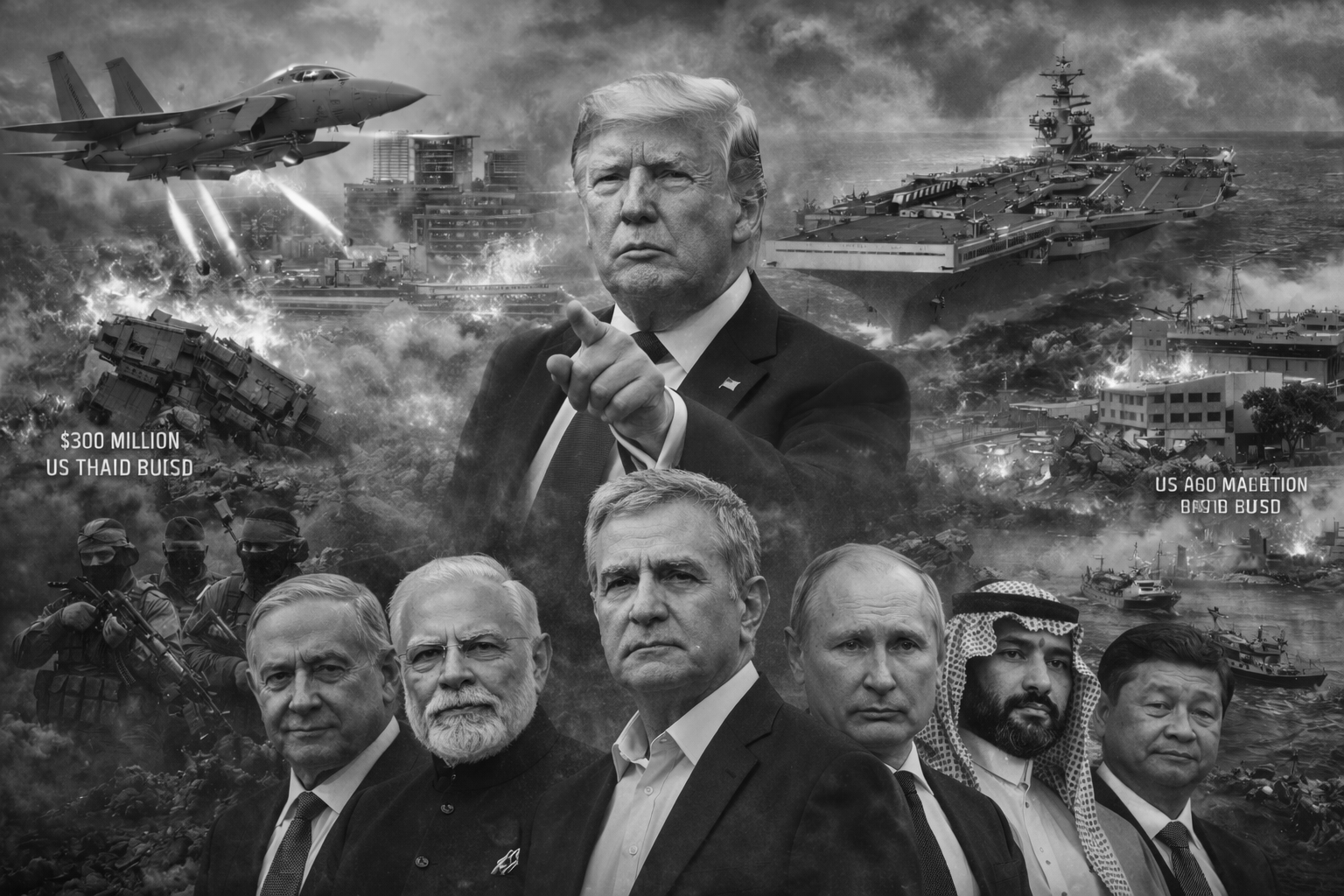
Middle East War, Day 8: More Carriers, More Bombs, More Bodies and Still No Plan B
The world woke up on Saturday to a Middle East that looked nothing like it did a week ago. The conflict has grown far beyond anyone's stated intention. What was launched as a targeted campaign to eliminate Iran's nuclear and military infrastructure has become a war consuming Lebanon, shaking Gulf capitals, disrupting global aviation, moving oil markets, pulling Russia and China into the shadows, and forcing India to choose its words very carefully. At least 1,332 people are dead in Iran. Over 217 have been killed in Lebanon. Eleven Israelis and six Americans have lost their lives. More than 330,000 people have been displaced. And on Saturday, every single front got worse.
Israel launched Day 8 with its fiercest bombardment yet, sending over 80 fighter jets to drop 230 bombs across Tehran, including Mehrabad Airport. The strikes targeted Iran’s missile factories, production lines, assembly halls, and underground storage, systematically dismantling its capacity to retaliate . On the same day, the US approved a $151 million arms sale to Israel . Operation Epic Fury’s first 100 hours have already cost $3.7 billion , prompting Trump to order US defense manufacturers to quadruple production. A third carrier strike group, the USS George H.W. Bush joined two others in the Persian Gulf and Eastern Mediterranean.
Iran has not absorbed any of this quietly. Iran struck back decisively Saturday. The IRGC launched its 23rd retaliatory wave, destroying a $300 million US THAAD radar the largest US hardware loss yet and hitting a US air combat center and satellite hub in the UAE . Iran claimed attacks on at least 27 US bases across the Middle East. Against Israel, coordinated waves of drones, cruise missiles, and ballistic missiles triggered explosions and air raid sirens, signaling a grinding war of attrition designed to deplete Israel’s Arrow-3, Arrow-2, and David’s Sling interceptors at $3 billion per week. Hezbollah confirmed clashes with Israeli troops in the Bekaa Valley, wounding eight soldiers.
The Gulf states woke to simultaneous strikes. Dubai International Airport was hit by Iranian drones, with at least one impact on facilities, several interceptions above the runway, and dozens of airlines diverting or suspending flights. Qatar shot down nine of ten drones; one got through, but Hamad International Airport partially resumed emergency flights to London, Paris, Madrid, Rome, and Frankfurt. Saudi Arabia intercepted drones near Riyadh and 16 more targeting the Shaybah oil field, signaling Iran’s readiness to strike Gulf capitals directly. In Bahrain , a hotel, two residential buildings, and an oil refinery were hit. Iran warned the Strait of Hormuz remains open but US or Israeli vessels will be targeted .
Beyond the attacks, Gulf states seethed at being blindsided . Sources said Saudi Arabia, the UAE, Qatar, and Bahrain received no advance notice before the February 28 strikes on Iran. Their direct warnings to US officials that such an assault would spark regional chaos were ignored. These were not timid objections. Gulf leaders had maintained quiet back-channels to Tehran for years, understood the blowback risks at an intimate level, and told Washington clearly what would happen. Washington chose not to listen.
European involvement in the conflict escalated Saturday. British Prime Minister Keir Starmer spoke with Saudi Crown Prince Mohammed bin Salman on military cooperation, including fighter jets, helicopters, and a destroyer. RAF Typhoon jets are set to deploy to Qatar to strengthen air defenses. British and European assets have already helped intercept Iranian drones and missiles in the Gulf, a presence Iran now cites to justify retaliation. Iran’s Deputy Foreign Minister warned that European nations could become legitimate targets if they join the US-Israeli campaign. Britain and France’s long-standing military bases, patrols, and defense agreements in the Gulf make their exposure real. The line between assistance and co-belligerence has become impossible to draw, and Tehran has noticed.
Diplomacy unfolded in stark contrast Saturday. Iranian President Masoud Pezeshkian defiantly rejected Trump’s demand for unconditional surrender while apologizing to Gulf neighbors, pledging not to target them unless provoked. Trump fired back on Truth Social, calling Iran “beat to hell” and vowing unconditional surrender, personally influencing the next Supreme Leader, ruling out Mojtaba Khamenei as a “lightweight.” Meanwhile, the IDF destroyed an underground Tehran bunker once built for Khamenei, now housing Iran’s surviving military commanders.
The shadow war is intensifying. Russia is reportedly sharing US ship and aircraft locations with Iran, while Chinese firm Mizarvision tracks American deployments via satellite. Moscow noted rising demand for Russian energy, just after Washington granted India a 30-day Iranian oil waiver. India, navigating independently, kept fuel prices steady, considered buying Russian LNG , and allowed an Iranian naval visit to Kochi signaling it will not take sides.